

238
inadequate water and/or access to agrochemical fertilizers. However, each depleted
soil has a different reaction to the same biochar and, to observe the result, can take
up to a year. Some studies have shown the biochar potential which can help to
increase crop yields up to four times on poor soils with low carbon content. Yang
and coworkers reported a significant rice growth, plant height, and root length promotion and growth of rice seedlings by addition of biochar-extracted liquor (Yang
et al. 2019).
Another study by Liu and colleagues represented a significant increase in crop
yield by mitigating N 2 O and CH 4 emissions. They stated that biochar enhances soil
fertility by increasing the availability of water and soil nutrients (Iftikhar et al. 2018;
Liu et al. 2019).
Fertilizers and biochar have a synergistic in enhancing crop yield; for instance,
maize productivity can raise more with the mixture of biochar and fertilizer application
compared to fertilizer alone in acidic soil in Indonesia (Yamato et al. 2006). Biochar
has an ability to improve crop yield under unfavorable conditions such as salinity and
drought (Thomas et al. 2013; Haider et al. 2015). For example, biochar enhanced the
permanent wilting point (Abel et al. 2013; Cornelissen et al. 2013); however, the quantity of water preserved at field capacity has been improved compared to the water held
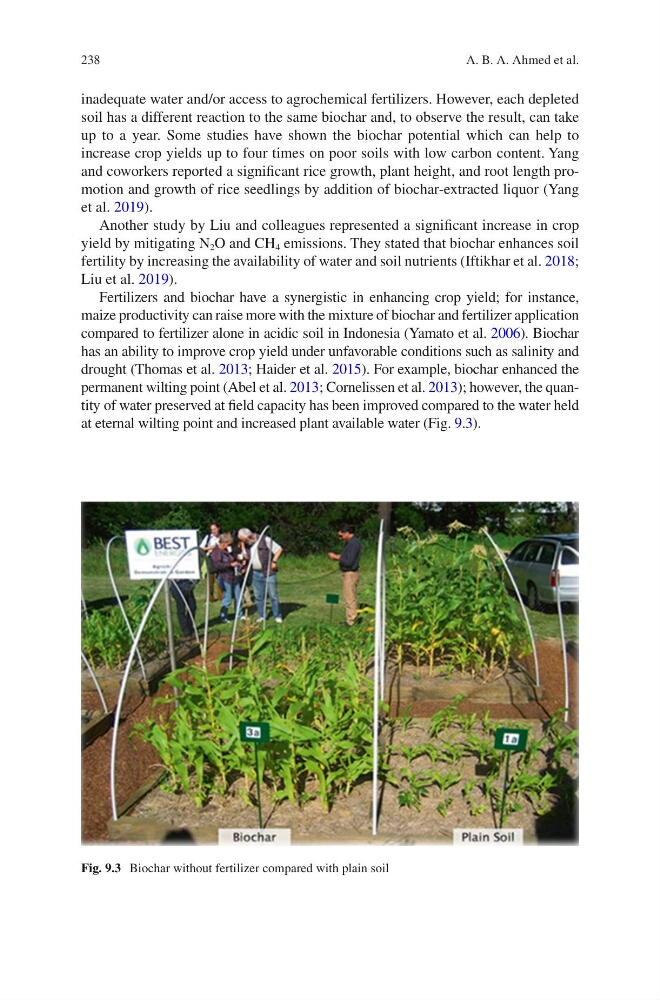
at eternal wilting point and increased plant available water (Fig. 9.3).
Fig. 9.3 Biochar without fertilizer compared with plain soil
A. B. A. Ahmed et al.
inadequate water and/or access to agrochemical fertilizers. However, each depleted
soil has a different reaction to the same biochar and, to observe the result, can take
up to a year. Some studies have shown the biochar potential which can help to
increase crop yields up to four times on poor soils with low carbon content. Yang
and coworkers reported a significant rice growth, plant height, and root length promotion and growth of rice seedlings by addition of biochar-extracted liquor (Yang
et al. 2019).
Another study by Liu and colleagues represented a significant increase in crop
yield by mitigating N 2 O and CH 4 emissions. They stated that biochar enhances soil
fertility by increasing the availability of water and soil nutrients (Iftikhar et al. 2018;
Liu et al. 2019).
Fertilizers and biochar have a synergistic in enhancing crop yield; for instance,
maize productivity can raise more with the mixture of biochar and fertilizer application
compared to fertilizer alone in acidic soil in Indonesia (Yamato et al. 2006). Biochar
has an ability to improve crop yield under unfavorable conditions such as salinity and
drought (Thomas et al. 2013; Haider et al. 2015). For example, biochar enhanced the
permanent wilting point (Abel et al. 2013; Cornelissen et al. 2013); however, the quantity of water preserved at field capacity has been improved compared to the water held
at eternal wilting point and increased plant available water (Fig. 9.3).
Fig. 9.3 Biochar without fertilizer compared with plain soil
A. B. A. Ahmed et al.