

237
The nature, type, and origin of the feedstock affect the quality and composition
characters of biochar such as surface area, porosity, moisture content, particle size
distribution, surface area, and pH (Downie et al. 2009; Rajapaksha et al. 2014;
Zhang et al. 2008; Enders et al. 2012). Pyrolysis possesses various advantages that
one of them is the wide variety of feedstock materials that are used, such as bioenergy crops, e.g. Karnal grass, hybrid poplar, and switch grass. These feedstock materials sequester carbon through root biomass decaying within the soil layer (Tilman
et al. 2006). Nguyen and colleagues suggested that biochar made from crop residues
has a higher quality compared to biochar made from wood residues due to higher
decrease in NH 4
+
and NO 3
−
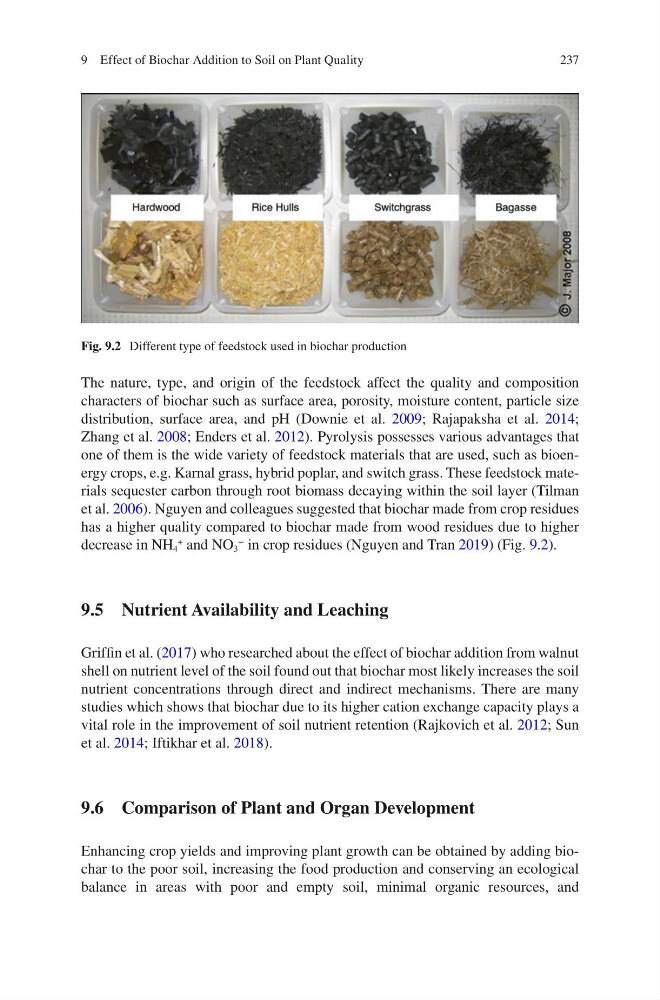
in crop residues (Nguyen and Tran 2019) (Fig. 9.2).
9.5 Nutrient Availability and Leaching
Griffin et al. (2017) who researched about the effect of biochar addition from walnut
shell on nutrient level of the soil found out that biochar most likely increases the soil
nutrient concentrations through direct and indirect mechanisms. There are many
studies which shows that biochar due to its higher cation exchange capacity plays a
vital role in the improvement of soil nutrient retention (Rajkovich et al. 2012; Sun
et al. 2014; Iftikhar et al. 2018).
9.6 Comparison of Plant and Organ Development
Enhancing crop yields and improving plant growth can be obtained by adding biochar to the poor soil, increasing the food production and conserving an ecological
balance in areas with poor and empty soil, minimal organic resources, and
Fig. 9.2 Different type of feedstock used in biochar production
9 Effect of Biochar Addition to Soil on Plant Quality
The nature, type, and origin of the feedstock affect the quality and composition
characters of biochar such as surface area, porosity, moisture content, particle size
distribution, surface area, and pH (Downie et al. 2009; Rajapaksha et al. 2014;
Zhang et al. 2008; Enders et al. 2012). Pyrolysis possesses various advantages that
one of them is the wide variety of feedstock materials that are used, such as bioenergy crops, e.g. Karnal grass, hybrid poplar, and switch grass. These feedstock materials sequester carbon through root biomass decaying within the soil layer (Tilman
et al. 2006). Nguyen and colleagues suggested that biochar made from crop residues
has a higher quality compared to biochar made from wood residues due to higher
decrease in NH 4
+
and NO 3
−
in crop residues (Nguyen and Tran 2019) (Fig. 9.2).
9.5 Nutrient Availability and Leaching
Griffin et al. (2017) who researched about the effect of biochar addition from walnut
shell on nutrient level of the soil found out that biochar most likely increases the soil
nutrient concentrations through direct and indirect mechanisms. There are many
studies which shows that biochar due to its higher cation exchange capacity plays a
vital role in the improvement of soil nutrient retention (Rajkovich et al. 2012; Sun
et al. 2014; Iftikhar et al. 2018).
9.6 Comparison of Plant and Organ Development
Enhancing crop yields and improving plant growth can be obtained by adding biochar to the poor soil, increasing the food production and conserving an ecological
balance in areas with poor and empty soil, minimal organic resources, and
Fig. 9.2 Different type of feedstock used in biochar production
9 Effect of Biochar Addition to Soil on Plant Quality