

184
Table 6.7 Alternative techniques to minimize fouling of membrane that includes pre-treatment
approach, optimization of operational conditions, and chemical cleaning
Approaches
Minimization
methods
Outcomes
References
Pre-treatment
Coagulation
Precipitation
Membrane
filtration
Chlorination
Sonication
Boiling
Change in the biological as well
as physicochemical properties of
the feed stream and reduce the
concentration of foulant
Chen et al. (2006), Fan
et al. (2008), Hilal
et al. (2004), and
Tabatabai et al. (2014)
Optimization of
operational
conditions
Bubbling of gas Increase in shear rate at the
surface of the membrane and
remove the fouling layer
Guillen-Burrieza et al.
(2016) and Tijing et al.
(2015)
Temperature
and flow
reversal
Inhibit the homogeneous
precipitation of salts
Chemical
cleaning
Using of acid as
well as base
Rinsing with acid removes the
inorganic scaling, whereas rinsing
with base removes organic and
biofouling
Chen et al. (2003)
primarily focuses on the removal of hardness of the feed stream. This method successfully reduces scaling caused by CaCO 3 and other salts to precipitate by heating.
Also, vey less mentioned, this method also reduces the amount of CO 2 in the feed
stream. The drawbacks of the method account for its expensive and extensive
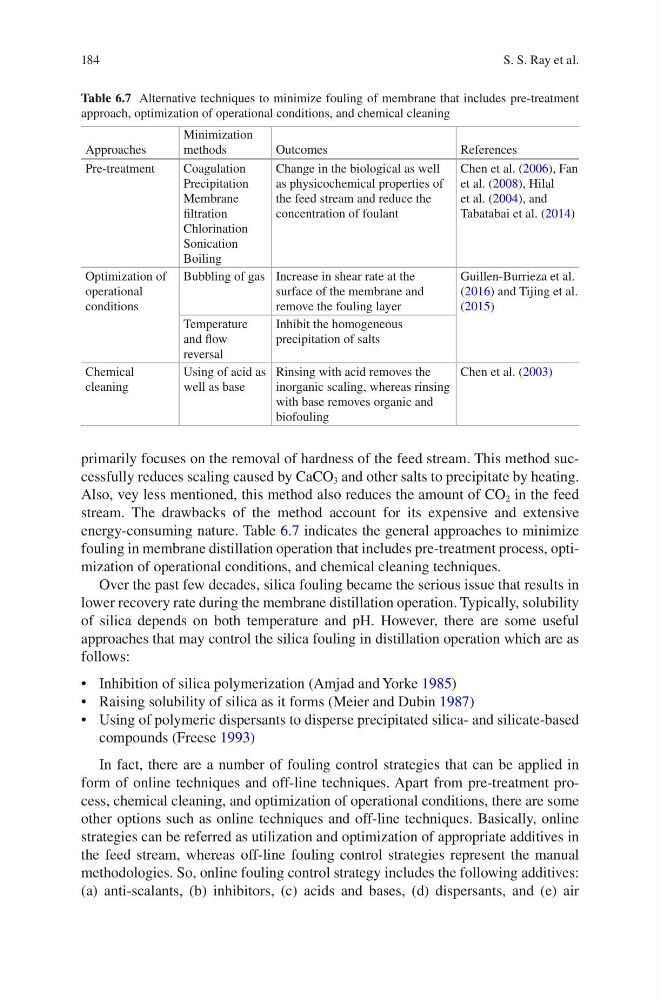
energy-consuming nature. Table 6.7 indicates the general approaches to minimize
fouling in membrane distillation operation that includes pre-treatment process, optimization of operational conditions, and chemical cleaning techniques.
Over the past few decades, silica fouling became the serious issue that results in
lower recovery rate during the membrane distillation operation. Typically, solubility
of silica depends on both temperature and pH. However, there are some useful
approaches that may control the silica fouling in distillation operation which are as
follows:
• Inhibition of silica polymerization (Amjad and Yorke 1985)
• Raising solubility of silica as it forms (Meier and Dubin 1987)
• Using of polymeric dispersants to disperse precipitated silica- and silicate-based
compounds (Freese 1993)
In fact, there are a number of fouling control strategies that can be applied in
form of online techniques and off-line techniques. Apart from pre-treatment process, chemical cleaning, and optimization of operational conditions, there are some
other options such as online techniques and off-line techniques. Basically, online
strategies can be referred as utilization and optimization of appropriate additives in
the feed stream, whereas off-line fouling control strategies represent the manual
methodologies. So, online fouling control strategy includes the following additives:
(a) anti-scalants, (b) inhibitors, (c) acids and bases, (d) dispersants, and (e) air
S. S. Ray et al.
Table 6.7 Alternative techniques to minimize fouling of membrane that includes pre-treatment
approach, optimization of operational conditions, and chemical cleaning
Approaches
Minimization
methods
Outcomes
References
Pre-treatment
Coagulation
Precipitation
Membrane
filtration
Chlorination
Sonication
Boiling
Change in the biological as well
as physicochemical properties of
the feed stream and reduce the
concentration of foulant
Chen et al. (2006), Fan
et al. (2008), Hilal
et al. (2004), and
Tabatabai et al. (2014)
Optimization of
operational
conditions
Bubbling of gas Increase in shear rate at the
surface of the membrane and
remove the fouling layer
Guillen-Burrieza et al.
(2016) and Tijing et al.
(2015)
Temperature
and flow
reversal
Inhibit the homogeneous
precipitation of salts
Chemical
cleaning
Using of acid as
well as base
Rinsing with acid removes the
inorganic scaling, whereas rinsing
with base removes organic and
biofouling
Chen et al. (2003)
primarily focuses on the removal of hardness of the feed stream. This method successfully reduces scaling caused by CaCO 3 and other salts to precipitate by heating.
Also, vey less mentioned, this method also reduces the amount of CO 2 in the feed
stream. The drawbacks of the method account for its expensive and extensive
energy-consuming nature. Table 6.7 indicates the general approaches to minimize
fouling in membrane distillation operation that includes pre-treatment process, optimization of operational conditions, and chemical cleaning techniques.
Over the past few decades, silica fouling became the serious issue that results in
lower recovery rate during the membrane distillation operation. Typically, solubility
of silica depends on both temperature and pH. However, there are some useful
approaches that may control the silica fouling in distillation operation which are as
follows:
• Inhibition of silica polymerization (Amjad and Yorke 1985)
• Raising solubility of silica as it forms (Meier and Dubin 1987)
• Using of polymeric dispersants to disperse precipitated silica- and silicate-based
compounds (Freese 1993)
In fact, there are a number of fouling control strategies that can be applied in
form of online techniques and off-line techniques. Apart from pre-treatment process, chemical cleaning, and optimization of operational conditions, there are some
other options such as online techniques and off-line techniques. Basically, online
strategies can be referred as utilization and optimization of appropriate additives in
the feed stream, whereas off-line fouling control strategies represent the manual
methodologies. So, online fouling control strategy includes the following additives:
(a) anti-scalants, (b) inhibitors, (c) acids and bases, (d) dispersants, and (e) air
S. S. Ray et al.