

the growth of anaerobic microorganisms during methane production. Apart from
micro- and macronutrients, trace elements such as iron, cobalt and nickel are also
vital for cell growth. Nickle is very important as is required as cell component
cofactor F 430 which is involved in methane production. Iron is required as constituent of electron carriers. Zinc is another important trace element which is required
for the synthesis of several enzymes. For optimal growth of methanogenic bacteria,
the cells require cobalt to build up the Co-containing corrinoid factor III.
2.7.2 Biological and Chemical Process
Anaerobic decomposition is a complex biochemical process consisting of consecutive and interactive reaction carried out by anaerobic symbiotic microorganisms. It is
the decomposition of biomass with the help of anaerobic microorganism. It is
controlled by various factors such as relative humidity, temperature, pH, oxygen
carbon dioxide concentration and substrates. Biogas is colourless, odourless gas and
burns same as liquefied petroleum gas to give same blue flame. Bacteria and
methanogenic Archaea are involved in the anaerobic decomposition of the organic
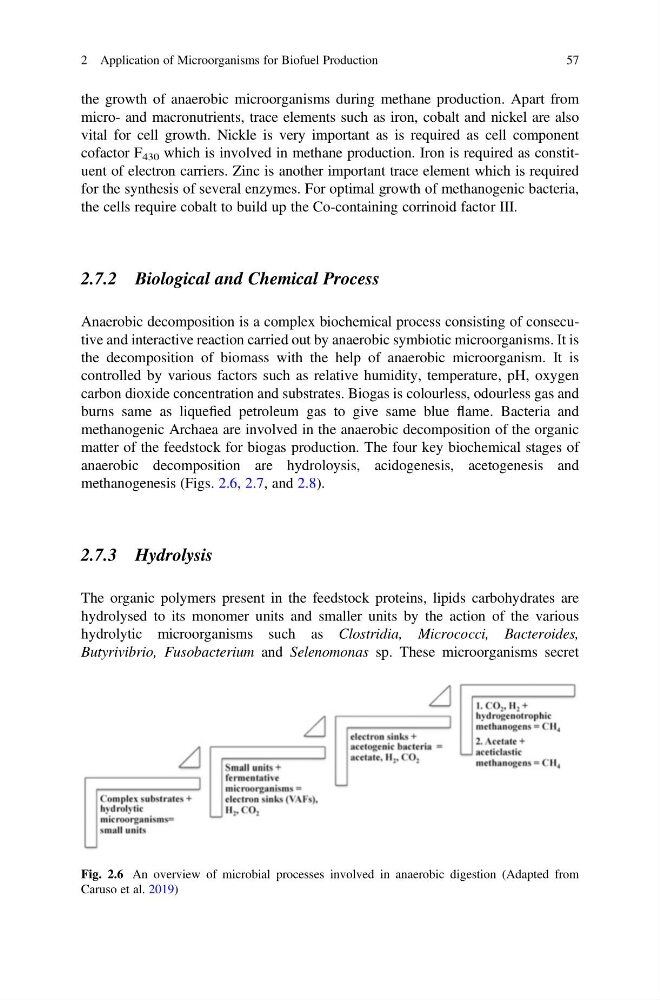
matter of the feedstock for biogas production. The four key biochemical stages of
anaerobic decomposition are hydroloysis, acidogenesis, acetogenesis and
methanogenesis (Figs. 2.6, 2.7, and 2.8).
2.7.3 Hydrolysis
The organic polymers present in the feedstock proteins, lipids carbohydrates are
hydrolysed to its monomer units and smaller units by the action of the various
hydrolytic microorganisms such as Clostridia, Micrococci, Bacteroides,
Butyrivibrio, Fusobacterium and Selenomonas sp. These microorganisms secret
Fig. 2.6 An overview of microbial processes involved in anaerobic digestion (Adapted from
Caruso et al. 2019)
2 Application of Microorganisms for Biofuel Production
57
micro- and macronutrients, trace elements such as iron, cobalt and nickel are also
vital for cell growth. Nickle is very important as is required as cell component
cofactor F 430 which is involved in methane production. Iron is required as constituent of electron carriers. Zinc is another important trace element which is required
for the synthesis of several enzymes. For optimal growth of methanogenic bacteria,
the cells require cobalt to build up the Co-containing corrinoid factor III.
2.7.2 Biological and Chemical Process
Anaerobic decomposition is a complex biochemical process consisting of consecutive and interactive reaction carried out by anaerobic symbiotic microorganisms. It is
the decomposition of biomass with the help of anaerobic microorganism. It is
controlled by various factors such as relative humidity, temperature, pH, oxygen
carbon dioxide concentration and substrates. Biogas is colourless, odourless gas and
burns same as liquefied petroleum gas to give same blue flame. Bacteria and
methanogenic Archaea are involved in the anaerobic decomposition of the organic
matter of the feedstock for biogas production. The four key biochemical stages of
anaerobic decomposition are hydroloysis, acidogenesis, acetogenesis and
methanogenesis (Figs. 2.6, 2.7, and 2.8).
2.7.3 Hydrolysis
The organic polymers present in the feedstock proteins, lipids carbohydrates are
hydrolysed to its monomer units and smaller units by the action of the various
hydrolytic microorganisms such as Clostridia, Micrococci, Bacteroides,
Butyrivibrio, Fusobacterium and Selenomonas sp. These microorganisms secret
Fig. 2.6 An overview of microbial processes involved in anaerobic digestion (Adapted from
Caruso et al. 2019)
2 Application of Microorganisms for Biofuel Production
57