

environment and are of three types: green, red and brown depending on the pigment
composition. Microalgae are simple aquatic single-celled or multi-celled photosynthetic organisms and can be cultivated in fresh, sea and waste water. Microalgae is
beneficial as high photosynthetic efficiencies will lead to the formation of organic
compounds and this will further convert to hydrogen giving high production efficiencies (Saratale et al. 2019; Show et al. 2019).
2.7 Microbial Production of Biogas/Biomethane
Natural gas is a fossil energy source which consists of hydrocarbons mainly methane
CH 4 , it contains hydrocarbon liquids and non-hydrocarbon gases such as CO 2 and
water vapour formed beneath the earth surface by buried plants and animal. Natural
gas is extensively used as fuel in various operations like heating, generating electricity and industrial manufacturing of chemicals.
Biogas is a renewable energy source like solar or wind energy and used as an
important substitute to natural gas. Biogas is produced biologically by anaerobic
decomposition of organic wastes. It is an environment friendly fuel. Raw biogas
consists of 60–65% methane, 30–35% carbon dioxide, small percentages of water
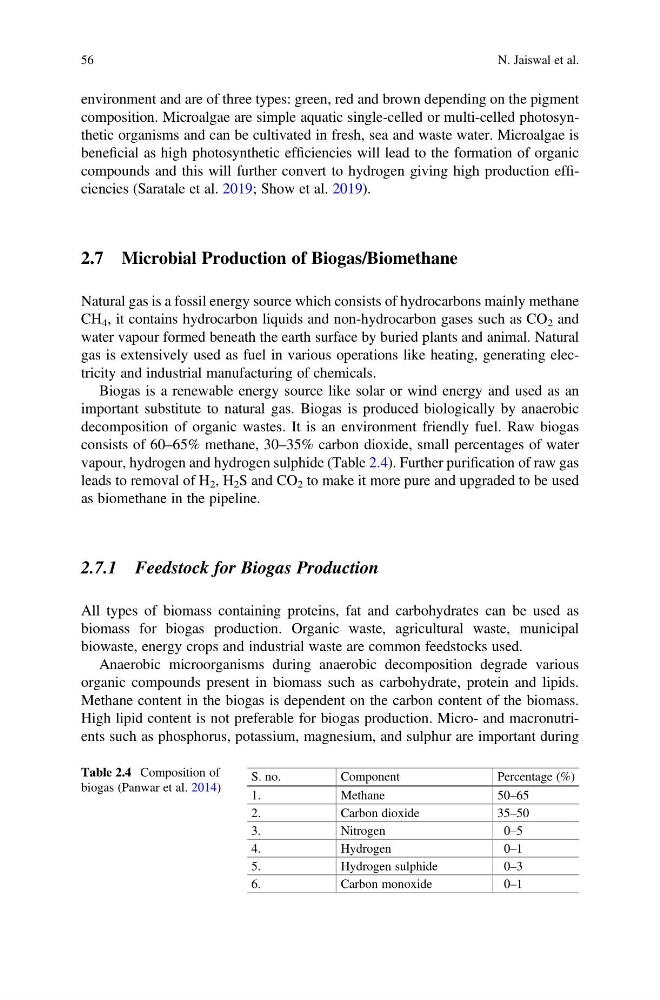
vapour, hydrogen and hydrogen sulphide (Table 2.4). Further purification of raw gas
leads to removal of H 2 , H 2 S and CO 2 to make it more pure and upgraded to be used
as biomethane in the pipeline.
2.7.1 Feedstock for Biogas Production
All types of biomass containing proteins, fat and carbohydrates can be used as
biomass for biogas production. Organic waste, agricultural waste, municipal
biowaste, energy crops and industrial waste are common feedstocks used.
Anaerobic microorganisms during anaerobic decomposition degrade various
organic compounds present in biomass such as carbohydrate, protein and lipids.
Methane content in the biogas is dependent on the carbon content of the biomass.
High lipid content is not preferable for biogas production. Micro- and macronutrients such as phosphorus, potassium, magnesium, and sulphur are important during
Table 2.4 Composition of
biogas (Panwar et al. 2014)
S. no.
Component
Percentage (%)
1.
Methane
50–65
2.
Carbon dioxide
35–50
3.
Nitrogen
0–5
4.
Hydrogen
0–1
5.
Hydrogen sulphide
0–3
6.
Carbon monoxide
0–1
56
N. Jaiswal et al.
composition. Microalgae are simple aquatic single-celled or multi-celled photosynthetic organisms and can be cultivated in fresh, sea and waste water. Microalgae is
beneficial as high photosynthetic efficiencies will lead to the formation of organic
compounds and this will further convert to hydrogen giving high production efficiencies (Saratale et al. 2019; Show et al. 2019).
2.7 Microbial Production of Biogas/Biomethane
Natural gas is a fossil energy source which consists of hydrocarbons mainly methane
CH 4 , it contains hydrocarbon liquids and non-hydrocarbon gases such as CO 2 and
water vapour formed beneath the earth surface by buried plants and animal. Natural
gas is extensively used as fuel in various operations like heating, generating electricity and industrial manufacturing of chemicals.
Biogas is a renewable energy source like solar or wind energy and used as an
important substitute to natural gas. Biogas is produced biologically by anaerobic
decomposition of organic wastes. It is an environment friendly fuel. Raw biogas
consists of 60–65% methane, 30–35% carbon dioxide, small percentages of water
vapour, hydrogen and hydrogen sulphide (Table 2.4). Further purification of raw gas
leads to removal of H 2 , H 2 S and CO 2 to make it more pure and upgraded to be used
as biomethane in the pipeline.
2.7.1 Feedstock for Biogas Production
All types of biomass containing proteins, fat and carbohydrates can be used as
biomass for biogas production. Organic waste, agricultural waste, municipal
biowaste, energy crops and industrial waste are common feedstocks used.
Anaerobic microorganisms during anaerobic decomposition degrade various
organic compounds present in biomass such as carbohydrate, protein and lipids.
Methane content in the biogas is dependent on the carbon content of the biomass.
High lipid content is not preferable for biogas production. Micro- and macronutrients such as phosphorus, potassium, magnesium, and sulphur are important during
Table 2.4 Composition of
biogas (Panwar et al. 2014)
S. no.
Component
Percentage (%)
1.
Methane
50–65
2.
Carbon dioxide
35–50
3.
Nitrogen
0–5
4.
Hydrogen
0–1
5.
Hydrogen sulphide
0–3
6.
Carbon monoxide
0–1
56
N. Jaiswal et al.