

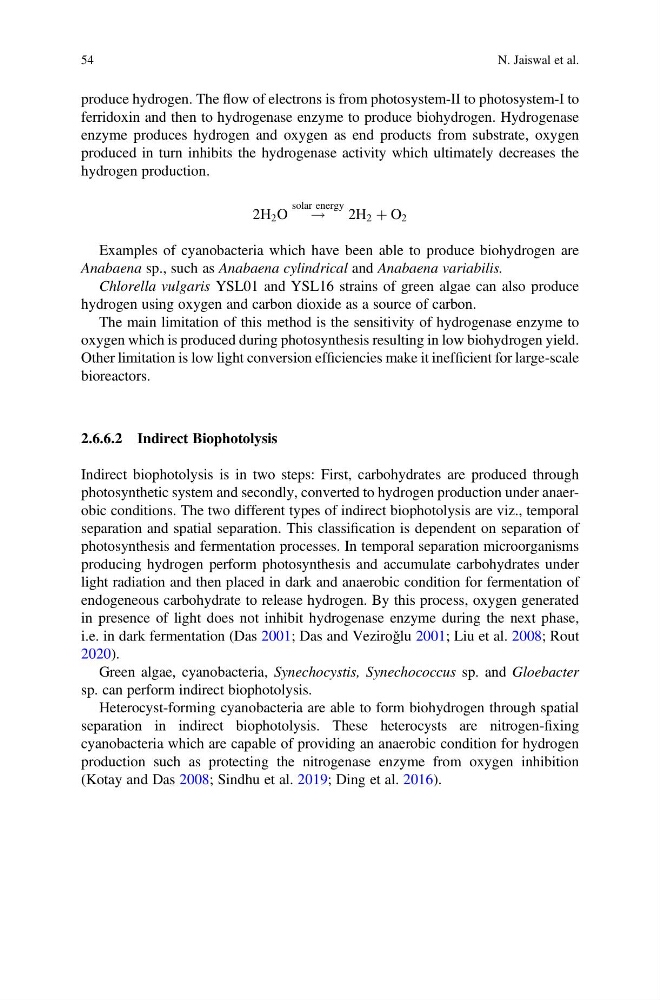
produce hydrogen. The flow of electrons is from photosystem-II to photosystem-I to
ferridoxin and then to hydrogenase enzyme to produce biohydrogen. Hydrogenase
enzyme produces hydrogen and oxygen as end products from substrate, oxygen
produced in turn inhibits the hydrogenase activity which ultimately decreases the
hydrogen production.
2H 2 O
!
solar energy 2H 2 þ O 2
Examples of cyanobacteria which have been able to produce biohydrogen are
Anabaena sp., such as Anabaena cylindrical and Anabaena variabilis.
Chlorella vulgaris YSL01 and YSL16 strains of green algae can also produce
hydrogen using oxygen and carbon dioxide as a source of carbon.
The main limitation of this method is the sensitivity of hydrogenase enzyme to
oxygen which is produced during photosynthesis resulting in low biohydrogen yield.
Other limitation is low light conversion efficiencies make it inefficient for large-scale
bioreactors.
2.6.6.2 Indirect Biophotolysis
Indirect biophotolysis is in two steps: First, carbohydrates are produced through
photosynthetic system and secondly, converted to hydrogen production under anaerobic conditions. The two different types of indirect biophotolysis are viz., temporal
separation and spatial separation. This classification is dependent on separation of
photosynthesis and fermentation processes. In temporal separation microorganisms
producing hydrogen perform photosynthesis and accumulate carbohydrates under
light radiation and then placed in dark and anaerobic condition for fermentation of
endogeneous carbohydrate to release hydrogen. By this process, oxygen generated
in presence of light does not inhibit hydrogenase enzyme during the next phase,
i.e. in dark fermentation (Das 2001; Das and Veziroǧlu 2001; Liu et al. 2008; Rout
2020).
Green algae, cyanobacteria, Synechocystis, Synechococcus sp. and Gloebacter
sp. can perform indirect biophotolysis.
Heterocyst-forming cyanobacteria are able to form biohydrogen through spatial
separation in indirect biophotolysis. These heterocysts are nitrogen-fixing
cyanobacteria which are capable of providing an anaerobic condition for hydrogen
production such as protecting the nitrogenase enzyme from oxygen inhibition
(Kotay and Das 2008; Sindhu et al. 2019; Ding et al. 2016).
54
N. Jaiswal et al.
ferridoxin and then to hydrogenase enzyme to produce biohydrogen. Hydrogenase
enzyme produces hydrogen and oxygen as end products from substrate, oxygen
produced in turn inhibits the hydrogenase activity which ultimately decreases the
hydrogen production.
2H 2 O
!
solar energy 2H 2 þ O 2
Examples of cyanobacteria which have been able to produce biohydrogen are
Anabaena sp., such as Anabaena cylindrical and Anabaena variabilis.
Chlorella vulgaris YSL01 and YSL16 strains of green algae can also produce
hydrogen using oxygen and carbon dioxide as a source of carbon.
The main limitation of this method is the sensitivity of hydrogenase enzyme to
oxygen which is produced during photosynthesis resulting in low biohydrogen yield.
Other limitation is low light conversion efficiencies make it inefficient for large-scale
bioreactors.
2.6.6.2 Indirect Biophotolysis
Indirect biophotolysis is in two steps: First, carbohydrates are produced through
photosynthetic system and secondly, converted to hydrogen production under anaerobic conditions. The two different types of indirect biophotolysis are viz., temporal
separation and spatial separation. This classification is dependent on separation of
photosynthesis and fermentation processes. In temporal separation microorganisms
producing hydrogen perform photosynthesis and accumulate carbohydrates under
light radiation and then placed in dark and anaerobic condition for fermentation of
endogeneous carbohydrate to release hydrogen. By this process, oxygen generated
in presence of light does not inhibit hydrogenase enzyme during the next phase,
i.e. in dark fermentation (Das 2001; Das and Veziroǧlu 2001; Liu et al. 2008; Rout
2020).
Green algae, cyanobacteria, Synechocystis, Synechococcus sp. and Gloebacter
sp. can perform indirect biophotolysis.
Heterocyst-forming cyanobacteria are able to form biohydrogen through spatial
separation in indirect biophotolysis. These heterocysts are nitrogen-fixing
cyanobacteria which are capable of providing an anaerobic condition for hydrogen
production such as protecting the nitrogenase enzyme from oxygen inhibition
(Kotay and Das 2008; Sindhu et al. 2019; Ding et al. 2016).
54
N. Jaiswal et al.