

pathway, butyric acid pathway, ethanol pathway, and acetone pathway; among all
these, acetone and acetic acid pathways generate high amounts of biohydrogen.
Clostridium sp. is the genera which are important in dark fermentation which
converts carbohydrate of the organic waste into hydrogen. Clostridia are obligate
anaerobic and spore-forming organisms. The important genus of Clostridia, which
are involved, are Clostridium buytricum, Clostridium thermolacticum, Clostridium
pasteurianum, Clostridium paraputrificum M-21, and Clostridium bifermentants.
Hydrogen gas is produced by the Clostridia sp. during the log phase of growth.
Another important genus responsible for hydrogen production is
Enterobactericeae family. It metabolizes glucose by acid fermentation pathway
and 2,3-butanediol fermentation pathways. In both the pathways, carbon dioxide
and hydrogen are produced along with the other end products as ethanol and
2,3-butanediol.
Thermophilic organism such as Caldicellulosiruptor saccharolyticus produces
high concentrations of hydrogen nearly about 83–100%.
Hydrogen gas is a common product in anaerobic bacterial fermentations and is an
interesting by-product in future large-scale industrial fermentation (Antoni et al.
2007; Show et al. 2011; Srivastava et al. 2019; Shao et al. 2020).
2.6.5 Photofermentation
Photofermentaion is decomposition of organic compounds to hydrogen by the
application of photosynthetic microorganism in the presence of sunlight. Photosynthetic bacteria include Chlorobi, Proteobacteria, Chloroflexi and Heliobacteria.
Most researches focus on hydrogen produced by purple non-sulphur bacteria
because of high hydrogen production rate, ability of the purple non-sulphur bacteria
to convert volatile fatty acids to CO 2 and H 2 and use different substrates such as
glucose, sucrose and succinate.
The most extensively used purple non-sulphur bacteria in photo-fermentative
hydrogen production are Rhodobacter sphaeroides O.U001, Rhodobacter
capsulatus, R. sphaeroides-RV, Rhodobacter sulfidophilus, Rhodopseudomonas
palustris and Rhodospirillum rubrum.
Two enzymes which are important in the hydrogen production are hydrogenase
and nitrogenase. Nitrogenase enzyme is important in hydrogen production under
anoxygenic conditions. It produces hydrogen gas from acetic acid by
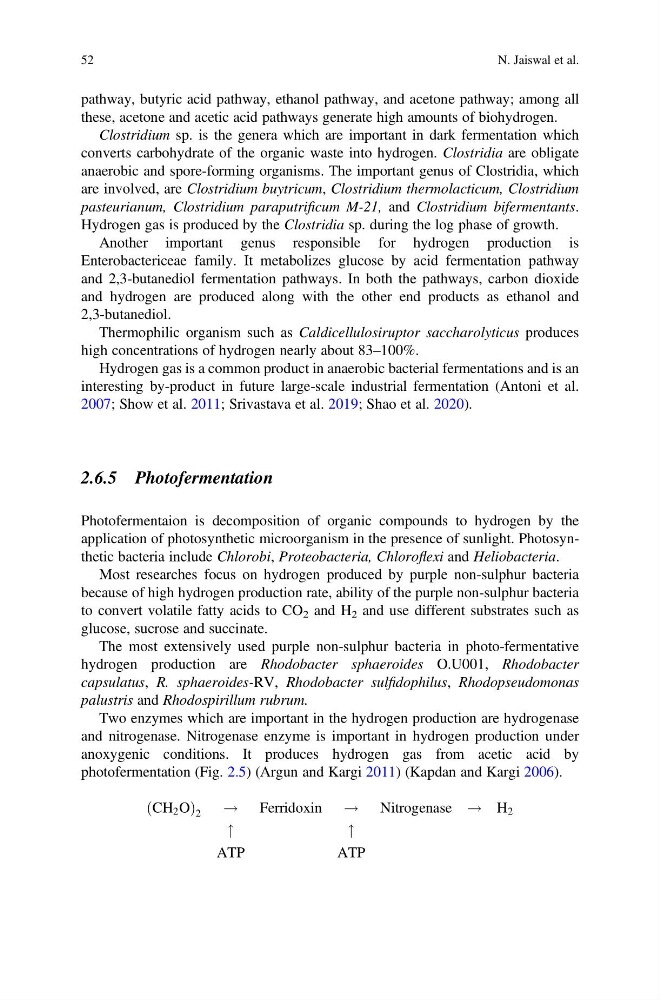
photofermentation (Fig. 2.5) (Argun and Kargi 2011) (Kapdan and Kargi 2006).
CH 2 O
ð
Þ 2 ! Ferridoxin ! Nitrogenase ! H 2
"
"
ATP
ATP
52
N. Jaiswal et al.
these, acetone and acetic acid pathways generate high amounts of biohydrogen.
Clostridium sp. is the genera which are important in dark fermentation which
converts carbohydrate of the organic waste into hydrogen. Clostridia are obligate
anaerobic and spore-forming organisms. The important genus of Clostridia, which
are involved, are Clostridium buytricum, Clostridium thermolacticum, Clostridium
pasteurianum, Clostridium paraputrificum M-21, and Clostridium bifermentants.
Hydrogen gas is produced by the Clostridia sp. during the log phase of growth.
Another important genus responsible for hydrogen production is
Enterobactericeae family. It metabolizes glucose by acid fermentation pathway
and 2,3-butanediol fermentation pathways. In both the pathways, carbon dioxide
and hydrogen are produced along with the other end products as ethanol and
2,3-butanediol.
Thermophilic organism such as Caldicellulosiruptor saccharolyticus produces
high concentrations of hydrogen nearly about 83–100%.
Hydrogen gas is a common product in anaerobic bacterial fermentations and is an
interesting by-product in future large-scale industrial fermentation (Antoni et al.
2007; Show et al. 2011; Srivastava et al. 2019; Shao et al. 2020).
2.6.5 Photofermentation
Photofermentaion is decomposition of organic compounds to hydrogen by the
application of photosynthetic microorganism in the presence of sunlight. Photosynthetic bacteria include Chlorobi, Proteobacteria, Chloroflexi and Heliobacteria.
Most researches focus on hydrogen produced by purple non-sulphur bacteria
because of high hydrogen production rate, ability of the purple non-sulphur bacteria
to convert volatile fatty acids to CO 2 and H 2 and use different substrates such as
glucose, sucrose and succinate.
The most extensively used purple non-sulphur bacteria in photo-fermentative
hydrogen production are Rhodobacter sphaeroides O.U001, Rhodobacter
capsulatus, R. sphaeroides-RV, Rhodobacter sulfidophilus, Rhodopseudomonas
palustris and Rhodospirillum rubrum.
Two enzymes which are important in the hydrogen production are hydrogenase
and nitrogenase. Nitrogenase enzyme is important in hydrogen production under
anoxygenic conditions. It produces hydrogen gas from acetic acid by
photofermentation (Fig. 2.5) (Argun and Kargi 2011) (Kapdan and Kargi 2006).
CH 2 O
ð
Þ 2 ! Ferridoxin ! Nitrogenase ! H 2
"
"
ATP
ATP
52
N. Jaiswal et al.