

2.6.2 Microorganisms Involved in Biohydrogen Production
Different microorganisms which are involved in the biohydrogen production are
cyanobacteria, anaerobic bacteria and fermentative bacteria.
Anaerobic bacteria such as Clostridia sp. perform dark fermentation and produce
H 2 . Cyanobacteria are photosynthetic bacteria having basic nutritional requirements.
They grow in presence of air, water, salts and light as energy source and carry out
photoconversion of water to hydrogen. Fermentative bacteria are E. coli,
Citrobacter, and Enterobacter which convert the substrate to hydrogen.
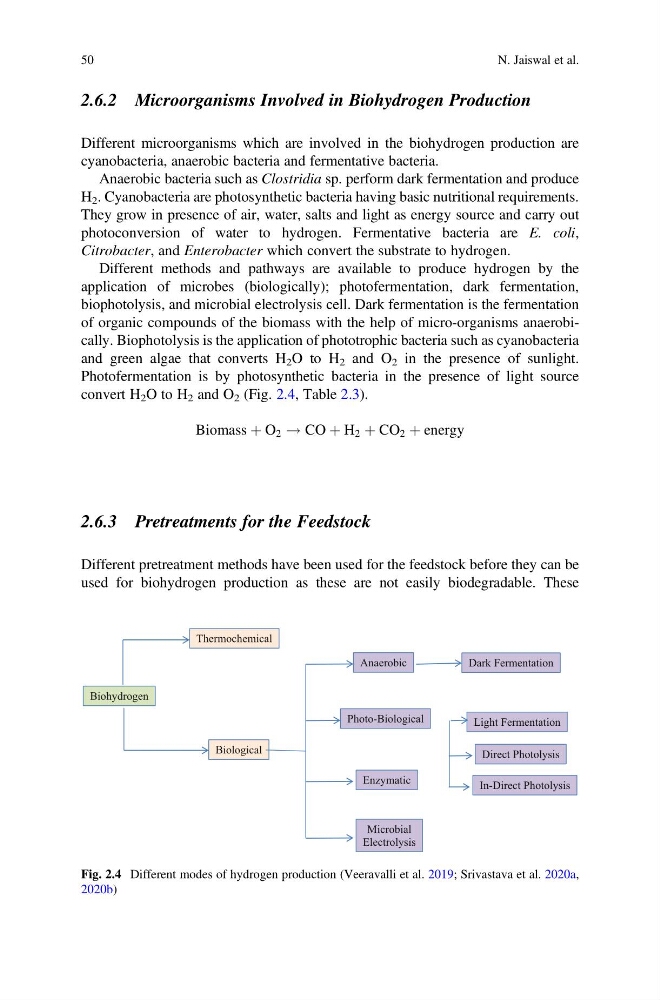
Different methods and pathways are available to produce hydrogen by the
application of microbes (biologically); photofermentation, dark fermentation,
biophotolysis, and microbial electrolysis cell. Dark fermentation is the fermentation
of organic compounds of the biomass with the help of micro-organisms anaerobically. Biophotolysis is the application of phototrophic bacteria such as cyanobacteria
and green algae that converts H 2 O to H 2 and O 2 in the presence of sunlight.
Photofermentation is by photosynthetic bacteria in the presence of light source
convert H 2 O to H 2 and O 2 (Fig. 2.4, Table 2.3).
Biomass þ O 2 ! CO þ H 2 þ CO 2 þ energy
2.6.3 Pretreatments for the Feedstock
Different pretreatment methods have been used for the feedstock before they can be
used for biohydrogen production as these are not easily biodegradable. These
Biohydrogen
Biological
Thermochemical
Microbial
Electrolysis
Enzymatic
Photo-Biological
Anaerobic
Dark Fermentation
Light Fermentation
Direct Photolysis
In-Direct Photolysis
Fig. 2.4 Different modes of hydrogen production (Veeravalli et al. 2019; Srivastava et al. 2020a,
2020b)
50
N. Jaiswal et al.
Different microorganisms which are involved in the biohydrogen production are
cyanobacteria, anaerobic bacteria and fermentative bacteria.
Anaerobic bacteria such as Clostridia sp. perform dark fermentation and produce
H 2 . Cyanobacteria are photosynthetic bacteria having basic nutritional requirements.
They grow in presence of air, water, salts and light as energy source and carry out
photoconversion of water to hydrogen. Fermentative bacteria are E. coli,
Citrobacter, and Enterobacter which convert the substrate to hydrogen.
Different methods and pathways are available to produce hydrogen by the
application of microbes (biologically); photofermentation, dark fermentation,
biophotolysis, and microbial electrolysis cell. Dark fermentation is the fermentation
of organic compounds of the biomass with the help of micro-organisms anaerobically. Biophotolysis is the application of phototrophic bacteria such as cyanobacteria
and green algae that converts H 2 O to H 2 and O 2 in the presence of sunlight.
Photofermentation is by photosynthetic bacteria in the presence of light source
convert H 2 O to H 2 and O 2 (Fig. 2.4, Table 2.3).
Biomass þ O 2 ! CO þ H 2 þ CO 2 þ energy
2.6.3 Pretreatments for the Feedstock
Different pretreatment methods have been used for the feedstock before they can be
used for biohydrogen production as these are not easily biodegradable. These
Biohydrogen
Biological
Thermochemical
Microbial
Electrolysis
Enzymatic
Photo-Biological
Anaerobic
Dark Fermentation
Light Fermentation
Direct Photolysis
In-Direct Photolysis
Fig. 2.4 Different modes of hydrogen production (Veeravalli et al. 2019; Srivastava et al. 2020a,
2020b)
50
N. Jaiswal et al.