

1. Manometric method
2. Volumetric method
3. Gas chromatography
In the volumetric methods, CO 2 is adsorbed in an alkaline solution and so
separated from methane; in this way only the volume of CH 4 is measured by
volumetric displacement. In the manometric method, the production of biogas is
calculated using a regression based on the increase of the pressure values inside the
vessels. To avoid the too much CO 2 dissolving inside the substrate and also the risk
of explosion, the pressure in the vessels must not exceed 300 kPa. Once it has been
estimated or measured, the gas volume has to be converted to dry gas, referring at
standard conditions (273.15 K, 101.33 kPa) following the procedure reported in
Strömberg et al. (Strömberg et al. 2014). For this sake, the ambient temperature and
pressure needs to be always registered. For the manometric measurement and the gas
chromatographic measurement, the GC should be calibrated with mixtures of standard gases (e.g., a mixture of CH 4 and CO 2 ; 50%/50%; v/v). The volume of the
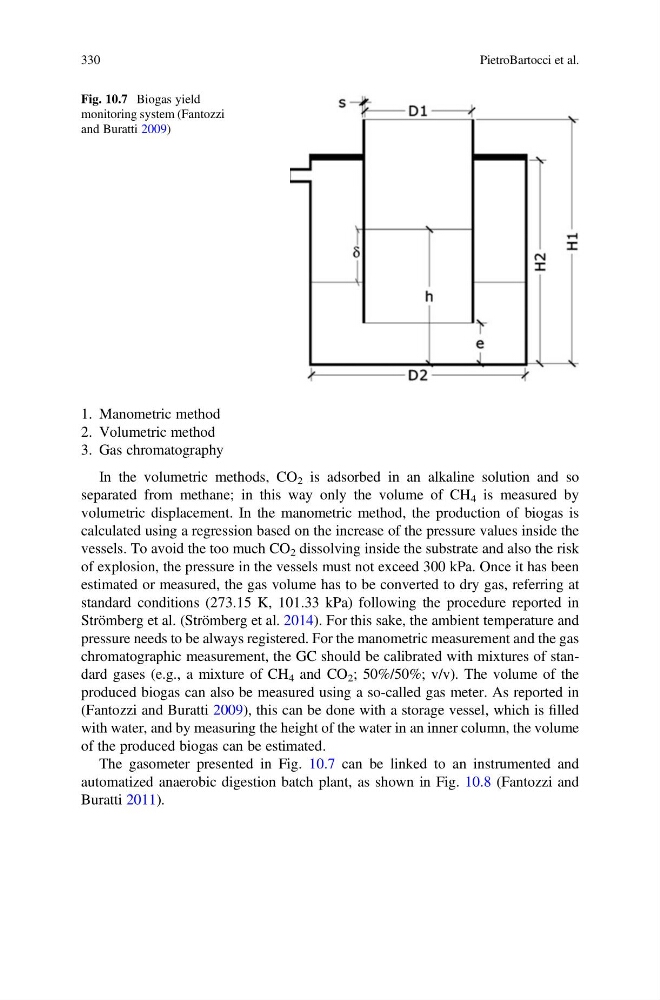
produced biogas can also be measured using a so-called gas meter. As reported in
(Fantozzi and Buratti 2009), this can be done with a storage vessel, which is filled
with water, and by measuring the height of the water in an inner column, the volume
of the produced biogas can be estimated.
The gasometer presented in Fig. 10.7 can be linked to an instrumented and
automatized anaerobic digestion batch plant, as shown in Fig. 10.8 (Fantozzi and
Buratti 2011).
Fig. 10.7 Biogas yield
monitoring system (Fantozzi
and Buratti 2009)
330
PietroBartocci et al.
2. Volumetric method
3. Gas chromatography
In the volumetric methods, CO 2 is adsorbed in an alkaline solution and so
separated from methane; in this way only the volume of CH 4 is measured by
volumetric displacement. In the manometric method, the production of biogas is
calculated using a regression based on the increase of the pressure values inside the
vessels. To avoid the too much CO 2 dissolving inside the substrate and also the risk
of explosion, the pressure in the vessels must not exceed 300 kPa. Once it has been
estimated or measured, the gas volume has to be converted to dry gas, referring at
standard conditions (273.15 K, 101.33 kPa) following the procedure reported in
Strömberg et al. (Strömberg et al. 2014). For this sake, the ambient temperature and
pressure needs to be always registered. For the manometric measurement and the gas
chromatographic measurement, the GC should be calibrated with mixtures of standard gases (e.g., a mixture of CH 4 and CO 2 ; 50%/50%; v/v). The volume of the
produced biogas can also be measured using a so-called gas meter. As reported in
(Fantozzi and Buratti 2009), this can be done with a storage vessel, which is filled
with water, and by measuring the height of the water in an inner column, the volume
of the produced biogas can be estimated.
The gasometer presented in Fig. 10.7 can be linked to an instrumented and
automatized anaerobic digestion batch plant, as shown in Fig. 10.8 (Fantozzi and
Buratti 2011).
Fig. 10.7 Biogas yield
monitoring system (Fantozzi
and Buratti 2009)
330
PietroBartocci et al.