

is the standard deviation of the blank tests, and SD is the standard deviation of the
tests performed on the substrate.
• If any one of the subsequent conditions is fulfilled, the test results must be
rejected:
– If the RSD is higher than 5% of the final value of the blank or of the positive
control, even after eliminating one single outlier
– If the RSD is higher than 5%, of the final value of the homogenous substrate,
even after eliminating one single outlier
– If the RSD is higher than 10%, of the final value of a heterogeneous substrate,
even after eliminating one single outlier
– If the BMP is higher than 85% and 100% of the value of the positive control
and of the theoretical BMP value (e.g., for cellulose: <352 NLCH4 kgVS-1
and > 414 NLCH4 kgVS-1)
The Dixon’s test will be used to reject a single outlier from triplicate measurements. If it is possible to have a substrate inhibition condition, then tests with
different inoculum-substrate ratios (ISRs) have to be performed in parallel.
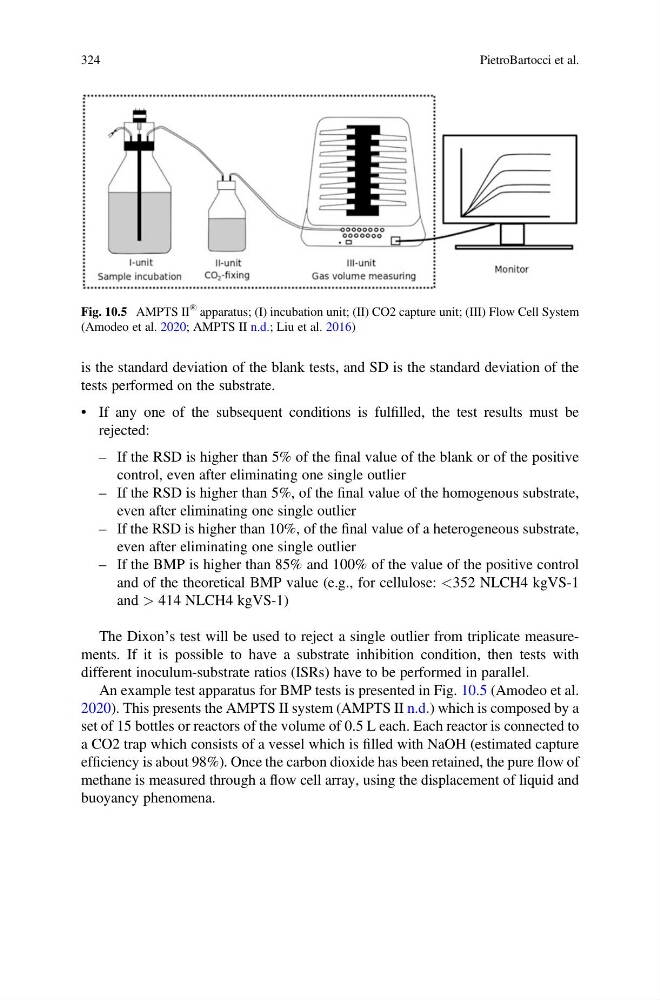
An example test apparatus for BMP tests is presented in Fig. 10.5 (Amodeo et al.
2020). This presents the AMPTS II system (AMPTS II n.d.) which is composed by a
set of 15 bottles or reactors of the volume of 0.5 L each. Each reactor is connected to
a CO2 trap which consists of a vessel which is filled with NaOH (estimated capture
efficiency is about 98%). Once the carbon dioxide has been retained, the pure flow of
methane is measured through a flow cell array, using the displacement of liquid and
buoyancy phenomena.
Fig. 10.5 AMPTS II
® apparatus; (I) incubation unit; (II) CO2 capture unit; (III) Flow Cell System
(Amodeo et al. 2020; AMPTS II n.d.; Liu et al. 2016)
324
PietroBartocci et al.
tests performed on the substrate.
• If any one of the subsequent conditions is fulfilled, the test results must be
rejected:
– If the RSD is higher than 5% of the final value of the blank or of the positive
control, even after eliminating one single outlier
– If the RSD is higher than 5%, of the final value of the homogenous substrate,
even after eliminating one single outlier
– If the RSD is higher than 10%, of the final value of a heterogeneous substrate,
even after eliminating one single outlier
– If the BMP is higher than 85% and 100% of the value of the positive control
and of the theoretical BMP value (e.g., for cellulose: <352 NLCH4 kgVS-1
and > 414 NLCH4 kgVS-1)
The Dixon’s test will be used to reject a single outlier from triplicate measurements. If it is possible to have a substrate inhibition condition, then tests with
different inoculum-substrate ratios (ISRs) have to be performed in parallel.
An example test apparatus for BMP tests is presented in Fig. 10.5 (Amodeo et al.
2020). This presents the AMPTS II system (AMPTS II n.d.) which is composed by a
set of 15 bottles or reactors of the volume of 0.5 L each. Each reactor is connected to
a CO2 trap which consists of a vessel which is filled with NaOH (estimated capture
efficiency is about 98%). Once the carbon dioxide has been retained, the pure flow of
methane is measured through a flow cell array, using the displacement of liquid and
buoyancy phenomena.
Fig. 10.5 AMPTS II
® apparatus; (I) incubation unit; (II) CO2 capture unit; (III) Flow Cell System
(Amodeo et al. 2020; AMPTS II n.d.; Liu et al. 2016)
324
PietroBartocci et al.