

guideline VDI 4630 (2016) titled “Fermentation of organic materials.” The procedures and standardized practices dealing with BMP analysis are continuously
improving; see (Weinrich et al. 2018; Holliger et al. 2016). For the BMP test
protocols, detailed guidelines were published by many authors (Raposo et al.
2011); Cresson et al. 2015), and international tests among different laboratories
have demonstrated that the results of the biomethanation potential measurements can
vary considerably between different laboratories, which require highly standardized
BMP test protocols and procedures. This means that each aspect of the BMP analysis
has to be highly repeatable and standardized as follows:
– The identification, the characterization, and the preparation of the inoculum;
– Substrate pretreatment, substrate preparation, and its storage;
– Test parameter setup;
– Data statistical analysis and data reporting;
– Final result interpretation.
In order to authenticate BMP test outcomes, the following essentials must be
satisfied:
• All experiments must be repeated at least three times.
• Together with the BMP of the substrate, also positive controls (performed using
standardized materials, like microcrystalline cellulose and tributyrine) and blank
assays must be assessed. The positive controls represent tests where the final
results are standardized and known; while the blank tests are useful to assess the
inoculum production and so to subtract this to the final methane yield obtained in
the test, this makes the test result not dependent from the inoculum which has
been used.
• The duration time of the BMP test is not predetermined before starting, but it is
determined based on the daily methane production; when this parameter is lower
than 1% of the total volume of methane, which has been accumulated during the
whole period, the test is stopped (the parameter is also called BMP1%).
• The final BMP results consist of the value of methane production expressed in
volume of dry methane produced, referred to as standard conditions (273.15 K
and 101.33 kPa) per mass of volatile solids (VS) contained in the feedstock. The
unit of measure is the following: NLCH 4 kgVS
À1 ;
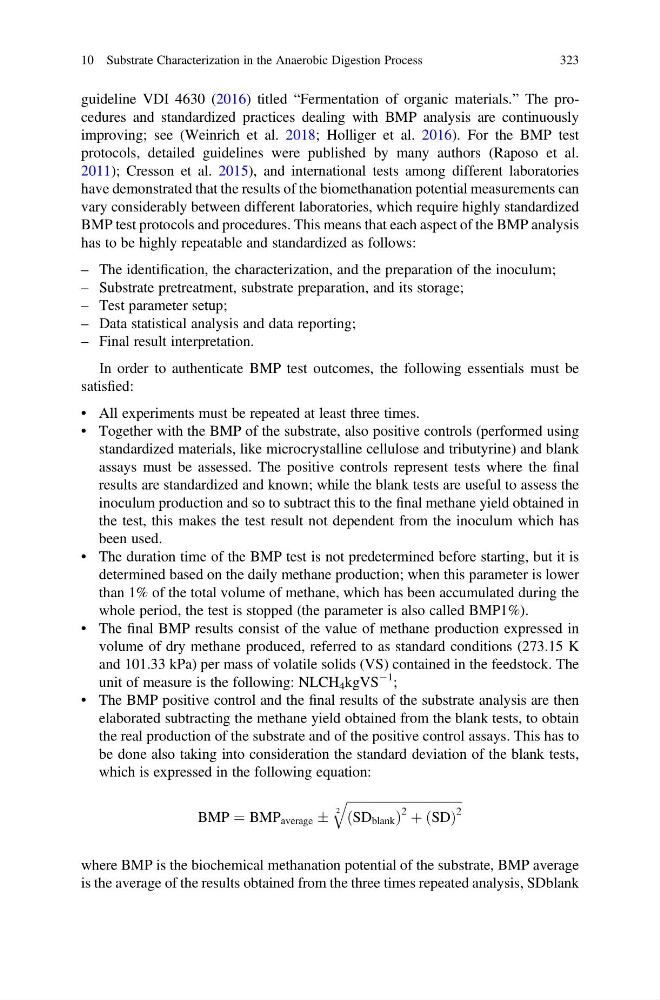
• The BMP positive control and the final results of the substrate analysis are then
elaborated subtracting the methane yield obtained from the blank tests, to obtain
the real production of the substrate and of the positive control assays. This has to
be done also taking into consideration the standard deviation of the blank tests,
which is expressed in the following equation:
BMP ¼ BMP average Æ
ffiffiffiffiffiffiffiffiffiffiffiffiffiffiffiffiffiffiffiffiffiffiffiffiffiffiffiffiffiffiffiffiffiffiffiffiffi
SD blank
ð
Þ
2 þ SD
ð Þ
2
2
q
where BMP is the biochemical methanation potential of the substrate, BMP average
is the average of the results obtained from the three times repeated analysis, SDblank
10 Substrate Characterization in the Anaerobic Digestion Process
323
improving; see (Weinrich et al. 2018; Holliger et al. 2016). For the BMP test
protocols, detailed guidelines were published by many authors (Raposo et al.
2011); Cresson et al. 2015), and international tests among different laboratories
have demonstrated that the results of the biomethanation potential measurements can
vary considerably between different laboratories, which require highly standardized
BMP test protocols and procedures. This means that each aspect of the BMP analysis
has to be highly repeatable and standardized as follows:
– The identification, the characterization, and the preparation of the inoculum;
– Substrate pretreatment, substrate preparation, and its storage;
– Test parameter setup;
– Data statistical analysis and data reporting;
– Final result interpretation.
In order to authenticate BMP test outcomes, the following essentials must be
satisfied:
• All experiments must be repeated at least three times.
• Together with the BMP of the substrate, also positive controls (performed using
standardized materials, like microcrystalline cellulose and tributyrine) and blank
assays must be assessed. The positive controls represent tests where the final
results are standardized and known; while the blank tests are useful to assess the
inoculum production and so to subtract this to the final methane yield obtained in
the test, this makes the test result not dependent from the inoculum which has
been used.
• The duration time of the BMP test is not predetermined before starting, but it is
determined based on the daily methane production; when this parameter is lower
than 1% of the total volume of methane, which has been accumulated during the
whole period, the test is stopped (the parameter is also called BMP1%).
• The final BMP results consist of the value of methane production expressed in
volume of dry methane produced, referred to as standard conditions (273.15 K
and 101.33 kPa) per mass of volatile solids (VS) contained in the feedstock. The
unit of measure is the following: NLCH 4 kgVS
À1 ;
• The BMP positive control and the final results of the substrate analysis are then
elaborated subtracting the methane yield obtained from the blank tests, to obtain
the real production of the substrate and of the positive control assays. This has to
be done also taking into consideration the standard deviation of the blank tests,
which is expressed in the following equation:
BMP ¼ BMP average Æ
ffiffiffiffiffiffiffiffiffiffiffiffiffiffiffiffiffiffiffiffiffiffiffiffiffiffiffiffiffiffiffiffiffiffiffiffiffi
SD blank
ð
Þ
2 þ SD
ð Þ
2
2
q
where BMP is the biochemical methanation potential of the substrate, BMP average
is the average of the results obtained from the three times repeated analysis, SDblank
10 Substrate Characterization in the Anaerobic Digestion Process
323