

proteins. As we see from (Koch et al. 2020a), methane yields of waste food can be
predicted from the composition of the raw material, and the model can be calibrated
with the results of BMP tests. According to Boyle (Boyle 1977), in fact the following
yields can be obtained for the different food components:
– Cellulose and starch: 414 L CH4 /kg VS (Angelidaki and Sanders 2004; Batstone
et al. 2002).
– Sugars: 392 L CH4 /kg VS (Moletta et al. 1986; Ntaikou et al. 2010).
– Proteins 534 L CH4 /kg VS (based on the following empirical formula C 4 H 6.1 O 1.2 N)
(Batstone et al. 2002; Miron et al. 2000).
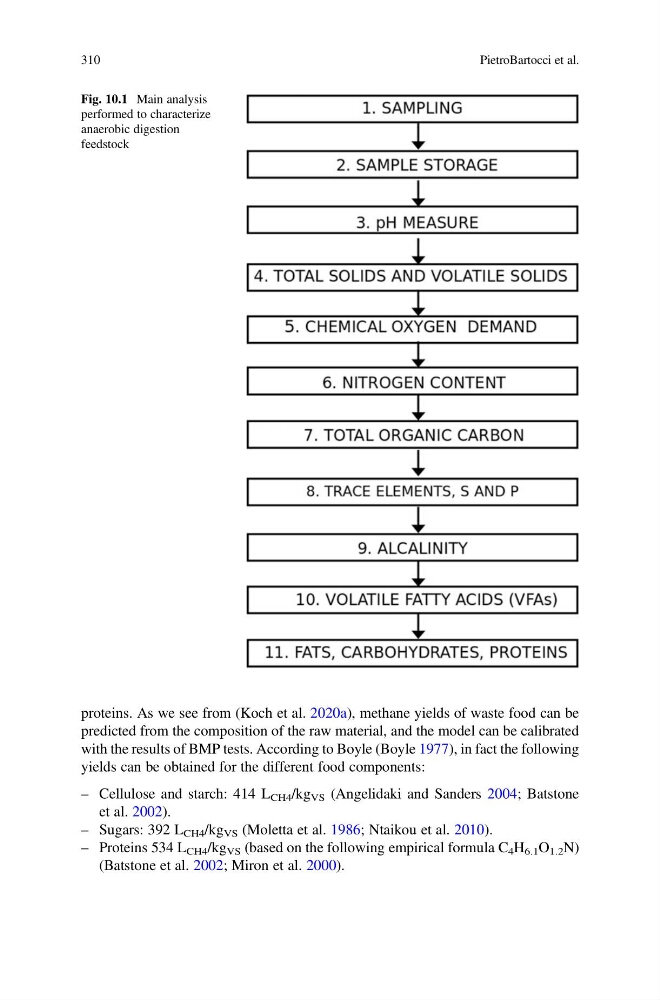
Fig. 10.1 Main analysis
performed to characterize
anaerobic digestion
feedstock
310
PietroBartocci et al.
predicted from the composition of the raw material, and the model can be calibrated
with the results of BMP tests. According to Boyle (Boyle 1977), in fact the following
yields can be obtained for the different food components:
– Cellulose and starch: 414 L CH4 /kg VS (Angelidaki and Sanders 2004; Batstone
et al. 2002).
– Sugars: 392 L CH4 /kg VS (Moletta et al. 1986; Ntaikou et al. 2010).
– Proteins 534 L CH4 /kg VS (based on the following empirical formula C 4 H 6.1 O 1.2 N)
(Batstone et al. 2002; Miron et al. 2000).
Fig. 10.1 Main analysis
performed to characterize
anaerobic digestion
feedstock
310
PietroBartocci et al.