

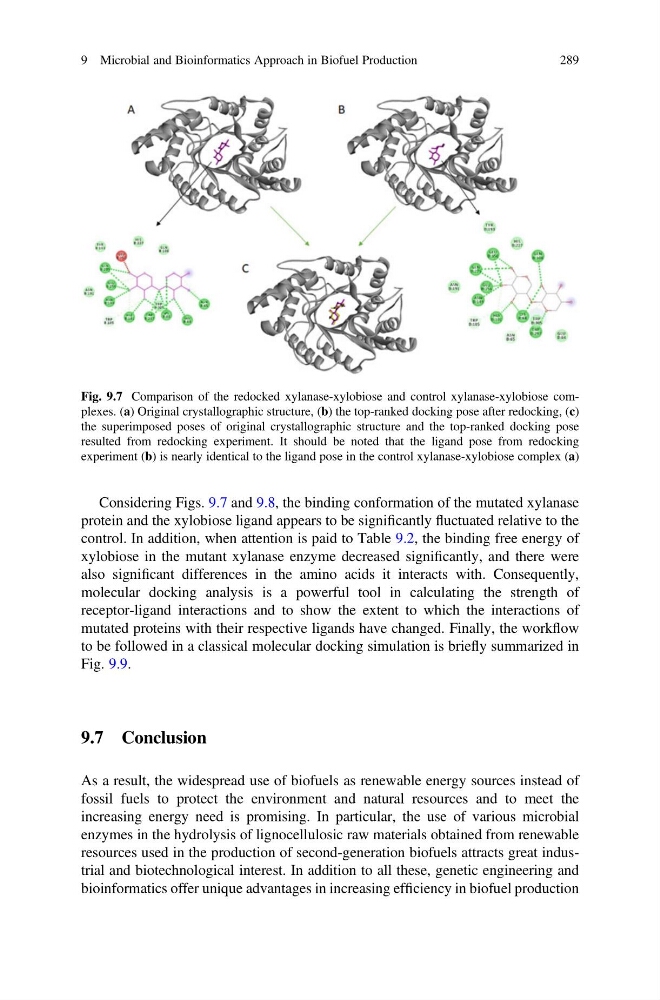
Considering Figs. 9.7 and 9.8, the binding conformation of the mutated xylanase
protein and the xylobiose ligand appears to be significantly fluctuated relative to the
control. In addition, when attention is paid to Table 9.2, the binding free energy of
xylobiose in the mutant xylanase enzyme decreased significantly, and there were
also significant differences in the amino acids it interacts with. Consequently,
molecular docking analysis is a powerful tool in calculating the strength of
receptor-ligand interactions and to show the extent to which the interactions of
mutated proteins with their respective ligands have changed. Finally, the workflow
to be followed in a classical molecular docking simulation is briefly summarized in
Fig. 9.9.
9.7 Conclusion
As a result, the widespread use of biofuels as renewable energy sources instead of
fossil fuels to protect the environment and natural resources and to meet the
increasing energy need is promising. In particular, the use of various microbial
enzymes in the hydrolysis of lignocellulosic raw materials obtained from renewable
resources used in the production of second-generation biofuels attracts great industrial and biotechnological interest. In addition to all these, genetic engineering and
bioinformatics offer unique advantages in increasing efficiency in biofuel production
Fig. 9.7 Comparison of the redocked xylanase-xylobiose and control xylanase-xylobiose complexes. (a) Original crystallographic structure, (b) the top-ranked docking pose after redocking, (c)
the superimposed poses of original crystallographic structure and the top-ranked docking pose
resulted from redocking experiment. It should be noted that the ligand pose from redocking
experiment (b) is nearly identical to the ligand pose in the control xylanase-xylobiose complex (a)
9 Microbial and Bioinformatics Approach in Biofuel Production
289
protein and the xylobiose ligand appears to be significantly fluctuated relative to the
control. In addition, when attention is paid to Table 9.2, the binding free energy of
xylobiose in the mutant xylanase enzyme decreased significantly, and there were
also significant differences in the amino acids it interacts with. Consequently,
molecular docking analysis is a powerful tool in calculating the strength of
receptor-ligand interactions and to show the extent to which the interactions of
mutated proteins with their respective ligands have changed. Finally, the workflow
to be followed in a classical molecular docking simulation is briefly summarized in
Fig. 9.9.
9.7 Conclusion
As a result, the widespread use of biofuels as renewable energy sources instead of
fossil fuels to protect the environment and natural resources and to meet the
increasing energy need is promising. In particular, the use of various microbial
enzymes in the hydrolysis of lignocellulosic raw materials obtained from renewable
resources used in the production of second-generation biofuels attracts great industrial and biotechnological interest. In addition to all these, genetic engineering and
bioinformatics offer unique advantages in increasing efficiency in biofuel production
Fig. 9.7 Comparison of the redocked xylanase-xylobiose and control xylanase-xylobiose complexes. (a) Original crystallographic structure, (b) the top-ranked docking pose after redocking, (c)
the superimposed poses of original crystallographic structure and the top-ranked docking pose
resulted from redocking experiment. It should be noted that the ligand pose from redocking
experiment (b) is nearly identical to the ligand pose in the control xylanase-xylobiose complex (a)
9 Microbial and Bioinformatics Approach in Biofuel Production
289