

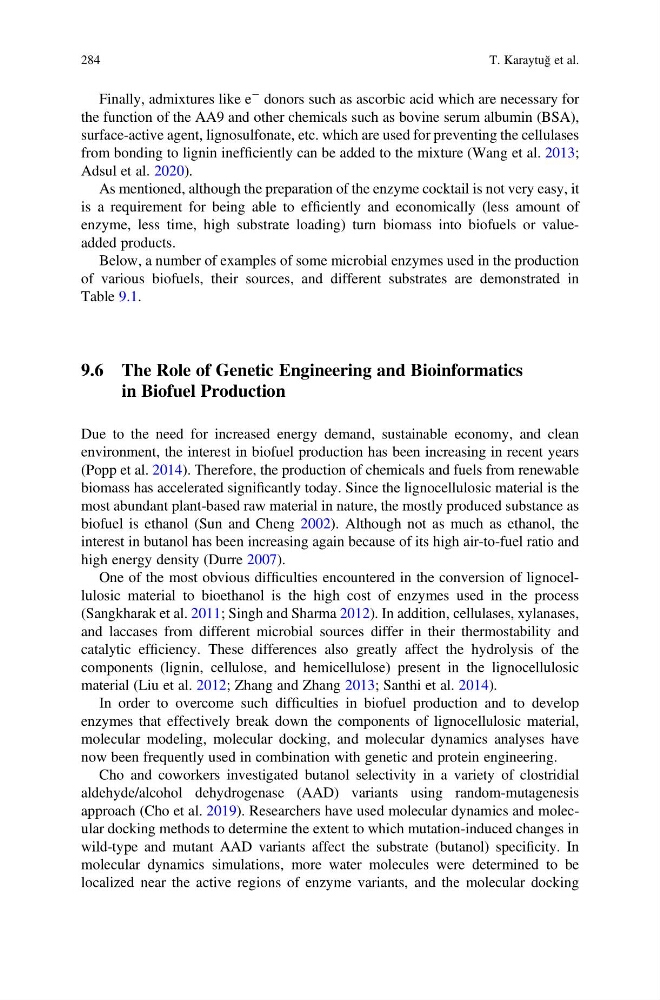
Finally, admixtures like e
À donors such as ascorbic acid which are necessary for
the function of the AA9 and other chemicals such as bovine serum albumin (BSA),
surface-active agent, lignosulfonate, etc. which are used for preventing the cellulases
from bonding to lignin inefficiently can be added to the mixture (Wang et al. 2013;
Adsul et al. 2020).
As mentioned, although the preparation of the enzyme cocktail is not very easy, it
is a requirement for being able to efficiently and economically (less amount of
enzyme, less time, high substrate loading) turn biomass into biofuels or valueadded products.
Below, a number of examples of some microbial enzymes used in the production
of various biofuels, their sources, and different substrates are demonstrated in
Table 9.1.
9.6 The Role of Genetic Engineering and Bioinformatics
in Biofuel Production
Due to the need for increased energy demand, sustainable economy, and clean
environment, the interest in biofuel production has been increasing in recent years
(Popp et al. 2014). Therefore, the production of chemicals and fuels from renewable
biomass has accelerated significantly today. Since the lignocellulosic material is the
most abundant plant-based raw material in nature, the mostly produced substance as
biofuel is ethanol (Sun and Cheng 2002). Although not as much as ethanol, the
interest in butanol has been increasing again because of its high air-to-fuel ratio and
high energy density (Durre 2007).
One of the most obvious difficulties encountered in the conversion of lignocellulosic material to bioethanol is the high cost of enzymes used in the process
(Sangkharak et al. 2011; Singh and Sharma 2012). In addition, cellulases, xylanases,
and laccases from different microbial sources differ in their thermostability and
catalytic efficiency. These differences also greatly affect the hydrolysis of the
components (lignin, cellulose, and hemicellulose) present in the lignocellulosic
material (Liu et al. 2012; Zhang and Zhang 2013; Santhi et al. 2014).
In order to overcome such difficulties in biofuel production and to develop
enzymes that effectively break down the components of lignocellulosic material,
molecular modeling, molecular docking, and molecular dynamics analyses have
now been frequently used in combination with genetic and protein engineering.
Cho and coworkers investigated butanol selectivity in a variety of clostridial
aldehyde/alcohol dehydrogenase (AAD) variants using random-mutagenesis
approach (Cho et al. 2019). Researchers have used molecular dynamics and molecular docking methods to determine the extent to which mutation-induced changes in
wild-type and mutant AAD variants affect the substrate (butanol) specificity. In
molecular dynamics simulations, more water molecules were determined to be
localized near the active regions of enzyme variants, and the molecular docking
284
T. Karaytuğ et al.
À donors such as ascorbic acid which are necessary for
the function of the AA9 and other chemicals such as bovine serum albumin (BSA),
surface-active agent, lignosulfonate, etc. which are used for preventing the cellulases
from bonding to lignin inefficiently can be added to the mixture (Wang et al. 2013;
Adsul et al. 2020).
As mentioned, although the preparation of the enzyme cocktail is not very easy, it
is a requirement for being able to efficiently and economically (less amount of
enzyme, less time, high substrate loading) turn biomass into biofuels or valueadded products.
Below, a number of examples of some microbial enzymes used in the production
of various biofuels, their sources, and different substrates are demonstrated in
Table 9.1.
9.6 The Role of Genetic Engineering and Bioinformatics
in Biofuel Production
Due to the need for increased energy demand, sustainable economy, and clean
environment, the interest in biofuel production has been increasing in recent years
(Popp et al. 2014). Therefore, the production of chemicals and fuels from renewable
biomass has accelerated significantly today. Since the lignocellulosic material is the
most abundant plant-based raw material in nature, the mostly produced substance as
biofuel is ethanol (Sun and Cheng 2002). Although not as much as ethanol, the
interest in butanol has been increasing again because of its high air-to-fuel ratio and
high energy density (Durre 2007).
One of the most obvious difficulties encountered in the conversion of lignocellulosic material to bioethanol is the high cost of enzymes used in the process
(Sangkharak et al. 2011; Singh and Sharma 2012). In addition, cellulases, xylanases,
and laccases from different microbial sources differ in their thermostability and
catalytic efficiency. These differences also greatly affect the hydrolysis of the
components (lignin, cellulose, and hemicellulose) present in the lignocellulosic
material (Liu et al. 2012; Zhang and Zhang 2013; Santhi et al. 2014).
In order to overcome such difficulties in biofuel production and to develop
enzymes that effectively break down the components of lignocellulosic material,
molecular modeling, molecular docking, and molecular dynamics analyses have
now been frequently used in combination with genetic and protein engineering.
Cho and coworkers investigated butanol selectivity in a variety of clostridial
aldehyde/alcohol dehydrogenase (AAD) variants using random-mutagenesis
approach (Cho et al. 2019). Researchers have used molecular dynamics and molecular docking methods to determine the extent to which mutation-induced changes in
wild-type and mutant AAD variants affect the substrate (butanol) specificity. In
molecular dynamics simulations, more water molecules were determined to be
localized near the active regions of enzyme variants, and the molecular docking
284
T. Karaytuğ et al.