

9.3 Lignocellulose
Lignocellulose is the most commonly found carbohydrate source in nature, and
represents a renewable energy source (Yeoman et al. 2010; Abdel-Hamid et al.
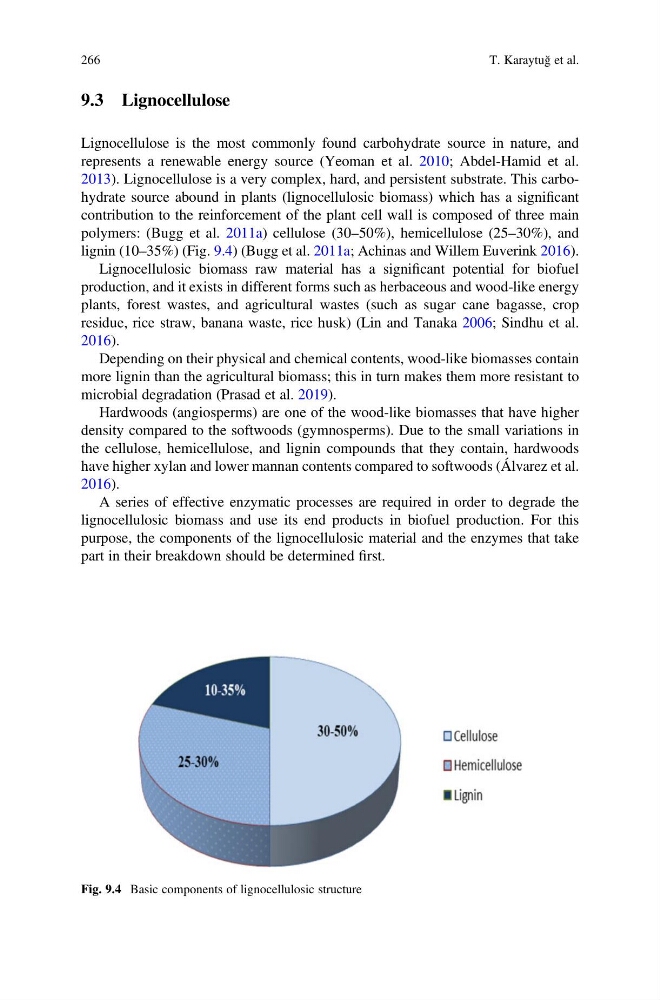
2013). Lignocellulose is a very complex, hard, and persistent substrate. This carbohydrate source abound in plants (lignocellulosic biomass) which has a significant
contribution to the reinforcement of the plant cell wall is composed of three main
polymers: (Bugg et al. 2011a) cellulose (30–50%), hemicellulose (25–30%), and
lignin (10–35%) (Fig. 9.4) (Bugg et al. 2011a; Achinas and Willem Euverink 2016).
Lignocellulosic biomass raw material has a significant potential for biofuel
production, and it exists in different forms such as herbaceous and wood-like energy
plants, forest wastes, and agricultural wastes (such as sugar cane bagasse, crop
residue, rice straw, banana waste, rice husk) (Lin and Tanaka 2006; Sindhu et al.
2016).
Depending on their physical and chemical contents, wood-like biomasses contain
more lignin than the agricultural biomass; this in turn makes them more resistant to
microbial degradation (Prasad et al. 2019).
Hardwoods (angiosperms) are one of the wood-like biomasses that have higher
density compared to the softwoods (gymnosperms). Due to the small variations in
the cellulose, hemicellulose, and lignin compounds that they contain, hardwoods
have higher xylan and lower mannan contents compared to softwoods (Álvarez et al.
2016).
A series of effective enzymatic processes are required in order to degrade the
lignocellulosic biomass and use its end products in biofuel production. For this
purpose, the components of the lignocellulosic material and the enzymes that take
part in their breakdown should be determined first.
Fig. 9.4 Basic components of lignocellulosic structure
266
T. Karaytuğ et al.
Lignocellulose is the most commonly found carbohydrate source in nature, and
represents a renewable energy source (Yeoman et al. 2010; Abdel-Hamid et al.
2013). Lignocellulose is a very complex, hard, and persistent substrate. This carbohydrate source abound in plants (lignocellulosic biomass) which has a significant
contribution to the reinforcement of the plant cell wall is composed of three main
polymers: (Bugg et al. 2011a) cellulose (30–50%), hemicellulose (25–30%), and
lignin (10–35%) (Fig. 9.4) (Bugg et al. 2011a; Achinas and Willem Euverink 2016).
Lignocellulosic biomass raw material has a significant potential for biofuel
production, and it exists in different forms such as herbaceous and wood-like energy
plants, forest wastes, and agricultural wastes (such as sugar cane bagasse, crop
residue, rice straw, banana waste, rice husk) (Lin and Tanaka 2006; Sindhu et al.
2016).
Depending on their physical and chemical contents, wood-like biomasses contain
more lignin than the agricultural biomass; this in turn makes them more resistant to
microbial degradation (Prasad et al. 2019).
Hardwoods (angiosperms) are one of the wood-like biomasses that have higher
density compared to the softwoods (gymnosperms). Due to the small variations in
the cellulose, hemicellulose, and lignin compounds that they contain, hardwoods
have higher xylan and lower mannan contents compared to softwoods (Álvarez et al.
2016).
A series of effective enzymatic processes are required in order to degrade the
lignocellulosic biomass and use its end products in biofuel production. For this
purpose, the components of the lignocellulosic material and the enzymes that take
part in their breakdown should be determined first.
Fig. 9.4 Basic components of lignocellulosic structure
266
T. Karaytuğ et al.