

and α-proteobacteria (Bugg et al. 2011b). Besides these, bacteria such as
Sphingobium sp., Bacillus sp., and Rhodococcus jostii also produce enzymes that
can act in delignification (Xu et al. 2018; Zabed et al. 2019).
The presence of bacteria in biological pretreatment has some benefits to shorten
the pretreatment time, such as having faster metabolic activity than fungi, multiple
and rapid reproduction, easy genetic manipulation, and low cost (Carrillo-Reyes
et al. 2016; Yan et al. 2017).
In the enzymatic pretreatment method, partially, fully purified, or raw hydrolytic
and ligninolytic enzyme groups are used (Asgher et al. 2013). Both single enzymes
and enzyme cocktails (see in Sect. 9.5) isolated from bacteria and fungi are preferred
in these methods. It is advantageous to use enzyme mixtures in order to obtain more
efficiency from the hydrolysis of various biopolymers in the structure of biomass to
be used for biofuel production (Ehimen et al. 2013; Zabed et al. 2019).
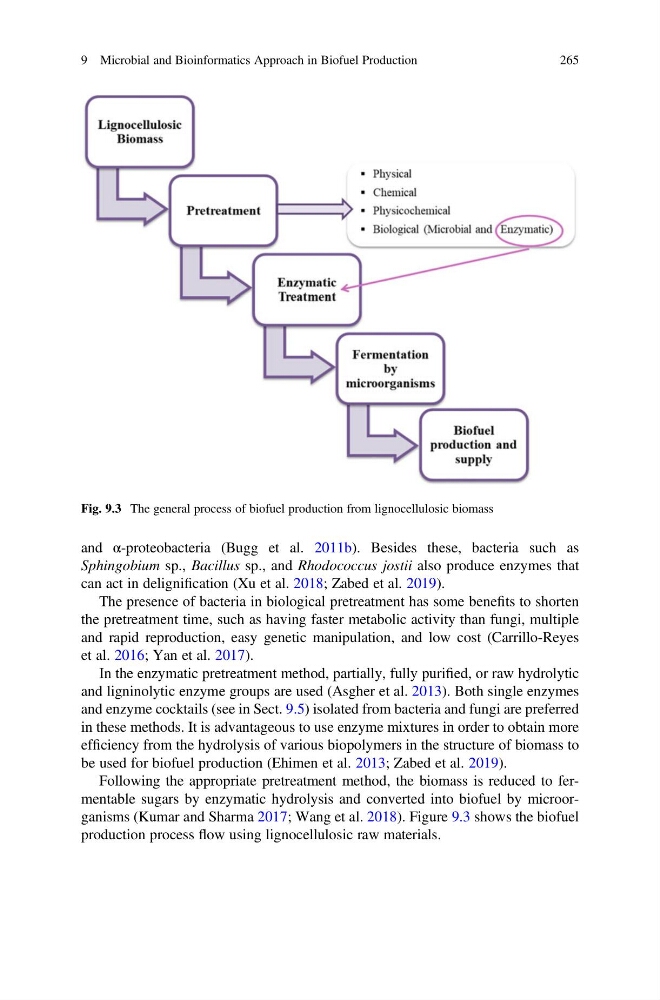
Following the appropriate pretreatment method, the biomass is reduced to fermentable sugars by enzymatic hydrolysis and converted into biofuel by microorganisms (Kumar and Sharma 2017; Wang et al. 2018). Figure 9.3 shows the biofuel
production process flow using lignocellulosic raw materials.
Fig. 9.3 The general process of biofuel production from lignocellulosic biomass
9 Microbial and Bioinformatics Approach in Biofuel Production
265
Sphingobium sp., Bacillus sp., and Rhodococcus jostii also produce enzymes that
can act in delignification (Xu et al. 2018; Zabed et al. 2019).
The presence of bacteria in biological pretreatment has some benefits to shorten
the pretreatment time, such as having faster metabolic activity than fungi, multiple
and rapid reproduction, easy genetic manipulation, and low cost (Carrillo-Reyes
et al. 2016; Yan et al. 2017).
In the enzymatic pretreatment method, partially, fully purified, or raw hydrolytic
and ligninolytic enzyme groups are used (Asgher et al. 2013). Both single enzymes
and enzyme cocktails (see in Sect. 9.5) isolated from bacteria and fungi are preferred
in these methods. It is advantageous to use enzyme mixtures in order to obtain more
efficiency from the hydrolysis of various biopolymers in the structure of biomass to
be used for biofuel production (Ehimen et al. 2013; Zabed et al. 2019).
Following the appropriate pretreatment method, the biomass is reduced to fermentable sugars by enzymatic hydrolysis and converted into biofuel by microorganisms (Kumar and Sharma 2017; Wang et al. 2018). Figure 9.3 shows the biofuel
production process flow using lignocellulosic raw materials.
Fig. 9.3 The general process of biofuel production from lignocellulosic biomass
9 Microbial and Bioinformatics Approach in Biofuel Production
265