

industrial wastes, edible/animal oils, and plants used for food (Palmer and Brigham
2016; Bhatia et al. 2017).
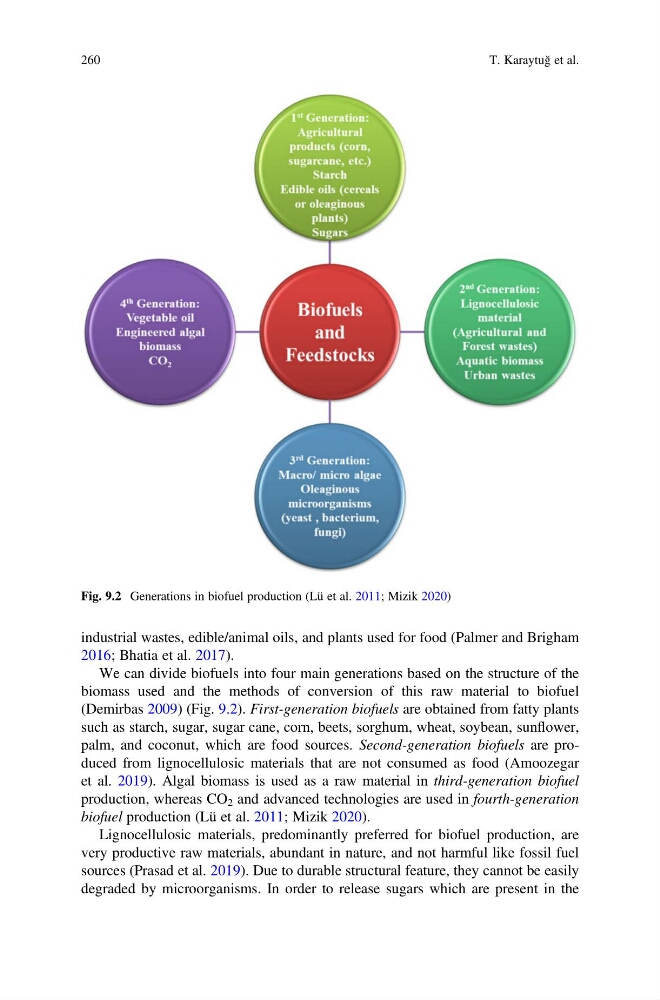
We can divide biofuels into four main generations based on the structure of the
biomass used and the methods of conversion of this raw material to biofuel
(Demirbas 2009) (Fig. 9.2). First-generation biofuels are obtained from fatty plants
such as starch, sugar, sugar cane, corn, beets, sorghum, wheat, soybean, sunflower,
palm, and coconut, which are food sources. Second-generation biofuels are produced from lignocellulosic materials that are not consumed as food (Amoozegar
et al. 2019). Algal biomass is used as a raw material in third-generation biofuel
production, whereas CO 2 and advanced technologies are used in fourth-generation
biofuel production (Lü et al. 2011; Mizik 2020).
Lignocellulosic materials, predominantly preferred for biofuel production, are
very productive raw materials, abundant in nature, and not harmful like fossil fuel
sources (Prasad et al. 2019). Due to durable structural feature, they cannot be easily
degraded by microorganisms. In order to release sugars which are present in the
Fig. 9.2 Generations in biofuel production (Lü et al. 2011; Mizik 2020)
260
T. Karaytuğ et al.
2016; Bhatia et al. 2017).
We can divide biofuels into four main generations based on the structure of the
biomass used and the methods of conversion of this raw material to biofuel
(Demirbas 2009) (Fig. 9.2). First-generation biofuels are obtained from fatty plants
such as starch, sugar, sugar cane, corn, beets, sorghum, wheat, soybean, sunflower,
palm, and coconut, which are food sources. Second-generation biofuels are produced from lignocellulosic materials that are not consumed as food (Amoozegar
et al. 2019). Algal biomass is used as a raw material in third-generation biofuel
production, whereas CO 2 and advanced technologies are used in fourth-generation
biofuel production (Lü et al. 2011; Mizik 2020).
Lignocellulosic materials, predominantly preferred for biofuel production, are
very productive raw materials, abundant in nature, and not harmful like fossil fuel
sources (Prasad et al. 2019). Due to durable structural feature, they cannot be easily
degraded by microorganisms. In order to release sugars which are present in the
Fig. 9.2 Generations in biofuel production (Lü et al. 2011; Mizik 2020)
260
T. Karaytuğ et al.