

any pathogenic organism present in the waste. Only when the reactor is run under
thermophilic conditions where high temperatures are used, pathogenic bacteria will
not survive; the effluent released may lead to zoonotic diseases if pathogenic
organisms survive. Anaerobic processes cannot handle if excess amounts of industrial effluents containing waste are treated as they contain mostly heavy metals which
may hinder the process of digestion. It is always better to see that the feedstock is
homogenous and steady. The amount of investment for maintaining an anaerobic
digestion plant is high. It is not efficient as that of gasification procedure which is
used for conversion of carbon to biogas. The anaerobic treatment can be accompanied by odor due to the formation of sulfide. This is one of the most seen disadvantages which are commonly found during the process of anaerobic digestion due to
which the area around the biogas plant gets exposed to this foul smell. Moreover,
there cannot be any inhabitation because of the smell which emanates from these
plants. One of the effective solutions to this problem is to employ a microaerophilic
posttreatment step, to convert sulfide to elemental sulfur. This will reduce the odor
emanating from the plant.
8.8 Challenges in Biogas Production
The challenges faced are based on the type of waste being treated in the anaerobic
digestion. For example, for municipal solid waste, aerobic treatment is preferred
compared to anaerobic treatment. This is because it has lower concentrations of
biodegradable COD and an effluent which is of better quality as it may be released
back into the atmosphere. In the case of industrial effluents which have more
concentrations of biodegradable COD, the process will be less expensive. Although
the presence of heavy metals should be less in these effluents. Biogas production is
challenging considering that there are many factors which need to be optimized and
Digestate
Feed
Tank
Biogas
Fermentation tank
FloaƟng Drum
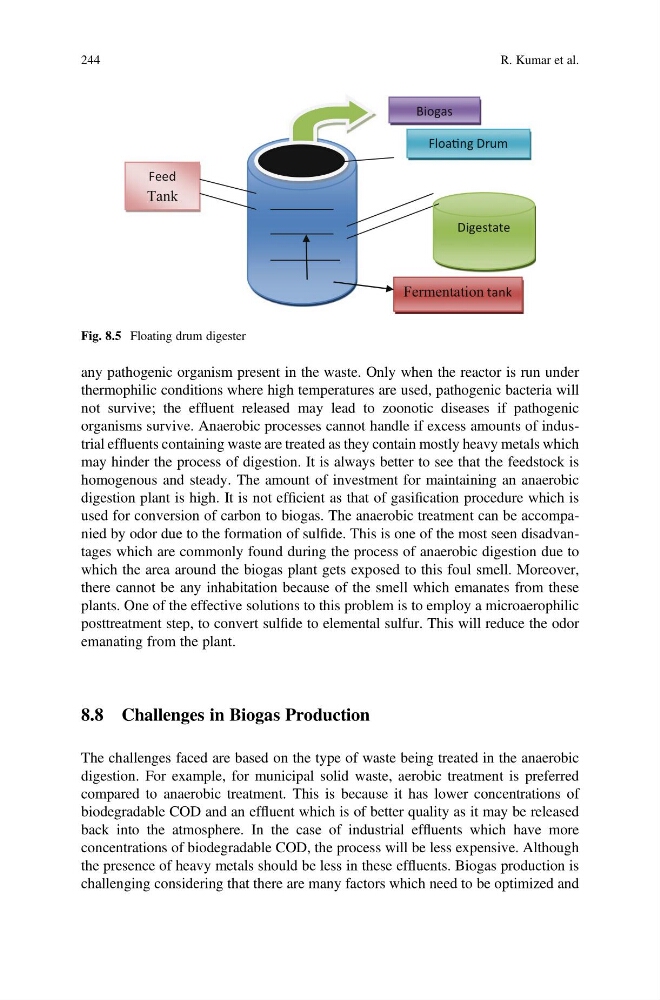
Fig. 8.5 Floating drum digester
244
R. Kumar et al.
thermophilic conditions where high temperatures are used, pathogenic bacteria will
not survive; the effluent released may lead to zoonotic diseases if pathogenic
organisms survive. Anaerobic processes cannot handle if excess amounts of industrial effluents containing waste are treated as they contain mostly heavy metals which
may hinder the process of digestion. It is always better to see that the feedstock is
homogenous and steady. The amount of investment for maintaining an anaerobic
digestion plant is high. It is not efficient as that of gasification procedure which is
used for conversion of carbon to biogas. The anaerobic treatment can be accompanied by odor due to the formation of sulfide. This is one of the most seen disadvantages which are commonly found during the process of anaerobic digestion due to
which the area around the biogas plant gets exposed to this foul smell. Moreover,
there cannot be any inhabitation because of the smell which emanates from these
plants. One of the effective solutions to this problem is to employ a microaerophilic
posttreatment step, to convert sulfide to elemental sulfur. This will reduce the odor
emanating from the plant.
8.8 Challenges in Biogas Production
The challenges faced are based on the type of waste being treated in the anaerobic
digestion. For example, for municipal solid waste, aerobic treatment is preferred
compared to anaerobic treatment. This is because it has lower concentrations of
biodegradable COD and an effluent which is of better quality as it may be released
back into the atmosphere. In the case of industrial effluents which have more
concentrations of biodegradable COD, the process will be less expensive. Although
the presence of heavy metals should be less in these effluents. Biogas production is
challenging considering that there are many factors which need to be optimized and
Digestate
Feed
Tank
Biogas
Fermentation tank
FloaƟng Drum
Fig. 8.5 Floating drum digester
244
R. Kumar et al.