

up of the process is very expensive (Sierra et al. 2008). Zijffers et al. (2008)
developed Green Solar Collector (GSC) for microalgal production and were found
to capture light efficiency by 57%. However, the main limitation of this is that the
fabrication of these kinds of bioreactors is expensive. The optical fibers used in this
bioreactor can be sterilized. Apart from this, they are also stable to agitation which is
a major advantage. Constant productivity (Gordon 2002) and continuous illumination allow for scaling up of the process. Parmentier et al. (2020) studied a new
electrocoagulation-flotation set-up with a tubular coaxial reactor using Chlorella
vulgaris. They reported only lower energy consumption rates compared to other
kinds of similar reactors. This kind of setup can be used for harvesting algae at larger
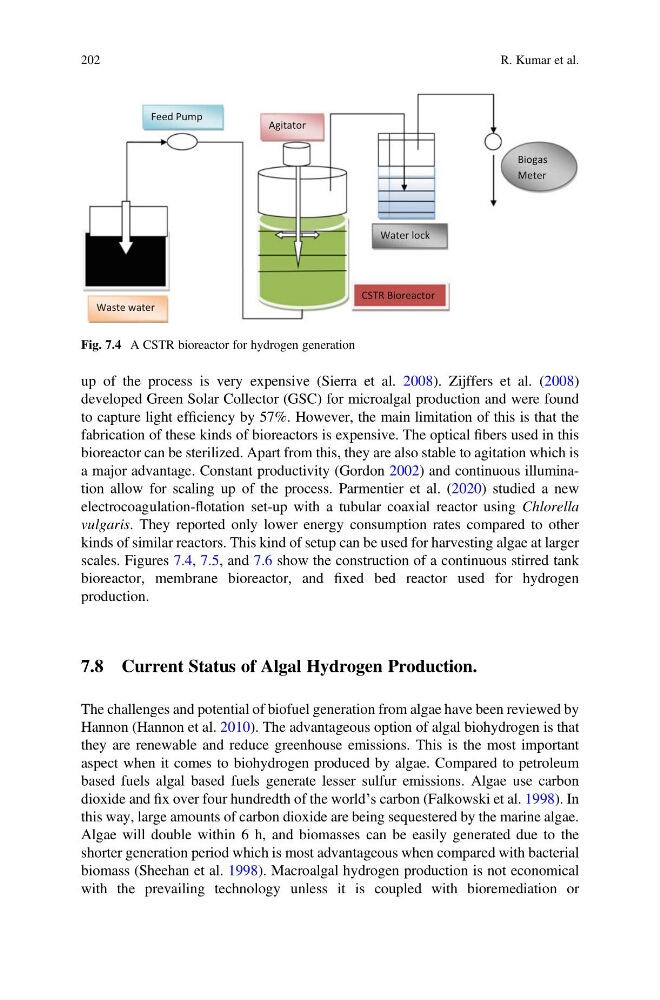
scales. Figures 7.4, 7.5, and 7.6 show the construction of a continuous stirred tank
bioreactor, membrane bioreactor, and fixed bed reactor used for hydrogen
production.
7.8 Current Status of Algal Hydrogen Production.
The challenges and potential of biofuel generation from algae have been reviewed by
Hannon (Hannon et al. 2010). The advantageous option of algal biohydrogen is that
they are renewable and reduce greenhouse emissions. This is the most important
aspect when it comes to biohydrogen produced by algae. Compared to petroleum
based fuels algal based fuels generate lesser sulfur emissions. Algae use carbon
dioxide and fix over four hundredth of the world’s carbon (Falkowski et al. 1998). In
this way, large amounts of carbon dioxide are being sequestered by the marine algae.
Algae will double within 6 h, and biomasses can be easily generated due to the
shorter generation period which is most advantageous when compared with bacterial
biomass (Sheehan et al. 1998). Macroalgal hydrogen production is not economical
with the prevailing technology unless it is coupled with bioremediation or
Waste water
Feed Pump
CSTR Bioreactor
Agitator
Biogas
Meter
Water lock
Fig. 7.4 A CSTR bioreactor for hydrogen generation
202
R. Kumar et al.
developed Green Solar Collector (GSC) for microalgal production and were found
to capture light efficiency by 57%. However, the main limitation of this is that the
fabrication of these kinds of bioreactors is expensive. The optical fibers used in this
bioreactor can be sterilized. Apart from this, they are also stable to agitation which is
a major advantage. Constant productivity (Gordon 2002) and continuous illumination allow for scaling up of the process. Parmentier et al. (2020) studied a new
electrocoagulation-flotation set-up with a tubular coaxial reactor using Chlorella
vulgaris. They reported only lower energy consumption rates compared to other
kinds of similar reactors. This kind of setup can be used for harvesting algae at larger
scales. Figures 7.4, 7.5, and 7.6 show the construction of a continuous stirred tank
bioreactor, membrane bioreactor, and fixed bed reactor used for hydrogen
production.
7.8 Current Status of Algal Hydrogen Production.
The challenges and potential of biofuel generation from algae have been reviewed by
Hannon (Hannon et al. 2010). The advantageous option of algal biohydrogen is that
they are renewable and reduce greenhouse emissions. This is the most important
aspect when it comes to biohydrogen produced by algae. Compared to petroleum
based fuels algal based fuels generate lesser sulfur emissions. Algae use carbon
dioxide and fix over four hundredth of the world’s carbon (Falkowski et al. 1998). In
this way, large amounts of carbon dioxide are being sequestered by the marine algae.
Algae will double within 6 h, and biomasses can be easily generated due to the
shorter generation period which is most advantageous when compared with bacterial
biomass (Sheehan et al. 1998). Macroalgal hydrogen production is not economical
with the prevailing technology unless it is coupled with bioremediation or
Waste water
Feed Pump
CSTR Bioreactor
Agitator
Biogas
Meter
Water lock
Fig. 7.4 A CSTR bioreactor for hydrogen generation
202
R. Kumar et al.