

rate of production was low at lower light intensities and highest temperature limit for
hydrogen production was about 46
C.
7.7 Bioreactors for Algal Hydrogen Production
Algal bioreactors are used in cultivating both micro- and macroalgae for
biohydrogen production. Algae bioreactors are of two types, namely, open reactors
and enclosed reactors. Enclosed reactors are called photobioreactors. The bioreactors
are based on the photosynthetic reaction of algal cultures using carbon dioxide and
sunlight energy. Tubular photobioreactors are fully closed and can be used for large
scale (Molina et al. 2001). They are made of plastic or glass (Miron et al. 1999). In
flat plate photobioreactors, compactness is the major advantage (Posten 2009). The
U-turns use small amount of space, and the thickness of the wall is thin when
compared to other kinds of bioreactors (Pulz and Scheibenbogen 1998). The reactor
panels are illuminated mainly on one side by direct sunlight so that maximum
absorption of the light energy takes place (Janssen et al. 2003). The airlift and
bubble-column bioreactors are also used for cultivating algal cultures. They are
used for biofuel production, wastewater treatment, and industry. They are economical and compact and can be easily handled (Miron et al. 2002). Anto et al. (2020) too
have discussed different configurations of reactors which are used to decrease risk of
contamination and methods of increasing biomass of the algae. They have
highlighted the importance of temperature, size, innoculum nutrient concentration,
light intensity, CO 2 , and mixing for hydrogen generation.
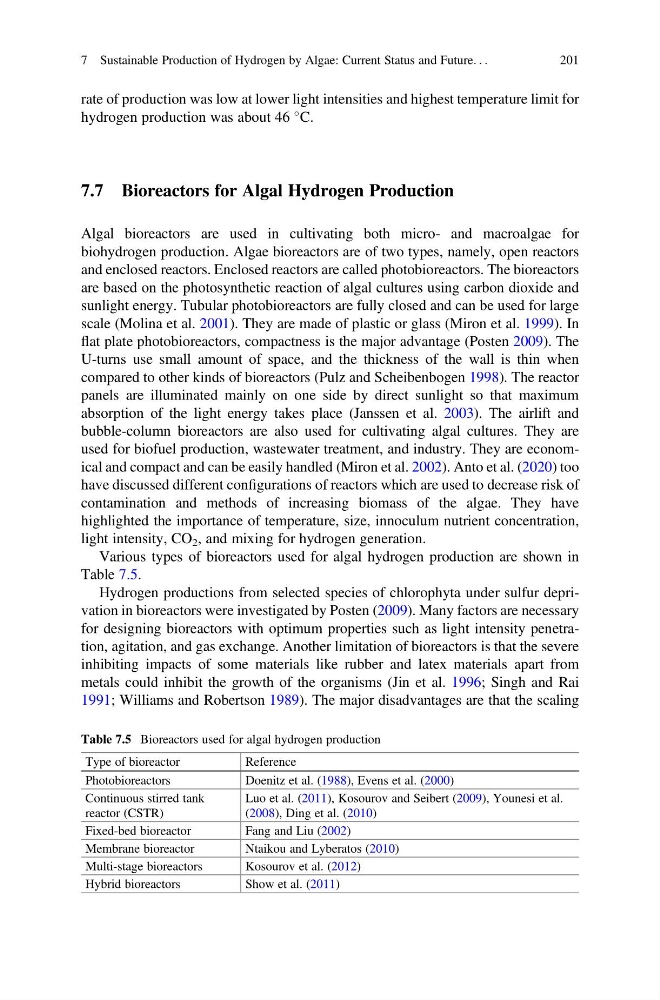
Various types of bioreactors used for algal hydrogen production are shown in
Table 7.5.
Hydrogen productions from selected species of chlorophyta under sulfur deprivation in bioreactors were investigated by Posten (2009). Many factors are necessary
for designing bioreactors with optimum properties such as light intensity penetration, agitation, and gas exchange. Another limitation of bioreactors is that the severe
inhibiting impacts of some materials like rubber and latex materials apart from
metals could inhibit the growth of the organisms (Jin et al. 1996; Singh and Rai
1991; Williams and Robertson 1989). The major disadvantages are that the scaling
Table 7.5 Bioreactors used for algal hydrogen production
Type of bioreactor
Reference
Photobioreactors
Doenitz et al. (1988), Evens et al. (2000)
Continuous stirred tank
reactor (CSTR)
Luo et al. (2011), Kosourov and Seibert (2009), Younesi et al.
(2008), Ding et al. (2010)
Fixed-bed bioreactor
Fang and Liu (2002)
Membrane bioreactor
Ntaikou and Lyberatos (2010)
Multi-stage bioreactors
Kosourov et al. (2012)
Hybrid bioreactors
Show et al. (2011)
7 Sustainable Production of Hydrogen by Algae: Current Status and Future. . .
201
hydrogen production was about 46
C.
7.7 Bioreactors for Algal Hydrogen Production
Algal bioreactors are used in cultivating both micro- and macroalgae for
biohydrogen production. Algae bioreactors are of two types, namely, open reactors
and enclosed reactors. Enclosed reactors are called photobioreactors. The bioreactors
are based on the photosynthetic reaction of algal cultures using carbon dioxide and
sunlight energy. Tubular photobioreactors are fully closed and can be used for large
scale (Molina et al. 2001). They are made of plastic or glass (Miron et al. 1999). In
flat plate photobioreactors, compactness is the major advantage (Posten 2009). The
U-turns use small amount of space, and the thickness of the wall is thin when
compared to other kinds of bioreactors (Pulz and Scheibenbogen 1998). The reactor
panels are illuminated mainly on one side by direct sunlight so that maximum
absorption of the light energy takes place (Janssen et al. 2003). The airlift and
bubble-column bioreactors are also used for cultivating algal cultures. They are
used for biofuel production, wastewater treatment, and industry. They are economical and compact and can be easily handled (Miron et al. 2002). Anto et al. (2020) too
have discussed different configurations of reactors which are used to decrease risk of
contamination and methods of increasing biomass of the algae. They have
highlighted the importance of temperature, size, innoculum nutrient concentration,
light intensity, CO 2 , and mixing for hydrogen generation.
Various types of bioreactors used for algal hydrogen production are shown in
Table 7.5.
Hydrogen productions from selected species of chlorophyta under sulfur deprivation in bioreactors were investigated by Posten (2009). Many factors are necessary
for designing bioreactors with optimum properties such as light intensity penetration, agitation, and gas exchange. Another limitation of bioreactors is that the severe
inhibiting impacts of some materials like rubber and latex materials apart from
metals could inhibit the growth of the organisms (Jin et al. 1996; Singh and Rai
1991; Williams and Robertson 1989). The major disadvantages are that the scaling
Table 7.5 Bioreactors used for algal hydrogen production
Type of bioreactor
Reference
Photobioreactors
Doenitz et al. (1988), Evens et al. (2000)
Continuous stirred tank
reactor (CSTR)
Luo et al. (2011), Kosourov and Seibert (2009), Younesi et al.
(2008), Ding et al. (2010)
Fixed-bed bioreactor
Fang and Liu (2002)
Membrane bioreactor
Ntaikou and Lyberatos (2010)
Multi-stage bioreactors
Kosourov et al. (2012)
Hybrid bioreactors
Show et al. (2011)
7 Sustainable Production of Hydrogen by Algae: Current Status and Future. . .
201