

7.3 Microalgae for Hydrogen Production
Lee (1997) have reported that some species of microalgae Arthrospira, Chlorella,
Isochrysis, Dunaliella, and Chaetoceros can be used for biohydrogen production.
High amounts of lipids in microalgae can be converted into biofuel (Avagyan 2008).
Xiong et al. (2008) observed that microalgae such as Chlorella species can shift its
nutrition mode. Williams and Laurens (2010) have reported that the major biomolecules in microalgae are carbohydrates, proteins, lipids, and nucleic acids.
Microalgae have a rapid growth rate which makes them attractive renewable energy
source for biohydrogen production (Tredici 2010). Algae use sunlight for growth
without competing for agricultural resources (Pirt 1986). They have a shortgeneration time, and the algal oil can be converted into biofuel (Sudhakar
Premalatha 2012). Searchinger et al. (2008) investigated US croplands for algae
harvesting and drying for biofuel production. Microalgae are tiny factories which
remove atmospheric carbon dioxide (CO 2 ) (Sumi 2009). Microalgae have benefits
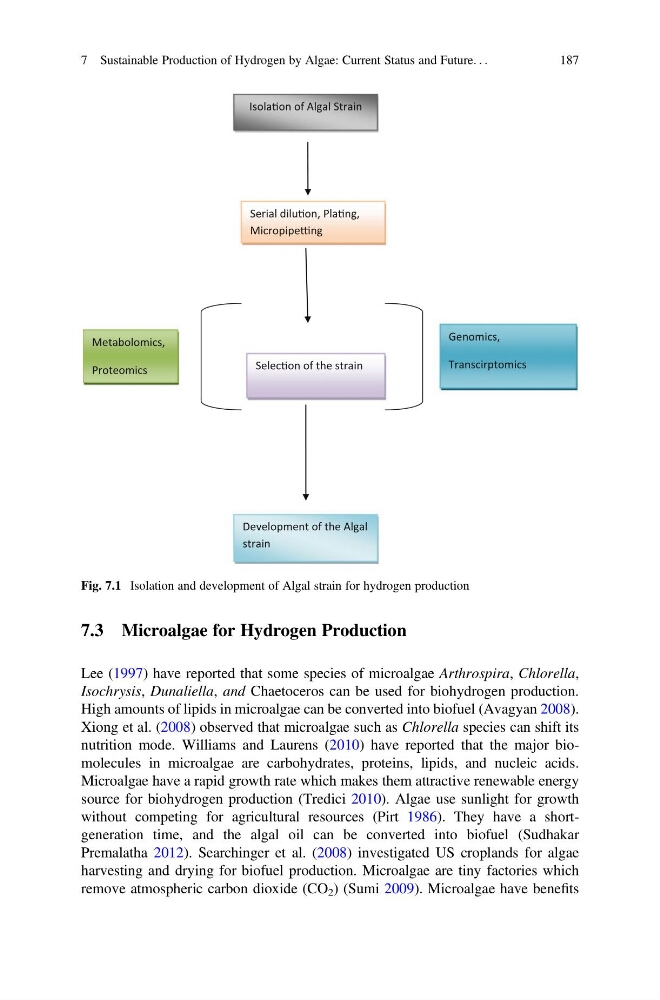
Serial diluƟon, PlaƟng,
Micropipeƫng
IsolaƟon of Algal Strain
SelecƟon of the strain
Development of the Algal
strain
Genomics,
Transcirptomics
Metabolomics,
Proteomics
Fig. 7.1 Isolation and development of Algal strain for hydrogen production
7 Sustainable Production of Hydrogen by Algae: Current Status and Future. . .
187
Lee (1997) have reported that some species of microalgae Arthrospira, Chlorella,
Isochrysis, Dunaliella, and Chaetoceros can be used for biohydrogen production.
High amounts of lipids in microalgae can be converted into biofuel (Avagyan 2008).
Xiong et al. (2008) observed that microalgae such as Chlorella species can shift its
nutrition mode. Williams and Laurens (2010) have reported that the major biomolecules in microalgae are carbohydrates, proteins, lipids, and nucleic acids.
Microalgae have a rapid growth rate which makes them attractive renewable energy
source for biohydrogen production (Tredici 2010). Algae use sunlight for growth
without competing for agricultural resources (Pirt 1986). They have a shortgeneration time, and the algal oil can be converted into biofuel (Sudhakar
Premalatha 2012). Searchinger et al. (2008) investigated US croplands for algae
harvesting and drying for biofuel production. Microalgae are tiny factories which
remove atmospheric carbon dioxide (CO 2 ) (Sumi 2009). Microalgae have benefits
Serial diluƟon, PlaƟng,
Micropipeƫng
IsolaƟon of Algal Strain
SelecƟon of the strain
Development of the Algal
strain
Genomics,
Transcirptomics
Metabolomics,
Proteomics
Fig. 7.1 Isolation and development of Algal strain for hydrogen production
7 Sustainable Production of Hydrogen by Algae: Current Status and Future. . .
187