

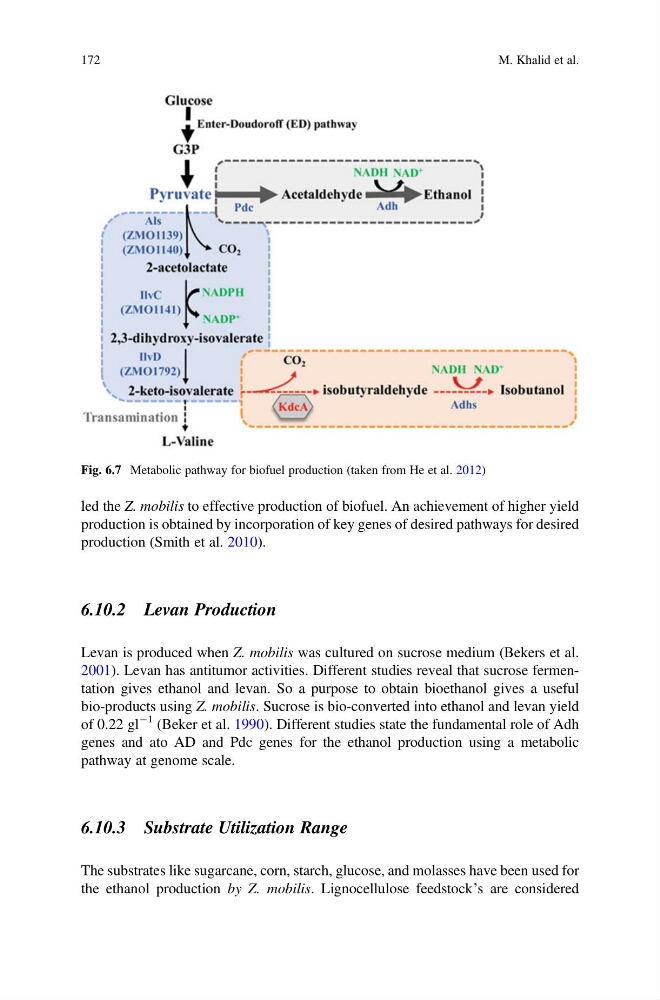
led the Z. mobilis to effective production of biofuel. An achievement of higher yield
production is obtained by incorporation of key genes of desired pathways for desired
production (Smith et al. 2010).
6.10.2 Levan Production
Levan is produced when Z. mobilis was cultured on sucrose medium (Bekers et al.
2001). Levan has antitumor activities. Different studies reveal that sucrose fermentation gives ethanol and levan. So a purpose to obtain bioethanol gives a useful
bio-products using Z. mobilis. Sucrose is bio-converted into ethanol and levan yield
of 0.22 gl
À1 (Beker et al. 1990). Different studies state the fundamental role of Adh
genes and ato AD and Pdc genes for the ethanol production using a metabolic
pathway at genome scale.
6.10.3 Substrate Utilization Range
The substrates like sugarcane, corn, starch, glucose, and molasses have been used for
the ethanol production by Z. mobilis. Lignocellulose feedstock’s are considered
Fig. 6.7 Metabolic pathway for biofuel production (taken from He et al. 2012)
172
M. Khalid et al.
production is obtained by incorporation of key genes of desired pathways for desired
production (Smith et al. 2010).
6.10.2 Levan Production
Levan is produced when Z. mobilis was cultured on sucrose medium (Bekers et al.
2001). Levan has antitumor activities. Different studies reveal that sucrose fermentation gives ethanol and levan. So a purpose to obtain bioethanol gives a useful
bio-products using Z. mobilis. Sucrose is bio-converted into ethanol and levan yield
of 0.22 gl
À1 (Beker et al. 1990). Different studies state the fundamental role of Adh
genes and ato AD and Pdc genes for the ethanol production using a metabolic
pathway at genome scale.
6.10.3 Substrate Utilization Range
The substrates like sugarcane, corn, starch, glucose, and molasses have been used for
the ethanol production by Z. mobilis. Lignocellulose feedstock’s are considered
Fig. 6.7 Metabolic pathway for biofuel production (taken from He et al. 2012)
172
M. Khalid et al.