

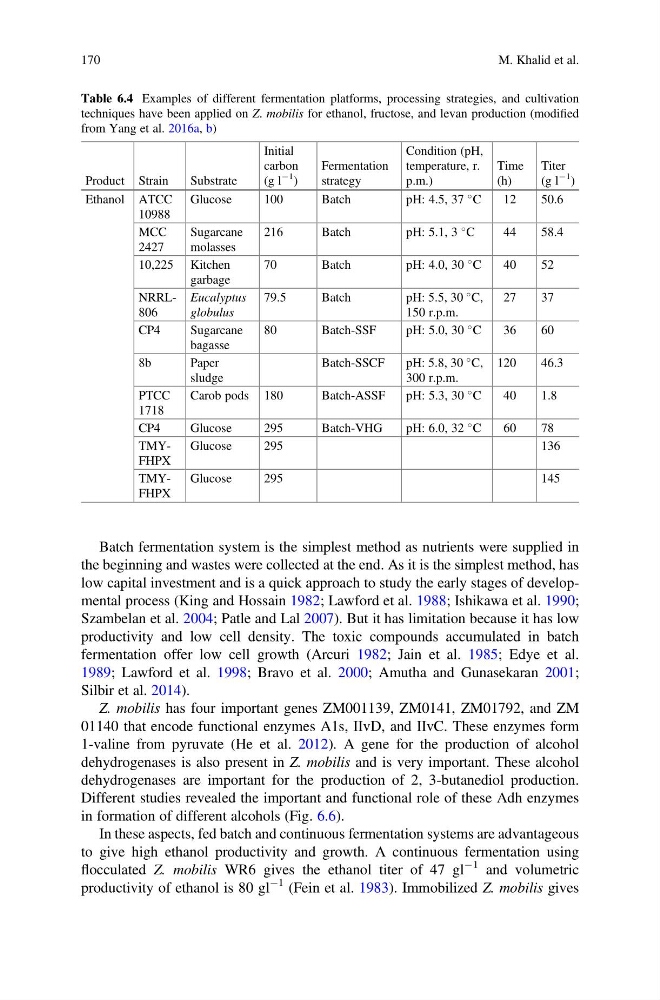
Batch fermentation system is the simplest method as nutrients were supplied in
the beginning and wastes were collected at the end. As it is the simplest method, has
low capital investment and is a quick approach to study the early stages of developmental process (King and Hossain 1982; Lawford et al. 1988; Ishikawa et al. 1990;
Szambelan et al. 2004; Patle and Lal 2007). But it has limitation because it has low
productivity and low cell density. The toxic compounds accumulated in batch
fermentation offer low cell growth (Arcuri 1982; Jain et al. 1985; Edye et al.
1989; Lawford et al. 1998; Bravo et al. 2000; Amutha and Gunasekaran 2001;
Silbir et al. 2014).
Z. mobilis has four important genes ZM001139, ZM0141, ZM01792, and ZM
01140 that encode functional enzymes A1s, IIvD, and IIvC. These enzymes form
1-valine from pyruvate (He et al. 2012). A gene for the production of alcohol
dehydrogenases is also present in Z. mobilis and is very important. These alcohol
dehydrogenases are important for the production of 2, 3-butanediol production.
Different studies revealed the important and functional role of these Adh enzymes
in formation of different alcohols (Fig. 6.6).
In these aspects, fed batch and continuous fermentation systems are advantageous
to give high ethanol productivity and growth. A continuous fermentation using
flocculated Z. mobilis WR6 gives the ethanol titer of 47 gl
À1 and volumetric
productivity of ethanol is 80 gl
À1 (Fein et al. 1983). Immobilized Z. mobilis gives
Table 6.4 Examples of different fermentation platforms, processing strategies, and cultivation
techniques have been applied on Z. mobilis for ethanol, fructose, and levan production (modified
from Yang et al. 2016a, b)
Product Strain
Substrate
Initial
carbon
(g l
À1
)
Fermentation
strategy
Condition (pH,
temperature, r.
p.m.)
Time
(h)
Titer
(g l
À1
)
Ethanol ATCC
10988
Glucose
100
Batch
pH: 4.5, 37
C
12
50.6
MCC
2427
Sugarcane
molasses
216
Batch
pH: 5.1, 3
C
44
58.4
10,225 Kitchen
garbage
70
Batch
pH: 4.0, 30
C
40
52
NRRL806
Eucalyptus
globulus
79.5
Batch
pH: 5.5, 30
C,
150 r.p.m.
27
37
CP4
Sugarcane
bagasse
80
Batch-SSF
pH: 5.0, 30
C
36
60
8b
Paper
sludge
Batch-SSCF
pH: 5.8, 30
C,
300 r.p.m.
120
46.3
PTCC
1718
Carob pods 180
Batch-ASSF
pH: 5.3, 30
C
40
1.8
CP4
Glucose
295
Batch-VHG
pH: 6.0, 32
C
60
78
TMYFHPX
Glucose
295
136
TMYFHPX
Glucose
295
145
170
M. Khalid et al.
the beginning and wastes were collected at the end. As it is the simplest method, has
low capital investment and is a quick approach to study the early stages of developmental process (King and Hossain 1982; Lawford et al. 1988; Ishikawa et al. 1990;
Szambelan et al. 2004; Patle and Lal 2007). But it has limitation because it has low
productivity and low cell density. The toxic compounds accumulated in batch
fermentation offer low cell growth (Arcuri 1982; Jain et al. 1985; Edye et al.
1989; Lawford et al. 1998; Bravo et al. 2000; Amutha and Gunasekaran 2001;
Silbir et al. 2014).
Z. mobilis has four important genes ZM001139, ZM0141, ZM01792, and ZM
01140 that encode functional enzymes A1s, IIvD, and IIvC. These enzymes form
1-valine from pyruvate (He et al. 2012). A gene for the production of alcohol
dehydrogenases is also present in Z. mobilis and is very important. These alcohol
dehydrogenases are important for the production of 2, 3-butanediol production.
Different studies revealed the important and functional role of these Adh enzymes
in formation of different alcohols (Fig. 6.6).
In these aspects, fed batch and continuous fermentation systems are advantageous
to give high ethanol productivity and growth. A continuous fermentation using
flocculated Z. mobilis WR6 gives the ethanol titer of 47 gl
À1 and volumetric
productivity of ethanol is 80 gl
À1 (Fein et al. 1983). Immobilized Z. mobilis gives
Table 6.4 Examples of different fermentation platforms, processing strategies, and cultivation
techniques have been applied on Z. mobilis for ethanol, fructose, and levan production (modified
from Yang et al. 2016a, b)
Product Strain
Substrate
Initial
carbon
(g l
À1
)
Fermentation
strategy
Condition (pH,
temperature, r.
p.m.)
Time
(h)
Titer
(g l
À1
)
Ethanol ATCC
10988
Glucose
100
Batch
pH: 4.5, 37
C
12
50.6
MCC
2427
Sugarcane
molasses
216
Batch
pH: 5.1, 3
C
44
58.4
10,225 Kitchen
garbage
70
Batch
pH: 4.0, 30
C
40
52
NRRL806
Eucalyptus
globulus
79.5
Batch
pH: 5.5, 30
C,
150 r.p.m.
27
37
CP4
Sugarcane
bagasse
80
Batch-SSF
pH: 5.0, 30
C
36
60
8b
Paper
sludge
Batch-SSCF
pH: 5.8, 30
C,
300 r.p.m.
120
46.3
PTCC
1718
Carob pods 180
Batch-ASSF
pH: 5.3, 30
C
40
1.8
CP4
Glucose
295
Batch-VHG
pH: 6.0, 32
C
60
78
TMYFHPX
Glucose
295
136
TMYFHPX
Glucose
295
145
170
M. Khalid et al.