

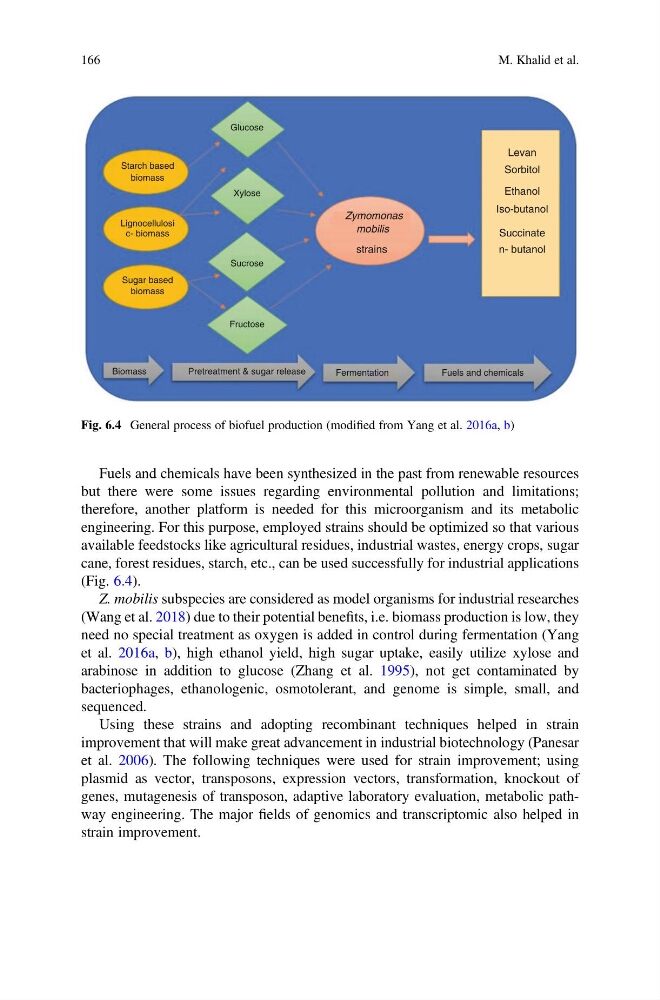
Fuels and chemicals have been synthesized in the past from renewable resources
but there were some issues regarding environmental pollution and limitations;
therefore, another platform is needed for this microorganism and its metabolic
engineering. For this purpose, employed strains should be optimized so that various
available feedstocks like agricultural residues, industrial wastes, energy crops, sugar
cane, forest residues, starch, etc., can be used successfully for industrial applications
(Fig. 6.4).
Z. mobilis subspecies are considered as model organisms for industrial researches
(Wang et al. 2018) due to their potential benefits, i.e. biomass production is low, they
need no special treatment as oxygen is added in control during fermentation (Yang
et al. 2016a, b), high ethanol yield, high sugar uptake, easily utilize xylose and
arabinose in addition to glucose (Zhang et al. 1995), not get contaminated by
bacteriophages, ethanologenic, osmotolerant, and genome is simple, small, and
sequenced.
Using these strains and adopting recombinant techniques helped in strain
improvement that will make great advancement in industrial biotechnology (Panesar
et al. 2006). The following techniques were used for strain improvement; using
plasmid as vector, transposons, expression vectors, transformation, knockout of
genes, mutagenesis of transposon, adaptive laboratory evaluation, metabolic pathway engineering. The major fields of genomics and transcriptomic also helped in
strain improvement.
Glucose
Xylose
Sucrose
Fructose
Starch based
biomass
Lignocellulosi
c- biomass
Sugar based
biomass
Pretreatment & sugar release
Fermentation
Biomass
Fuels and chemicals
Zymomonas
mobilis
strains
Levan
Sorbitol
Ethanol
Iso-butanol
Succinate
n- butanol
Fig. 6.4 General process of biofuel production (modified from Yang et al. 2016a, b)
166
M. Khalid et al.
but there were some issues regarding environmental pollution and limitations;
therefore, another platform is needed for this microorganism and its metabolic
engineering. For this purpose, employed strains should be optimized so that various
available feedstocks like agricultural residues, industrial wastes, energy crops, sugar
cane, forest residues, starch, etc., can be used successfully for industrial applications
(Fig. 6.4).
Z. mobilis subspecies are considered as model organisms for industrial researches
(Wang et al. 2018) due to their potential benefits, i.e. biomass production is low, they
need no special treatment as oxygen is added in control during fermentation (Yang
et al. 2016a, b), high ethanol yield, high sugar uptake, easily utilize xylose and
arabinose in addition to glucose (Zhang et al. 1995), not get contaminated by
bacteriophages, ethanologenic, osmotolerant, and genome is simple, small, and
sequenced.
Using these strains and adopting recombinant techniques helped in strain
improvement that will make great advancement in industrial biotechnology (Panesar
et al. 2006). The following techniques were used for strain improvement; using
plasmid as vector, transposons, expression vectors, transformation, knockout of
genes, mutagenesis of transposon, adaptive laboratory evaluation, metabolic pathway engineering. The major fields of genomics and transcriptomic also helped in
strain improvement.
Glucose
Xylose
Sucrose
Fructose
Starch based
biomass
Lignocellulosi
c- biomass
Sugar based
biomass
Pretreatment & sugar release
Fermentation
Biomass
Fuels and chemicals
Zymomonas
mobilis
strains
Levan
Sorbitol
Ethanol
Iso-butanol
Succinate
n- butanol
Fig. 6.4 General process of biofuel production (modified from Yang et al. 2016a, b)
166
M. Khalid et al.