

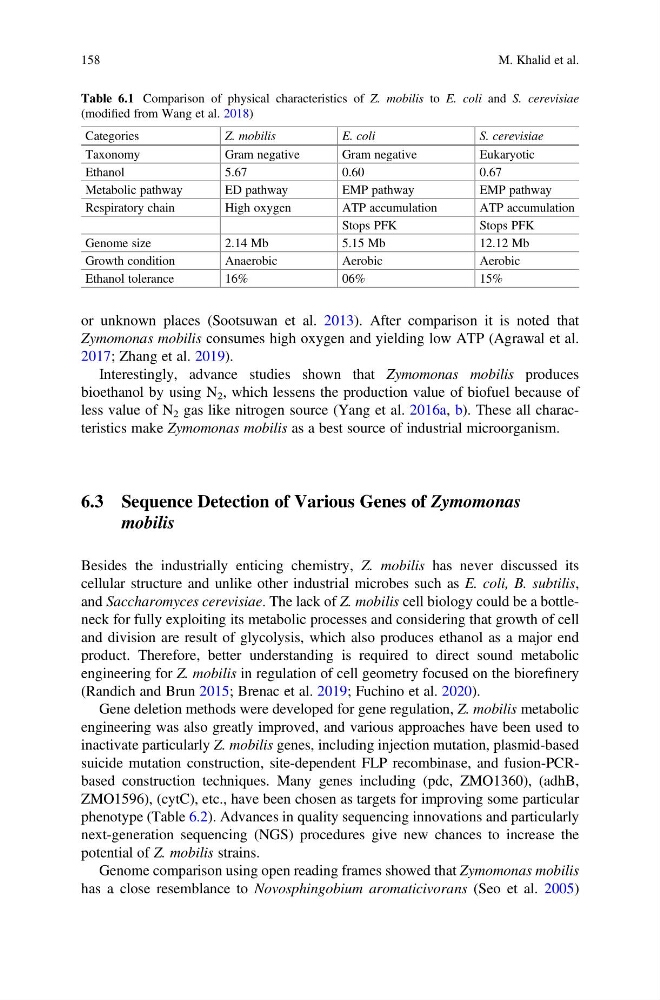
or unknown places (Sootsuwan et al. 2013). After comparison it is noted that
Zymomonas mobilis consumes high oxygen and yielding low ATP (Agrawal et al.
2017; Zhang et al. 2019).
Interestingly, advance studies shown that Zymomonas mobilis produces
bioethanol by using N 2 , which lessens the production value of biofuel because of
less value of N 2 gas like nitrogen source (Yang et al. 2016a, b). These all characteristics make Zymomonas mobilis as a best source of industrial microorganism.
6.3 Sequence Detection of Various Genes of Zymomonas
mobilis
Besides the industrially enticing chemistry, Z. mobilis has never discussed its
cellular structure and unlike other industrial microbes such as E. coli, B. subtilis,
and Saccharomyces cerevisiae. The lack of Z. mobilis cell biology could be a bottleneck for fully exploiting its metabolic processes and considering that growth of cell
and division are result of glycolysis, which also produces ethanol as a major end
product. Therefore, better understanding is required to direct sound metabolic
engineering for Z. mobilis in regulation of cell geometry focused on the biorefinery
(Randich and Brun 2015; Brenac et al. 2019; Fuchino et al. 2020).
Gene deletion methods were developed for gene regulation, Z. mobilis metabolic
engineering was also greatly improved, and various approaches have been used to
inactivate particularly Z. mobilis genes, including injection mutation, plasmid-based
suicide mutation construction, site-dependent FLP recombinase, and fusion-PCRbased construction techniques. Many genes including (pdc, ZMO1360), (adhB,
ZMO1596), (cytC), etc., have been chosen as targets for improving some particular
phenotype (Table 6.2). Advances in quality sequencing innovations and particularly
next-generation sequencing (NGS) procedures give new chances to increase the
potential of Z. mobilis strains.
Genome comparison using open reading frames showed that Zymomonas mobilis
has a close resemblance to Novosphingobium aromaticivorans (Seo et al. 2005)
Table 6.1 Comparison of physical characteristics of Z. mobilis to E. coli and S. cerevisiae
(modified from Wang et al. 2018)
Categories
Z. mobilis
E. coli
S. cerevisiae
Taxonomy
Gram negative
Gram negative
Eukaryotic
Ethanol
5.67
0.60
0.67
Metabolic pathway
ED pathway
EMP pathway
EMP pathway
Respiratory chain
High oxygen
ATP accumulation
ATP accumulation
Stops PFK
Stops PFK
Genome size
2.14 Mb
5.15 Mb
12.12 Mb
Growth condition
Anaerobic
Aerobic
Aerobic
Ethanol tolerance
16%
06%
15%
158
M. Khalid et al.
Zymomonas mobilis consumes high oxygen and yielding low ATP (Agrawal et al.
2017; Zhang et al. 2019).
Interestingly, advance studies shown that Zymomonas mobilis produces
bioethanol by using N 2 , which lessens the production value of biofuel because of
less value of N 2 gas like nitrogen source (Yang et al. 2016a, b). These all characteristics make Zymomonas mobilis as a best source of industrial microorganism.
6.3 Sequence Detection of Various Genes of Zymomonas
mobilis
Besides the industrially enticing chemistry, Z. mobilis has never discussed its
cellular structure and unlike other industrial microbes such as E. coli, B. subtilis,
and Saccharomyces cerevisiae. The lack of Z. mobilis cell biology could be a bottleneck for fully exploiting its metabolic processes and considering that growth of cell
and division are result of glycolysis, which also produces ethanol as a major end
product. Therefore, better understanding is required to direct sound metabolic
engineering for Z. mobilis in regulation of cell geometry focused on the biorefinery
(Randich and Brun 2015; Brenac et al. 2019; Fuchino et al. 2020).
Gene deletion methods were developed for gene regulation, Z. mobilis metabolic
engineering was also greatly improved, and various approaches have been used to
inactivate particularly Z. mobilis genes, including injection mutation, plasmid-based
suicide mutation construction, site-dependent FLP recombinase, and fusion-PCRbased construction techniques. Many genes including (pdc, ZMO1360), (adhB,
ZMO1596), (cytC), etc., have been chosen as targets for improving some particular
phenotype (Table 6.2). Advances in quality sequencing innovations and particularly
next-generation sequencing (NGS) procedures give new chances to increase the
potential of Z. mobilis strains.
Genome comparison using open reading frames showed that Zymomonas mobilis
has a close resemblance to Novosphingobium aromaticivorans (Seo et al. 2005)
Table 6.1 Comparison of physical characteristics of Z. mobilis to E. coli and S. cerevisiae
(modified from Wang et al. 2018)
Categories
Z. mobilis
E. coli
S. cerevisiae
Taxonomy
Gram negative
Gram negative
Eukaryotic
Ethanol
5.67
0.60
0.67
Metabolic pathway
ED pathway
EMP pathway
EMP pathway
Respiratory chain
High oxygen
ATP accumulation
ATP accumulation
Stops PFK
Stops PFK
Genome size
2.14 Mb
5.15 Mb
12.12 Mb
Growth condition
Anaerobic
Aerobic
Aerobic
Ethanol tolerance
16%
06%
15%
158
M. Khalid et al.