

6.1 Introduction
Fuel ethanol is recently produced from sugar-based feedstock, which is known as
first generation (1G) biofuel. Due to expanding population, there is competition
between food and first generation biofuel, so alternative sources are much needed for
the production of biofuels. Basic consequences of 1G biofuel production on eatable
things protection have continued throughout the centuries (de Andrade Ramos et al.
2016). Many of the lignocellulosic biomass, especially crops debris is not related to
food and mostly accessible, and it shows an acceptable source material for producing
second generation (2G) biofuel (Gupta and Verma 2015).
Microbial strains are the hallmarks of biofuel production. Some strains of Saccharomyces cerevisiae are very efficient in utilization of starch based sugars for the
production of biofuel while cellulosic based sugars yield low productivity due to
fermentation inhibitors (Andre et al. 2016; Gombert and van Maris 2015).
The xylulose converted into xylulose 5-phosphate by Saccharomyces cerevisiae
an intermediary of pentose phosphate pathway that is able to form G3P for biofuel
production by glycolysis mechanism. The Saccharomyces cerevisiae can be
established by xylose mechanism by the uses of many genes that are encoding
enzymes in microorganisms which use pentose, e.g. Acetobacter aceti (Seo et al.
2017), as well as overexpression of xylulokinase, to stabilize hexose and pentose
sugar to produce bioethanol. The heterologous pathway constructed from various
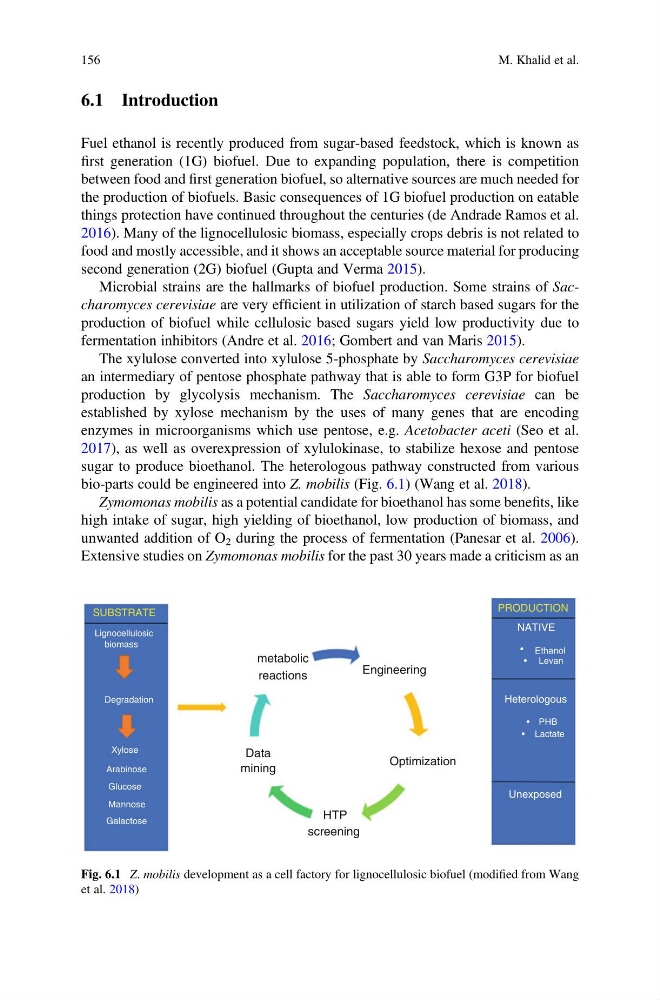
bio-parts could be engineered into Z. mobilis (Fig. 6.1) (Wang et al. 2018).
Zymomonas mobilis as a potential candidate for bioethanol has some benefits, like
high intake of sugar, high yielding of bioethanol, low production of biomass, and
unwanted addition of O 2 during the process of fermentation (Panesar et al. 2006).
Extensive studies on Zymomonas mobilis for the past 30 years made a criticism as an
metabolic
reactions
Data
mining
Engineering
NATIVE
Ethanol
•
•
•
•
Levan
Heterologous
PHB
Lactate
Unexposed
Optimization
HTP
screening
SUBSTRATE
PRODUCTION
Lignocellulosic
biomass
Degradation
Xylose
Arabinose
Glucose
Mannose
Galactose
Fig. 6.1 Z. mobilis development as a cell factory for lignocellulosic biofuel (modified from Wang
et al. 2018)
156
M. Khalid et al.
Fuel ethanol is recently produced from sugar-based feedstock, which is known as
first generation (1G) biofuel. Due to expanding population, there is competition
between food and first generation biofuel, so alternative sources are much needed for
the production of biofuels. Basic consequences of 1G biofuel production on eatable
things protection have continued throughout the centuries (de Andrade Ramos et al.
2016). Many of the lignocellulosic biomass, especially crops debris is not related to
food and mostly accessible, and it shows an acceptable source material for producing
second generation (2G) biofuel (Gupta and Verma 2015).
Microbial strains are the hallmarks of biofuel production. Some strains of Saccharomyces cerevisiae are very efficient in utilization of starch based sugars for the
production of biofuel while cellulosic based sugars yield low productivity due to
fermentation inhibitors (Andre et al. 2016; Gombert and van Maris 2015).
The xylulose converted into xylulose 5-phosphate by Saccharomyces cerevisiae
an intermediary of pentose phosphate pathway that is able to form G3P for biofuel
production by glycolysis mechanism. The Saccharomyces cerevisiae can be
established by xylose mechanism by the uses of many genes that are encoding
enzymes in microorganisms which use pentose, e.g. Acetobacter aceti (Seo et al.
2017), as well as overexpression of xylulokinase, to stabilize hexose and pentose
sugar to produce bioethanol. The heterologous pathway constructed from various
bio-parts could be engineered into Z. mobilis (Fig. 6.1) (Wang et al. 2018).
Zymomonas mobilis as a potential candidate for bioethanol has some benefits, like
high intake of sugar, high yielding of bioethanol, low production of biomass, and
unwanted addition of O 2 during the process of fermentation (Panesar et al. 2006).
Extensive studies on Zymomonas mobilis for the past 30 years made a criticism as an
metabolic
reactions
Data
mining
Engineering
NATIVE
Ethanol
•
•
•
•
Levan
Heterologous
PHB
Lactate
Unexposed
Optimization
HTP
screening
SUBSTRATE
PRODUCTION
Lignocellulosic
biomass
Degradation
Xylose
Arabinose
Glucose
Mannose
Galactose
Fig. 6.1 Z. mobilis development as a cell factory for lignocellulosic biofuel (modified from Wang
et al. 2018)
156
M. Khalid et al.