

Theoretically, hexoses can be transformed into HMF by a reaction involving
three steps as illustrated in Fig. 5.9:
Step 1: hydrolysis of any polymer which is glucose-based (which may be starch or
cellulose) into glucose (Bronsted acid catalyzes this reaction).
Step 2: conversion of glucose to fructose (Lewis acid catalyzes this reaction).
Step 3: loss of water molecules by fructose and conversion to HMF carried out by
Bronsted acid (Menegazzo et al. 2018).
The mechanism of the procedure is depicted by in Fig. 5.9 (Ranoux et al. 2013).
Studies have shown that furfural along with acetate and phenolic compounds is
the major inhibitory compound, observed in the pretreatment of corn stover hydrolysate for Z. mobilis in dilute acid pretreatment. And the inhibitory activity is related
to the hydrophobic nature of these inhibitors (Yang et al. 2018).
Table 5.2 Pretreatment strategies and inhibitors formation (Abraham et al. 2020; Harmsen et al.
2010; Ravindran and Jaiswal 2016)
Pretreatment
Mode of action
Inhibitors
formation
Mechanical
method
• Cutback in the sizes of particles linked with surface area
increase
+
Dilute acid
pretreatment
• Increase in the pore sizes/volumes of plant cell walls
• Significant redistribution and disruption of lignin
• Nearly complete removal of hemicelluloses
_
Alkaline hot water • Expansion in size of pores in plant material
• Removing hemicelluloses and depolymerization of lignin
• Preserving most of the cellulose
_
Alkali
• Increase in the central surface area due to blistering of
cellulose
• Eradication of lignin
• Substitution of uronic acid on hemicelluloses and acetyl
groups removal
++
SO2-catalyzed
steam explosion
• Partial lignin transformation and lignocellulose removal
• Pore size and volume expansion
• Particle size reduction linked with increase in surface area
+
Organosolv
• Increment of approachable surface area and pore volume
• Significant removal of hemicelluloses and lignin
++
AFEX
• Ammonolysis of lignin carbohydrate solubilization formation of nanoporous, and ester linkages formation relocation
of cell wall, interconnected networks
++
+ ¼ positive characteristic: low fermentation inhibitors; À ¼ negative characteristic: high amount of
fermentation inhibitors.
O
OH
O
HMF
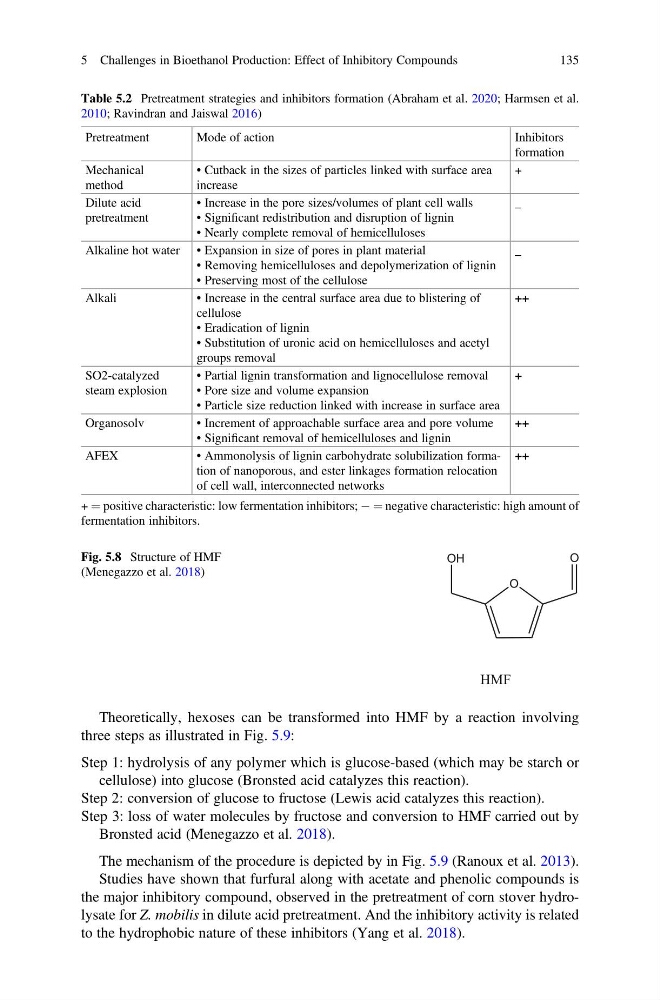
Fig. 5.8 Structure of HMF
(Menegazzo et al. 2018)
5 Challenges in Bioethanol Production: Effect of Inhibitory Compounds
135
three steps as illustrated in Fig. 5.9:
Step 1: hydrolysis of any polymer which is glucose-based (which may be starch or
cellulose) into glucose (Bronsted acid catalyzes this reaction).
Step 2: conversion of glucose to fructose (Lewis acid catalyzes this reaction).
Step 3: loss of water molecules by fructose and conversion to HMF carried out by
Bronsted acid (Menegazzo et al. 2018).
The mechanism of the procedure is depicted by in Fig. 5.9 (Ranoux et al. 2013).
Studies have shown that furfural along with acetate and phenolic compounds is
the major inhibitory compound, observed in the pretreatment of corn stover hydrolysate for Z. mobilis in dilute acid pretreatment. And the inhibitory activity is related
to the hydrophobic nature of these inhibitors (Yang et al. 2018).
Table 5.2 Pretreatment strategies and inhibitors formation (Abraham et al. 2020; Harmsen et al.
2010; Ravindran and Jaiswal 2016)
Pretreatment
Mode of action
Inhibitors
formation
Mechanical
method
• Cutback in the sizes of particles linked with surface area
increase
+
Dilute acid
pretreatment
• Increase in the pore sizes/volumes of plant cell walls
• Significant redistribution and disruption of lignin
• Nearly complete removal of hemicelluloses
_
Alkaline hot water • Expansion in size of pores in plant material
• Removing hemicelluloses and depolymerization of lignin
• Preserving most of the cellulose
_
Alkali
• Increase in the central surface area due to blistering of
cellulose
• Eradication of lignin
• Substitution of uronic acid on hemicelluloses and acetyl
groups removal
++
SO2-catalyzed
steam explosion
• Partial lignin transformation and lignocellulose removal
• Pore size and volume expansion
• Particle size reduction linked with increase in surface area
+
Organosolv
• Increment of approachable surface area and pore volume
• Significant removal of hemicelluloses and lignin
++
AFEX
• Ammonolysis of lignin carbohydrate solubilization formation of nanoporous, and ester linkages formation relocation
of cell wall, interconnected networks
++
+ ¼ positive characteristic: low fermentation inhibitors; À ¼ negative characteristic: high amount of
fermentation inhibitors.
O
OH
O
HMF
Fig. 5.8 Structure of HMF
(Menegazzo et al. 2018)
5 Challenges in Bioethanol Production: Effect of Inhibitory Compounds
135