

before use of fossil fuels in combination with restricted fossil fuel supplies and
inconsistent prices caused by unpredictable political uncertainty, significant attention has recently been paid to alternative renewable energy sources (Sarkar and
Shimizu 2015). As substitutes for transportation fuels derived from petroleum,
alternative options are attracting growing worldwide prominence to help address
oil costs, climate efficiency, and global warming issues related to fossil fuels. Often
the word biofuel is used to describe any fluid fuel derived from plant resource that
could be used as a replacement for fuel derived from petroleum. Biofuels may
include pretty common fuels, such as ethanol from sugarcane or soya oil which is
diesel-like, to less acquainted fuels some of them are dimethyl ether (DME) or
Fischer-Tropsch liquids (FTL) produced from biomass of lignocellulosic origin
(Callegari et al. 2020; Faiz et al. 1996). Biomass provides a variety of biofuels,
such as butanol, ethanol, biodiesel, methanol, renewable diesel, methane, and syngas
(Bharathiraja et al. 2017; Oluyede and Phillips 2007). FAO defines biofuels as “Fuel
[s] produced directly or indirectly from biomass” while Biomass: “Biologically
derived material except material found in geological formations and are transformed
to fossil (FAO 2004).” Various physical and chemical properties of biofuels in
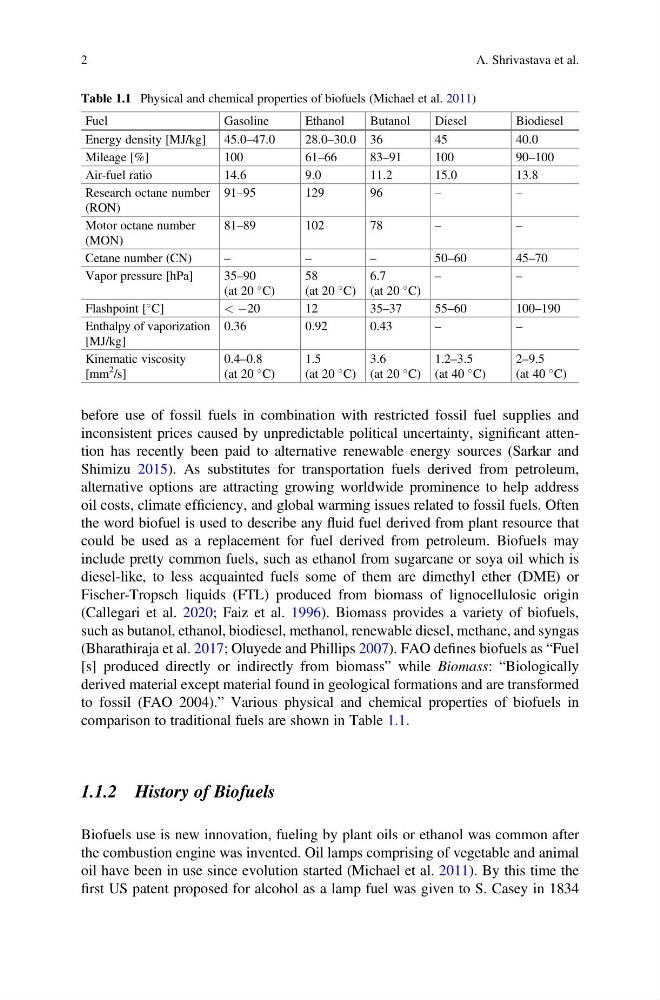
comparison to traditional fuels are shown in Table 1.1.
1.1.2 History of Biofuels
Biofuels use is new innovation, fueling by plant oils or ethanol was common after
the combustion engine was invented. Oil lamps comprising of vegetable and animal
oil have been in use since evolution started (Michael et al. 2011). By this time the
first US patent proposed for alcohol as a lamp fuel was given to S. Casey in 1834
Table 1.1 Physical and chemical properties of biofuels (Michael et al. 2011)
Fuel
Gasoline
Ethanol
Butanol
Diesel
Biodiesel
Energy density [MJ/kg] 45.0–47.0
28.0–30.0 36
45
40.0
Mileage [%]
100
61–66
83–91
100
90–100
Air-fuel ratio
14.6
9.0
11.2
15.0
13.8
Research octane number
(RON)
91–95
129
96
–
–
Motor octane number
(MON)
81–89
102
78
–
–
Cetane number (CN)
–
–
–
50–60
45–70
Vapor pressure [hPa]
35–90
(at 20
C)
58
(at 20
C)
6.7
(at 20
C)
–
–
Flashpoint [
C]
< À20
12
35–37
55–60
100–190
Enthalpy of vaporization
[MJ/kg]
0.36
0.92
0.43
–
–
Kinematic viscosity
[mm
2
/s]
0.4–0.8
(at 20
C)
1.5
(at 20
C)
3.6
(at 20
C)
1.2–3.5
(at 40
C)
2–9.5
(at 40
C)
2
A. Shrivastava et al.
inconsistent prices caused by unpredictable political uncertainty, significant attention has recently been paid to alternative renewable energy sources (Sarkar and
Shimizu 2015). As substitutes for transportation fuels derived from petroleum,
alternative options are attracting growing worldwide prominence to help address
oil costs, climate efficiency, and global warming issues related to fossil fuels. Often
the word biofuel is used to describe any fluid fuel derived from plant resource that
could be used as a replacement for fuel derived from petroleum. Biofuels may
include pretty common fuels, such as ethanol from sugarcane or soya oil which is
diesel-like, to less acquainted fuels some of them are dimethyl ether (DME) or
Fischer-Tropsch liquids (FTL) produced from biomass of lignocellulosic origin
(Callegari et al. 2020; Faiz et al. 1996). Biomass provides a variety of biofuels,
such as butanol, ethanol, biodiesel, methanol, renewable diesel, methane, and syngas
(Bharathiraja et al. 2017; Oluyede and Phillips 2007). FAO defines biofuels as “Fuel
[s] produced directly or indirectly from biomass” while Biomass: “Biologically
derived material except material found in geological formations and are transformed
to fossil (FAO 2004).” Various physical and chemical properties of biofuels in
comparison to traditional fuels are shown in Table 1.1.
1.1.2 History of Biofuels
Biofuels use is new innovation, fueling by plant oils or ethanol was common after
the combustion engine was invented. Oil lamps comprising of vegetable and animal
oil have been in use since evolution started (Michael et al. 2011). By this time the
first US patent proposed for alcohol as a lamp fuel was given to S. Casey in 1834
Table 1.1 Physical and chemical properties of biofuels (Michael et al. 2011)
Fuel
Gasoline
Ethanol
Butanol
Diesel
Biodiesel
Energy density [MJ/kg] 45.0–47.0
28.0–30.0 36
45
40.0
Mileage [%]
100
61–66
83–91
100
90–100
Air-fuel ratio
14.6
9.0
11.2
15.0
13.8
Research octane number
(RON)
91–95
129
96
–
–
Motor octane number
(MON)
81–89
102
78
–
–
Cetane number (CN)
–
–
–
50–60
45–70
Vapor pressure [hPa]
35–90
(at 20
C)
58
(at 20
C)
6.7
(at 20
C)
–
–
Flashpoint [
C]
< À20
12
35–37
55–60
100–190
Enthalpy of vaporization
[MJ/kg]
0.36
0.92
0.43
–
–
Kinematic viscosity
[mm
2
/s]
0.4–0.8
(at 20
C)
1.5
(at 20
C)
3.6
(at 20
C)
1.2–3.5
(at 40
C)
2–9.5
(at 40
C)
2
A. Shrivastava et al.