

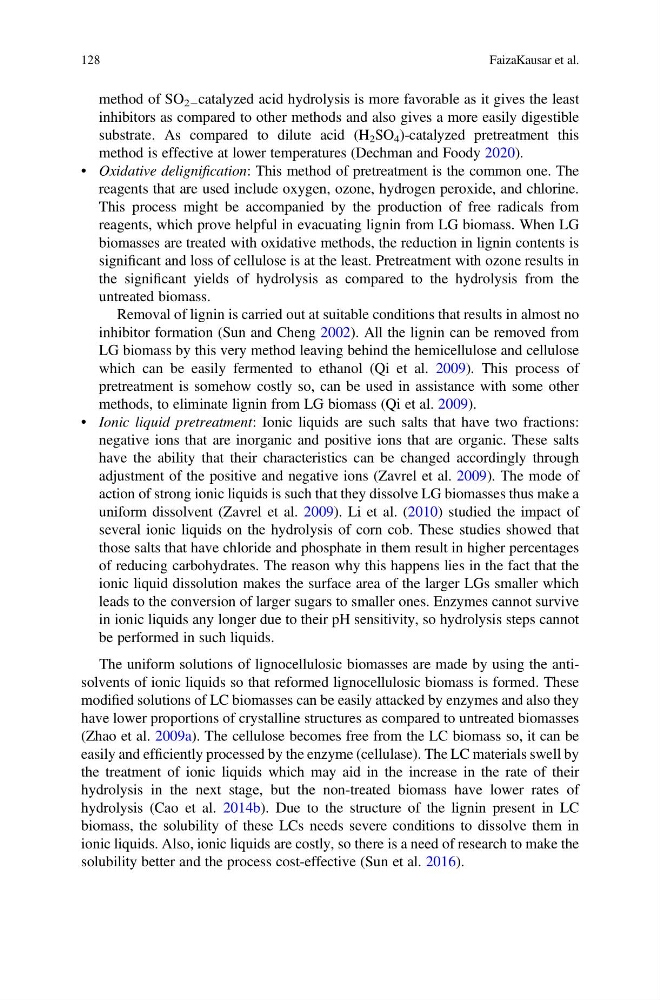
method of SO 2À catalyzed acid hydrolysis is more favorable as it gives the least
inhibitors as compared to other methods and also gives a more easily digestible
substrate. As compared to dilute acid (H 2 SO 4 )-catalyzed pretreatment this
method is effective at lower temperatures (Dechman and Foody 2020).
• Oxidative delignification: This method of pretreatment is the common one. The
reagents that are used include oxygen, ozone, hydrogen peroxide, and chlorine.
This process might be accompanied by the production of free radicals from
reagents, which prove helpful in evacuating lignin from LG biomass. When LG
biomasses are treated with oxidative methods, the reduction in lignin contents is
significant and loss of cellulose is at the least. Pretreatment with ozone results in
the significant yields of hydrolysis as compared to the hydrolysis from the
untreated biomass.
Removal of lignin is carried out at suitable conditions that results in almost no
inhibitor formation (Sun and Cheng 2002). All the lignin can be removed from
LG biomass by this very method leaving behind the hemicellulose and cellulose
which can be easily fermented to ethanol (Qi et al. 2009). This process of
pretreatment is somehow costly so, can be used in assistance with some other
methods, to eliminate lignin from LG biomass (Qi et al. 2009).
• Ionic liquid pretreatment: Ionic liquids are such salts that have two fractions:
negative ions that are inorganic and positive ions that are organic. These salts
have the ability that their characteristics can be changed accordingly through
adjustment of the positive and negative ions (Zavrel et al. 2009). The mode of
action of strong ionic liquids is such that they dissolve LG biomasses thus make a
uniform dissolvent (Zavrel et al. 2009). Li et al. (2010) studied the impact of
several ionic liquids on the hydrolysis of corn cob. These studies showed that
those salts that have chloride and phosphate in them result in higher percentages
of reducing carbohydrates. The reason why this happens lies in the fact that the
ionic liquid dissolution makes the surface area of the larger LGs smaller which
leads to the conversion of larger sugars to smaller ones. Enzymes cannot survive
in ionic liquids any longer due to their pH sensitivity, so hydrolysis steps cannot
be performed in such liquids.
The uniform solutions of lignocellulosic biomasses are made by using the antisolvents of ionic liquids so that reformed lignocellulosic biomass is formed. These
modified solutions of LC biomasses can be easily attacked by enzymes and also they
have lower proportions of crystalline structures as compared to untreated biomasses
(Zhao et al. 2009a). The cellulose becomes free from the LC biomass so, it can be
easily and efficiently processed by the enzyme (cellulase). The LC materials swell by
the treatment of ionic liquids which may aid in the increase in the rate of their
hydrolysis in the next stage, but the non-treated biomass have lower rates of
hydrolysis (Cao et al. 2014b). Due to the structure of the lignin present in LC
biomass, the solubility of these LCs needs severe conditions to dissolve them in
ionic liquids. Also, ionic liquids are costly, so there is a need of research to make the
solubility better and the process cost-effective (Sun et al. 2016).
128
FaizaKausar et al.
inhibitors as compared to other methods and also gives a more easily digestible
substrate. As compared to dilute acid (H 2 SO 4 )-catalyzed pretreatment this
method is effective at lower temperatures (Dechman and Foody 2020).
• Oxidative delignification: This method of pretreatment is the common one. The
reagents that are used include oxygen, ozone, hydrogen peroxide, and chlorine.
This process might be accompanied by the production of free radicals from
reagents, which prove helpful in evacuating lignin from LG biomass. When LG
biomasses are treated with oxidative methods, the reduction in lignin contents is
significant and loss of cellulose is at the least. Pretreatment with ozone results in
the significant yields of hydrolysis as compared to the hydrolysis from the
untreated biomass.
Removal of lignin is carried out at suitable conditions that results in almost no
inhibitor formation (Sun and Cheng 2002). All the lignin can be removed from
LG biomass by this very method leaving behind the hemicellulose and cellulose
which can be easily fermented to ethanol (Qi et al. 2009). This process of
pretreatment is somehow costly so, can be used in assistance with some other
methods, to eliminate lignin from LG biomass (Qi et al. 2009).
• Ionic liquid pretreatment: Ionic liquids are such salts that have two fractions:
negative ions that are inorganic and positive ions that are organic. These salts
have the ability that their characteristics can be changed accordingly through
adjustment of the positive and negative ions (Zavrel et al. 2009). The mode of
action of strong ionic liquids is such that they dissolve LG biomasses thus make a
uniform dissolvent (Zavrel et al. 2009). Li et al. (2010) studied the impact of
several ionic liquids on the hydrolysis of corn cob. These studies showed that
those salts that have chloride and phosphate in them result in higher percentages
of reducing carbohydrates. The reason why this happens lies in the fact that the
ionic liquid dissolution makes the surface area of the larger LGs smaller which
leads to the conversion of larger sugars to smaller ones. Enzymes cannot survive
in ionic liquids any longer due to their pH sensitivity, so hydrolysis steps cannot
be performed in such liquids.
The uniform solutions of lignocellulosic biomasses are made by using the antisolvents of ionic liquids so that reformed lignocellulosic biomass is formed. These
modified solutions of LC biomasses can be easily attacked by enzymes and also they
have lower proportions of crystalline structures as compared to untreated biomasses
(Zhao et al. 2009a). The cellulose becomes free from the LC biomass so, it can be
easily and efficiently processed by the enzyme (cellulase). The LC materials swell by
the treatment of ionic liquids which may aid in the increase in the rate of their
hydrolysis in the next stage, but the non-treated biomass have lower rates of
hydrolysis (Cao et al. 2014b). Due to the structure of the lignin present in LC
biomass, the solubility of these LCs needs severe conditions to dissolve them in
ionic liquids. Also, ionic liquids are costly, so there is a need of research to make the
solubility better and the process cost-effective (Sun et al. 2016).
128
FaizaKausar et al.