

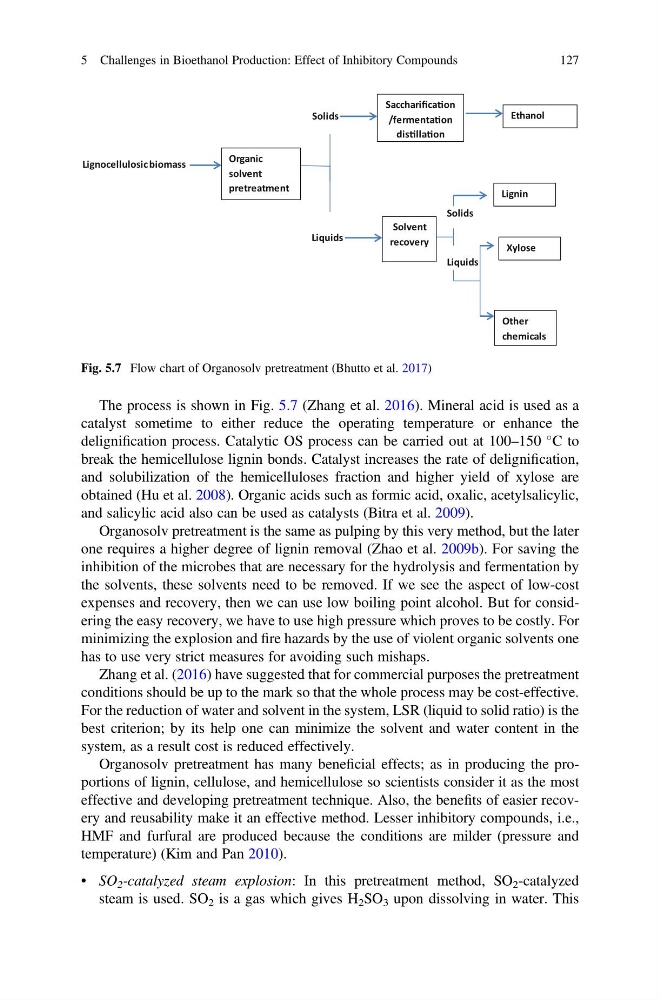
The process is shown in Fig. 5.7 (Zhang et al. 2016). Mineral acid is used as a
catalyst sometime to either reduce the operating temperature or enhance the
delignification process. Catalytic OS process can be carried out at 100–150
C to
break the hemicellulose lignin bonds. Catalyst increases the rate of delignification,
and solubilization of the hemicelluloses fraction and higher yield of xylose are
obtained (Hu et al. 2008). Organic acids such as formic acid, oxalic, acetylsalicylic,
and salicylic acid also can be used as catalysts (Bitra et al. 2009).
Organosolv pretreatment is the same as pulping by this very method, but the later
one requires a higher degree of lignin removal (Zhao et al. 2009b). For saving the
inhibition of the microbes that are necessary for the hydrolysis and fermentation by
the solvents, these solvents need to be removed. If we see the aspect of low-cost
expenses and recovery, then we can use low boiling point alcohol. But for considering the easy recovery, we have to use high pressure which proves to be costly. For
minimizing the explosion and fire hazards by the use of violent organic solvents one
has to use very strict measures for avoiding such mishaps.
Zhang et al. (2016) have suggested that for commercial purposes the pretreatment
conditions should be up to the mark so that the whole process may be cost-effective.
For the reduction of water and solvent in the system, LSR (liquid to solid ratio) is the
best criterion; by its help one can minimize the solvent and water content in the
system, as a result cost is reduced effectively.
Organosolv pretreatment has many beneficial effects; as in producing the proportions of lignin, cellulose, and hemicellulose so scientists consider it as the most
effective and developing pretreatment technique. Also, the benefits of easier recovery and reusability make it an effective method. Lesser inhibitory compounds, i.e.,
HMF and furfural are produced because the conditions are milder (pressure and
temperature) (Kim and Pan 2010).
• SO 2 -catalyzed steam explosion: In this pretreatment method, SO 2 -catalyzed
steam is used. SO 2 is a gas which gives H 2 SO 3 upon dissolving in water. This
Solids
Lignocellulosic biomass
Solids
Liquids
Liquids
Organic
solvent
pretreatment
SaccharificaƟon
/fermentaƟon
disƟllaƟon
Solvent
recovery
Other
chemicals
Ethanol
Lignin
Xylose
Fig. 5.7 Flow chart of Organosolv pretreatment (Bhutto et al. 2017)
5 Challenges in Bioethanol Production: Effect of Inhibitory Compounds
127
catalyst sometime to either reduce the operating temperature or enhance the
delignification process. Catalytic OS process can be carried out at 100–150
C to
break the hemicellulose lignin bonds. Catalyst increases the rate of delignification,
and solubilization of the hemicelluloses fraction and higher yield of xylose are
obtained (Hu et al. 2008). Organic acids such as formic acid, oxalic, acetylsalicylic,
and salicylic acid also can be used as catalysts (Bitra et al. 2009).
Organosolv pretreatment is the same as pulping by this very method, but the later
one requires a higher degree of lignin removal (Zhao et al. 2009b). For saving the
inhibition of the microbes that are necessary for the hydrolysis and fermentation by
the solvents, these solvents need to be removed. If we see the aspect of low-cost
expenses and recovery, then we can use low boiling point alcohol. But for considering the easy recovery, we have to use high pressure which proves to be costly. For
minimizing the explosion and fire hazards by the use of violent organic solvents one
has to use very strict measures for avoiding such mishaps.
Zhang et al. (2016) have suggested that for commercial purposes the pretreatment
conditions should be up to the mark so that the whole process may be cost-effective.
For the reduction of water and solvent in the system, LSR (liquid to solid ratio) is the
best criterion; by its help one can minimize the solvent and water content in the
system, as a result cost is reduced effectively.
Organosolv pretreatment has many beneficial effects; as in producing the proportions of lignin, cellulose, and hemicellulose so scientists consider it as the most
effective and developing pretreatment technique. Also, the benefits of easier recovery and reusability make it an effective method. Lesser inhibitory compounds, i.e.,
HMF and furfural are produced because the conditions are milder (pressure and
temperature) (Kim and Pan 2010).
• SO 2 -catalyzed steam explosion: In this pretreatment method, SO 2 -catalyzed
steam is used. SO 2 is a gas which gives H 2 SO 3 upon dissolving in water. This
Solids
Lignocellulosic biomass
Solids
Liquids
Liquids
Organic
solvent
pretreatment
SaccharificaƟon
/fermentaƟon
disƟllaƟon
Solvent
recovery
Other
chemicals
Ethanol
Lignin
Xylose
Fig. 5.7 Flow chart of Organosolv pretreatment (Bhutto et al. 2017)
5 Challenges in Bioethanol Production: Effect of Inhibitory Compounds
127