

for the bioconversion of lignocellulosic materials into various helpful bioenergy
products (e.g., bioethanol, lactic acid, microbial polysaccharides). The non-specific
nature of these ligninolytic enzymes not only degrades lignin but also oxidizes the
compounds of the lignin type, such as phenolic compounds, PAHs, and pesticides.
Industrial and environmental applications of LMEs and WRF have been extensively
reported in recent reviews. But it was also identified that very few recent research
reports are available on how to interact with this WRF with xenobiotic compounds.
Hence, the current chapter analyzed the effect of various pollutants on the growth
and production of ligninolytic enzymes (LE) by WRF and also analyzed the intern
action of WRF in the degradation of xenobiotics. All the above studies concluded
that different kinds of xenobiotic compounds influence the growth and secretion of
LE by WRF depending upon the concentrations of residues. From the above
references, it was noticed that at a lower concentration of xenobiotics treatment
shows enhanced both biomass and secretion of LMEs in WRF. It was also identified
that at higher concentrations of xenobiotics treatments inhibit the growth as well as
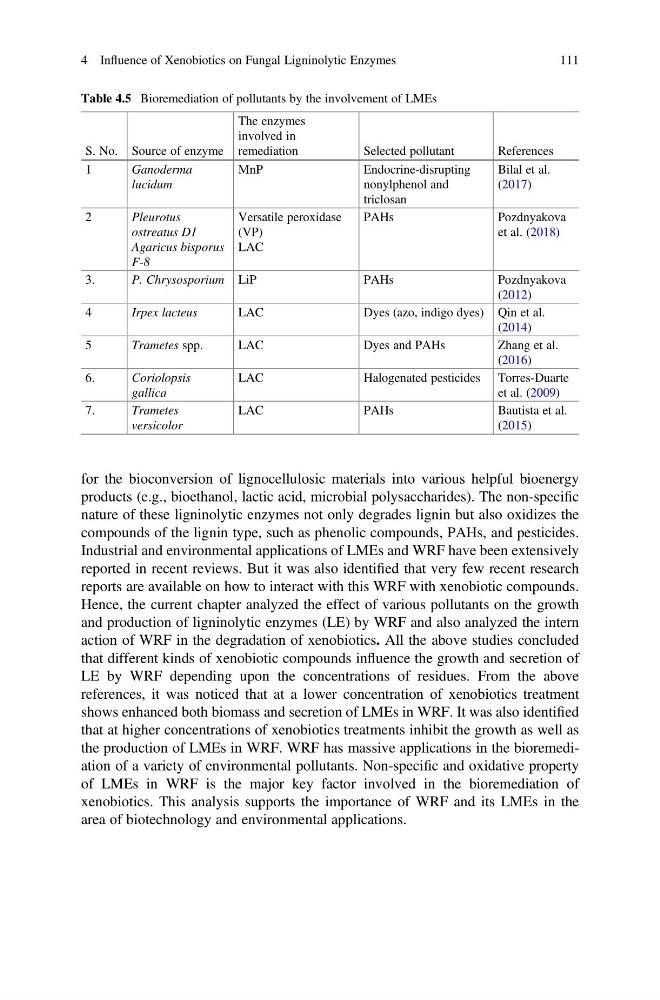
the production of LMEs in WRF. WRF has massive applications in the bioremediation of a variety of environmental pollutants. Non-specific and oxidative property
of LMEs in WRF is the major key factor involved in the bioremediation of
xenobiotics. This analysis supports the importance of WRF and its LMEs in the
area of biotechnology and environmental applications.
Table 4.5 Bioremediation of pollutants by the involvement of LMEs
S. No. Source of enzyme
The enzymes
involved in
remediation
Selected pollutant
References
1
Ganoderma
lucidum
MnP
Endocrine-disrupting
nonylphenol and
triclosan
Bilal et al.
(2017)
2
Pleurotus
ostreatus D1
Agaricus bisporus
F-8
Versatile peroxidase
(VP)
LAC
PAHs
Pozdnyakova
et al. (2018)
3.
P. Chrysosporium LiP
PAHs
Pozdnyakova
(2012)
4
Irpex lacteus
LAC
Dyes (azo, indigo dyes) Qin et al.
(2014)
5
Trametes spp.
LAC
Dyes and PAHs
Zhang et al.
(2016)
6.
Coriolopsis
gallica
LAC
Halogenated pesticides Torres-Duarte
et al. (2009)
7.
Trametes
versicolor
LAC
PAHs
Bautista et al.
(2015)
4 Influence of Xenobiotics on Fungal Ligninolytic Enzymes
111
products (e.g., bioethanol, lactic acid, microbial polysaccharides). The non-specific
nature of these ligninolytic enzymes not only degrades lignin but also oxidizes the
compounds of the lignin type, such as phenolic compounds, PAHs, and pesticides.
Industrial and environmental applications of LMEs and WRF have been extensively
reported in recent reviews. But it was also identified that very few recent research
reports are available on how to interact with this WRF with xenobiotic compounds.
Hence, the current chapter analyzed the effect of various pollutants on the growth
and production of ligninolytic enzymes (LE) by WRF and also analyzed the intern
action of WRF in the degradation of xenobiotics. All the above studies concluded
that different kinds of xenobiotic compounds influence the growth and secretion of
LE by WRF depending upon the concentrations of residues. From the above
references, it was noticed that at a lower concentration of xenobiotics treatment
shows enhanced both biomass and secretion of LMEs in WRF. It was also identified
that at higher concentrations of xenobiotics treatments inhibit the growth as well as
the production of LMEs in WRF. WRF has massive applications in the bioremediation of a variety of environmental pollutants. Non-specific and oxidative property
of LMEs in WRF is the major key factor involved in the bioremediation of
xenobiotics. This analysis supports the importance of WRF and its LMEs in the
area of biotechnology and environmental applications.
Table 4.5 Bioremediation of pollutants by the involvement of LMEs
S. No. Source of enzyme
The enzymes
involved in
remediation
Selected pollutant
References
1
Ganoderma
lucidum
MnP
Endocrine-disrupting
nonylphenol and
triclosan
Bilal et al.
(2017)
2
Pleurotus
ostreatus D1
Agaricus bisporus
F-8
Versatile peroxidase
(VP)
LAC
PAHs
Pozdnyakova
et al. (2018)
3.
P. Chrysosporium LiP
PAHs
Pozdnyakova
(2012)
4
Irpex lacteus
LAC
Dyes (azo, indigo dyes) Qin et al.
(2014)
5
Trametes spp.
LAC
Dyes and PAHs
Zhang et al.
(2016)
6.
Coriolopsis
gallica
LAC
Halogenated pesticides Torres-Duarte
et al. (2009)
7.
Trametes
versicolor
LAC
PAHs
Bautista et al.
(2015)
4 Influence of Xenobiotics on Fungal Ligninolytic Enzymes
111