

4.3.8 Effect of Fluorene
Ligninolytic enzymes laccase and MnP occurred to the extent of 138 and 44 U/L in
the culture broth of Polyporus sp. have grown on fluorene in the presence of
surfactant-Tween 80, respectively (Lazim and Hadibarata 2016).
4.3.9 Effect of Dyes
Textile industry effluents—a dynamic combination of chemicals, among which
colorants (Dyes) are of special concern—impose major ecological challenges.
Moreover, various dyes have shown to be carcinogenic and mutagenic effects
(Weisburger 2002). Azo dyes polluted with wastewater have shown to be either
toxic or maybe biologically transformed into hazardous or carcinogenic compounds
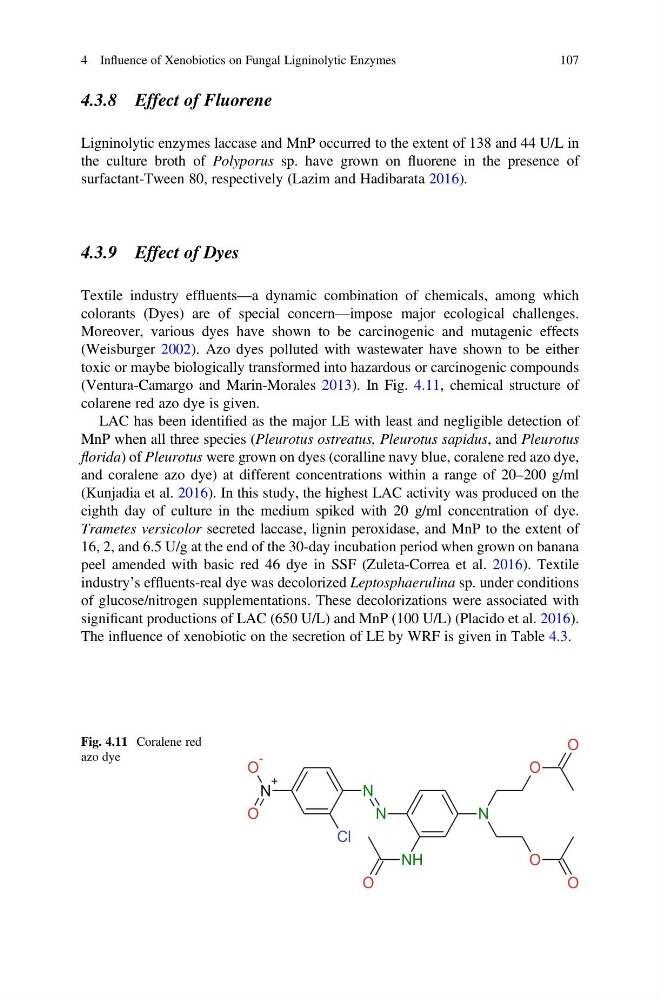
(Ventura-Camargo and Marin-Morales 2013). In Fig. 4.11, chemical structure of
colarene red azo dye is given.
LAC has been identified as the major LE with least and negligible detection of
MnP when all three species (Pleurotus ostreatus, Pleurotus sapidus, and Pleurotus
florida) of Pleurotus were grown on dyes (coralline navy blue, coralene red azo dye,
and coralene azo dye) at different concentrations within a range of 20–200 g/ml
(Kunjadia et al. 2016). In this study, the highest LAC activity was produced on the
eighth day of culture in the medium spiked with 20 g/ml concentration of dye.
Trametes versicolor secreted laccase, lignin peroxidase, and MnP to the extent of
16, 2, and 6.5 U/g at the end of the 30-day incubation period when grown on banana
peel amended with basic red 46 dye in SSF (Zuleta-Correa et al. 2016). Textile
industry’s effluents-real dye was decolorized Leptosphaerulina sp. under conditions
of glucose/nitrogen supplementations. These decolorizations were associated with
significant productions of LAC (650 U/L) and MnP (100 U/L) (Placido et al. 2016).
The influence of xenobiotic on the secretion of LE by WRF is given in Table 4.3.
N
O
O
N
N
Cl
N
+
O
-
O
NH
O
O
O
Fig. 4.11 Coralene red
azo dye
4 Influence of Xenobiotics on Fungal Ligninolytic Enzymes
107
Ligninolytic enzymes laccase and MnP occurred to the extent of 138 and 44 U/L in
the culture broth of Polyporus sp. have grown on fluorene in the presence of
surfactant-Tween 80, respectively (Lazim and Hadibarata 2016).
4.3.9 Effect of Dyes
Textile industry effluents—a dynamic combination of chemicals, among which
colorants (Dyes) are of special concern—impose major ecological challenges.
Moreover, various dyes have shown to be carcinogenic and mutagenic effects
(Weisburger 2002). Azo dyes polluted with wastewater have shown to be either
toxic or maybe biologically transformed into hazardous or carcinogenic compounds
(Ventura-Camargo and Marin-Morales 2013). In Fig. 4.11, chemical structure of
colarene red azo dye is given.
LAC has been identified as the major LE with least and negligible detection of
MnP when all three species (Pleurotus ostreatus, Pleurotus sapidus, and Pleurotus
florida) of Pleurotus were grown on dyes (coralline navy blue, coralene red azo dye,
and coralene azo dye) at different concentrations within a range of 20–200 g/ml
(Kunjadia et al. 2016). In this study, the highest LAC activity was produced on the
eighth day of culture in the medium spiked with 20 g/ml concentration of dye.
Trametes versicolor secreted laccase, lignin peroxidase, and MnP to the extent of
16, 2, and 6.5 U/g at the end of the 30-day incubation period when grown on banana
peel amended with basic red 46 dye in SSF (Zuleta-Correa et al. 2016). Textile
industry’s effluents-real dye was decolorized Leptosphaerulina sp. under conditions
of glucose/nitrogen supplementations. These decolorizations were associated with
significant productions of LAC (650 U/L) and MnP (100 U/L) (Placido et al. 2016).
The influence of xenobiotic on the secretion of LE by WRF is given in Table 4.3.
N
O
O
N
N
Cl
N
+
O
-
O
NH
O
O
O
Fig. 4.11 Coralene red
azo dye
4 Influence of Xenobiotics on Fungal Ligninolytic Enzymes
107