

molecules, mRNA stability, and mRNA translation. Translational
regulation exerted by the action of lncRNAs can be positive or
negative (Fig. 2). Several mammalian lncRNAs have been implicated in the regulation of protein translation. For example, the BC1
RNA plays a role in several types of cancer, as well as in cell
migration and proliferation [5, 6]. This lncRNA interacts and
sequesters polyA-binding proteins (PABP), preventing translation
of other polyadenylated mRNAs in human and mouse cell-free
lysates [7]. In addition, it has been shown that BC1 interacts with
the eukaryotic translation initiation factor 4A (eIF4A), inhibiting the formation of the 48S complex in a rat brain lysate
[8]. Thus, BC1 RNA globally represses translation. Other lncRNAs
implicated in the regulation of translation act on specific mRNAs.
One of them, designated as p21, is a lincRNA that associates with
the translational apparatus suppressing the translation of JUNB and
CTNNB1 mRNAs [9]. Another lncRNA acting on specific mRNAs
is a neuron-specific NAT lncRNA transcribed in the opposite strand
of the ubiquitin carboxy-terminal hydrolase L1 (Uchl1)-coding
gene, which has been involved in Parkinson’s and Alzheimer’s
diseases. This NAT lncRNA, which exhibits base pair complementarity with its target sense mRNA, is translocated from the nucleus
to the cytoplasm under rapamycin treatment and recruited to active
polysomes, where it specifically promotes the translation of
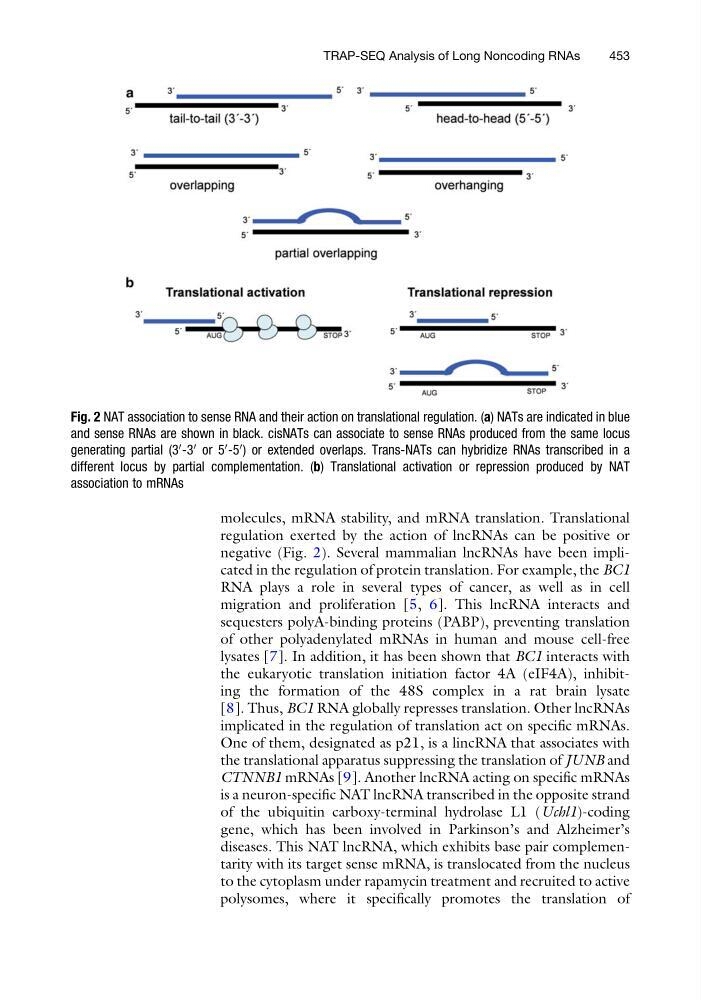
Fig. 2 NAT association to sense RNA and their action on translational regulation. (a) NATs are indicated in blue
and sense RNAs are shown in black. cisNATs can associate to sense RNAs produced from the same locus
generating partial (3
0 -3
0 or 5
0 -5
0 ) or extended overlaps. Trans-NATs can hybridize RNAs transcribed in a
different locus by partial complementation. (b) Translational activation or repression produced by NAT
association to mRNAs
TRAP-SEQ Analysis of Long Noncoding RNAs
453
regulation exerted by the action of lncRNAs can be positive or
negative (Fig. 2). Several mammalian lncRNAs have been implicated in the regulation of protein translation. For example, the BC1
RNA plays a role in several types of cancer, as well as in cell
migration and proliferation [5, 6]. This lncRNA interacts and
sequesters polyA-binding proteins (PABP), preventing translation
of other polyadenylated mRNAs in human and mouse cell-free
lysates [7]. In addition, it has been shown that BC1 interacts with
the eukaryotic translation initiation factor 4A (eIF4A), inhibiting the formation of the 48S complex in a rat brain lysate
[8]. Thus, BC1 RNA globally represses translation. Other lncRNAs
implicated in the regulation of translation act on specific mRNAs.
One of them, designated as p21, is a lincRNA that associates with
the translational apparatus suppressing the translation of JUNB and
CTNNB1 mRNAs [9]. Another lncRNA acting on specific mRNAs
is a neuron-specific NAT lncRNA transcribed in the opposite strand
of the ubiquitin carboxy-terminal hydrolase L1 (Uchl1)-coding
gene, which has been involved in Parkinson’s and Alzheimer’s
diseases. This NAT lncRNA, which exhibits base pair complementarity with its target sense mRNA, is translocated from the nucleus
to the cytoplasm under rapamycin treatment and recruited to active
polysomes, where it specifically promotes the translation of
Fig. 2 NAT association to sense RNA and their action on translational regulation. (a) NATs are indicated in blue
and sense RNAs are shown in black. cisNATs can associate to sense RNAs produced from the same locus
generating partial (3
0 -3
0 or 5
0 -5
0 ) or extended overlaps. Trans-NATs can hybridize RNAs transcribed in a
different locus by partial complementation. (b) Translational activation or repression produced by NAT
association to mRNAs
TRAP-SEQ Analysis of Long Noncoding RNAs
453