

transcripts longer than 200 nt with limited or no coding potential,
which have gained major attention due to their function in developmental processes, diseases, and responses to environmental cues
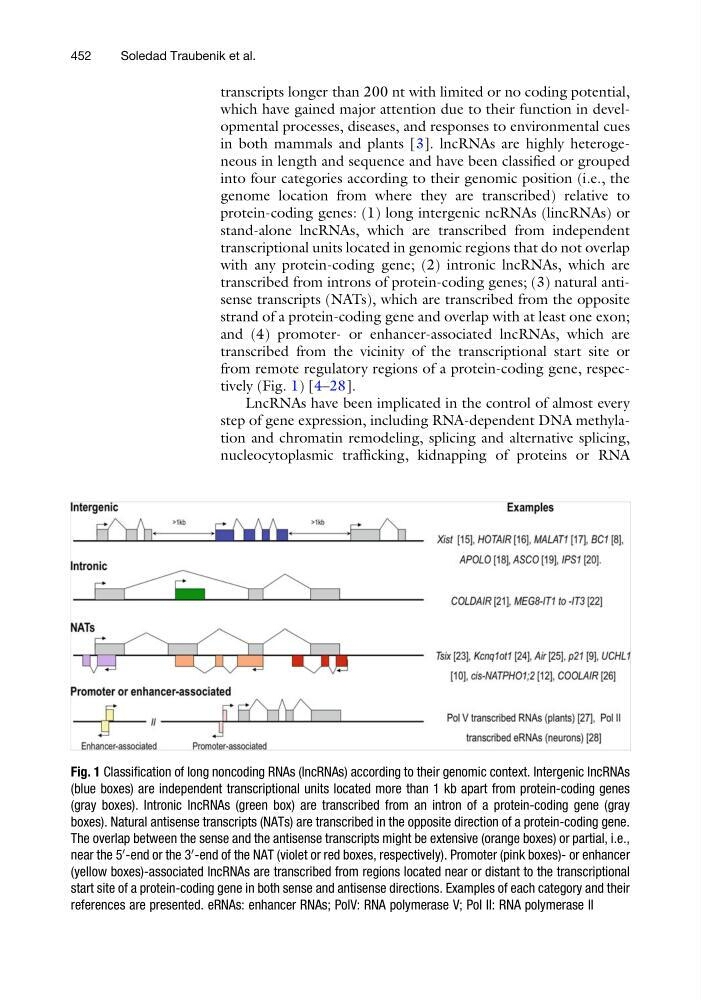
in both mammals and plants [3]. lncRNAs are highly heterogeneous in length and sequence and have been classified or grouped
into four categories according to their genomic position (i.e., the
genome location from where they are transcribed) relative to
protein-coding genes: (1) long intergenic ncRNAs (lincRNAs) or
stand-alone lncRNAs, which are transcribed from independent
transcriptional units located in genomic regions that do not overlap
with any protein-coding gene; (2) intronic lncRNAs, which are
transcribed from introns of protein-coding genes; (3) natural antisense transcripts (NATs), which are transcribed from the opposite
strand of a protein-coding gene and overlap with at least one exon;
and (4) promoter- or enhancer-associated lncRNAs, which are
transcribed from the vicinity of the transcriptional start site or
from remote regulatory regions of a protein-coding gene, respectively (Fig. 1) [4–28].
LncRNAs have been implicated in the control of almost every
step of gene expression, including RNA-dependent DNA methylation and chromatin remodeling, splicing and alternative splicing,
nucleocytoplasmic trafficking, kidnapping of proteins or RNA
Fig. 1 Classification of long noncoding RNAs (lncRNAs) according to their genomic context. Intergenic lncRNAs
(blue boxes) are independent transcriptional units located more than 1 kb apart from protein-coding genes
(gray boxes). Intronic lncRNAs (green box) are transcribed from an intron of a protein-coding gene (gray
boxes). Natural antisense transcripts (NATs) are transcribed in the opposite direction of a protein-coding gene.
The overlap between the sense and the antisense transcripts might be extensive (orange boxes) or partial, i.e.,
near the 5
0 -end or the 3
0 -end of the NAT (violet or red boxes, respectively). Promoter (pink boxes)- or enhancer
(yellow boxes)-associated lncRNAs are transcribed from regions located near or distant to the transcriptional
start site of a protein-coding gene in both sense and antisense directions. Examples of each category and their
references are presented. eRNAs: enhancer RNAs; PolV: RNA polymerase V; Pol II: RNA polymerase II
452
Soledad Traubenik et al.
which have gained major attention due to their function in developmental processes, diseases, and responses to environmental cues
in both mammals and plants [3]. lncRNAs are highly heterogeneous in length and sequence and have been classified or grouped
into four categories according to their genomic position (i.e., the
genome location from where they are transcribed) relative to
protein-coding genes: (1) long intergenic ncRNAs (lincRNAs) or
stand-alone lncRNAs, which are transcribed from independent
transcriptional units located in genomic regions that do not overlap
with any protein-coding gene; (2) intronic lncRNAs, which are
transcribed from introns of protein-coding genes; (3) natural antisense transcripts (NATs), which are transcribed from the opposite
strand of a protein-coding gene and overlap with at least one exon;
and (4) promoter- or enhancer-associated lncRNAs, which are
transcribed from the vicinity of the transcriptional start site or
from remote regulatory regions of a protein-coding gene, respectively (Fig. 1) [4–28].
LncRNAs have been implicated in the control of almost every
step of gene expression, including RNA-dependent DNA methylation and chromatin remodeling, splicing and alternative splicing,
nucleocytoplasmic trafficking, kidnapping of proteins or RNA
Fig. 1 Classification of long noncoding RNAs (lncRNAs) according to their genomic context. Intergenic lncRNAs
(blue boxes) are independent transcriptional units located more than 1 kb apart from protein-coding genes
(gray boxes). Intronic lncRNAs (green box) are transcribed from an intron of a protein-coding gene (gray
boxes). Natural antisense transcripts (NATs) are transcribed in the opposite direction of a protein-coding gene.
The overlap between the sense and the antisense transcripts might be extensive (orange boxes) or partial, i.e.,
near the 5
0 -end or the 3
0 -end of the NAT (violet or red boxes, respectively). Promoter (pink boxes)- or enhancer
(yellow boxes)-associated lncRNAs are transcribed from regions located near or distant to the transcriptional
start site of a protein-coding gene in both sense and antisense directions. Examples of each category and their
references are presented. eRNAs: enhancer RNAs; PolV: RNA polymerase V; Pol II: RNA polymerase II
452
Soledad Traubenik et al.