

4 Notes
1. All Cas9 expression vectors are based on the vector pCAS9TPC [22, 23]. The vectors mentioned in this protocol are
available from the Botanical Institute, Karlsruhe Institute of
Technology, POB 6980, 76049 Karlsruhe, Germany. Vector
information can be found on the respective webpage (https://
www.botanik.kit.edu/molbio/1057.php).
2. This centrifuge is used to precipitate leaf nuclei onto a microscopic slide. It enables to obtain purified leaf nuclei at high
density without any remaining cytoplasm. It is crucial to
remove any cytoplasm for a successful immunostaining and
FISH. If a cytocentrifuge is not available, the following alternative method could be used to prepare microscopic slides
carrying nuclei. Drop 12 μL sucrose buffer on a clean glass
slide, add 12 μL of nuclei suspension obtained after filtration of
chopped leaf, and gently mix both types of drops with the
pipette tip. Let slides dry overnight.
3. This tube contains a 35 μm nylon mesh to filtrate the extracted
nuclei from leave debris.
4. Prepare 4% paraformaldehyde solution by diluting 37% readyto-use paraformaldehyde solution.
5. DAPI solution is usually prepared by diluting 1 μL DAPI
(stock) in 999 μL VECTASHIELD antifade mounting
medium. Mix well by vortexing.
6. VECTASHIELD is used to prevent immediate fading of fluorescent signals during microscopy.
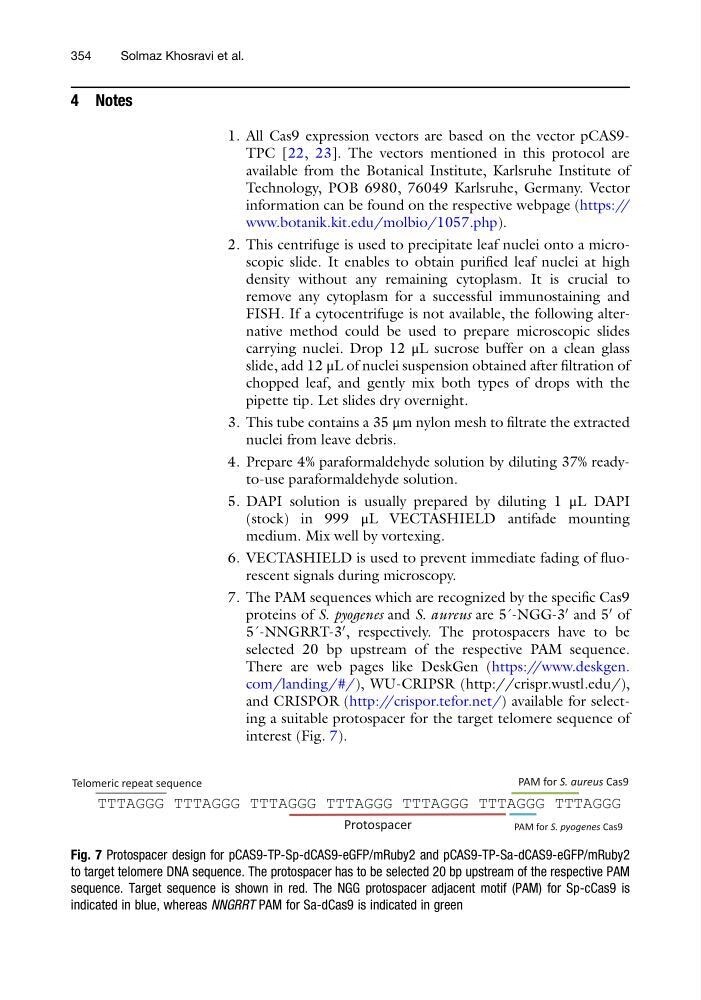
7. The PAM sequences which are recognized by the specific Cas9
proteins of S. pyogenes and S. aureus are 5´-NGG-3
0 and 5
0 of
5´-NNGRRT-3
0 , respectively. The protospacers have to be
selected 20 bp upstream of the respective PAM sequence.
There are web pages like DeskGen (https://www.deskgen.
com/landing/#/), WU-CRIPSR (http://crispr.wustl.edu/),
and CRISPOR (http://crispor.tefor.net/) available for selecting a suitable protospacer for the target telomere sequence of
interest (Fig. 7).
TTTAGGG TTTAGGG TTTAGGG TTTAGGG TTTAGGG TTTAGGG TTTAGGG
Telomeric repeat sequence
Protospacer
PAM for S. pyogenes Cas9
PAM for S. aureus Cas9
Fig. 7 Protospacer design for pCAS9-TP-Sp-dCAS9-eGFP/mRuby2 and pCAS9-TP-Sa-dCAS9-eGFP/mRuby2
to target telomere DNA sequence. The protospacer has to be selected 20 bp upstream of the respective PAM
sequence. Target sequence is shown in red. The NGG protospacer adjacent motif (PAM) for Sp-cCas9 is
indicated in blue, whereas NNGRRT PAM for Sa-dCas9 is indicated in green
354
Solmaz Khosravi et al.
1. All Cas9 expression vectors are based on the vector pCAS9TPC [22, 23]. The vectors mentioned in this protocol are
available from the Botanical Institute, Karlsruhe Institute of
Technology, POB 6980, 76049 Karlsruhe, Germany. Vector
information can be found on the respective webpage (https://
www.botanik.kit.edu/molbio/1057.php).
2. This centrifuge is used to precipitate leaf nuclei onto a microscopic slide. It enables to obtain purified leaf nuclei at high
density without any remaining cytoplasm. It is crucial to
remove any cytoplasm for a successful immunostaining and
FISH. If a cytocentrifuge is not available, the following alternative method could be used to prepare microscopic slides
carrying nuclei. Drop 12 μL sucrose buffer on a clean glass
slide, add 12 μL of nuclei suspension obtained after filtration of
chopped leaf, and gently mix both types of drops with the
pipette tip. Let slides dry overnight.
3. This tube contains a 35 μm nylon mesh to filtrate the extracted
nuclei from leave debris.
4. Prepare 4% paraformaldehyde solution by diluting 37% readyto-use paraformaldehyde solution.
5. DAPI solution is usually prepared by diluting 1 μL DAPI
(stock) in 999 μL VECTASHIELD antifade mounting
medium. Mix well by vortexing.
6. VECTASHIELD is used to prevent immediate fading of fluorescent signals during microscopy.
7. The PAM sequences which are recognized by the specific Cas9
proteins of S. pyogenes and S. aureus are 5´-NGG-3
0 and 5
0 of
5´-NNGRRT-3
0 , respectively. The protospacers have to be
selected 20 bp upstream of the respective PAM sequence.
There are web pages like DeskGen (https://www.deskgen.
com/landing/#/), WU-CRIPSR (http://crispr.wustl.edu/),
and CRISPOR (http://crispor.tefor.net/) available for selecting a suitable protospacer for the target telomere sequence of
interest (Fig. 7).
TTTAGGG TTTAGGG TTTAGGG TTTAGGG TTTAGGG TTTAGGG TTTAGGG
Telomeric repeat sequence
Protospacer
PAM for S. pyogenes Cas9
PAM for S. aureus Cas9
Fig. 7 Protospacer design for pCAS9-TP-Sp-dCAS9-eGFP/mRuby2 and pCAS9-TP-Sa-dCAS9-eGFP/mRuby2
to target telomere DNA sequence. The protospacer has to be selected 20 bp upstream of the respective PAM
sequence. Target sequence is shown in red. The NGG protospacer adjacent motif (PAM) for Sp-cCas9 is
indicated in blue, whereas NNGRRT PAM for Sa-dCas9 is indicated in green
354
Solmaz Khosravi et al.