

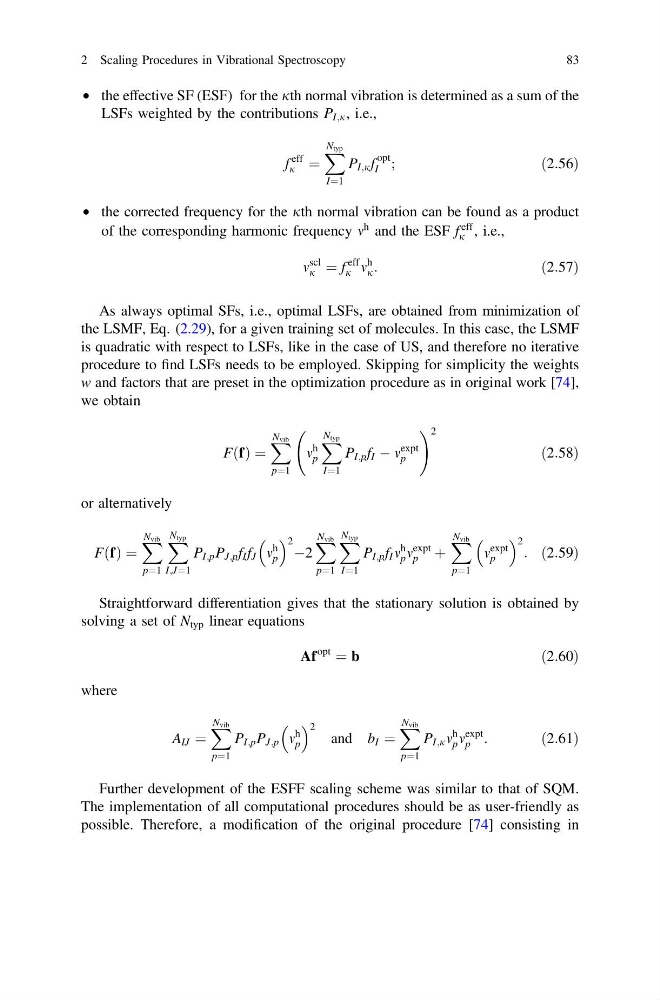
• the effective SF (ESF) for the jth normal vibration is determined as a sum of the
LSFs weighted by the contributions P I;j , i.e.,
f
eff
j ¼
X N typ
I¼1
P I;j f
opt
I ;
ð2:56Þ
• the corrected frequency for the jth normal vibration can be found as a product
of the corresponding harmonic frequency m
h and the ESF f
eff
j , i.e.,
m
scl
j ¼ f
eff
j m
h
j :
ð2:57Þ
As always optimal SFs, i.e., optimal LSFs, are obtained from minimization of
the LSMF, Eq. (2.29), for a given training set of molecules. In this case, the LSMF
is quadratic with respect to LSFs, like in the case of US, and therefore no iterative
procedure to find LSFs needs to be employed. Skipping for simplicity the weights
w and factors that are preset in the optimization procedure as in original work [74],
we obtain
F f
ð Þ ¼
X N vib
p¼1
m
h
p
X N typ
I¼1
P I;p f I À m
expt
p
! 2
ð2:58Þ
or alternatively
F f
ð Þ ¼
X N vib
p¼1
X N typ
I;J¼1
P I;p P J;p f I f J m
h
p
2 À2
X N vib
p¼1
X N typ
I¼1
P I;p f I m
h
p m
expt
p
þ
X N vib
p¼1
m
expt
p
2 : ð2:59Þ
Straightforward differentiation gives that the stationary solution is obtained by
solving a set of N typ linear equations
Af
opt
¼ b
ð2:60Þ
where
A IJ ¼
X N vib
p¼1
P I;p P J;p m
h
p
2
and b I ¼
X N vib
p¼1
P I;j m
h
p m
expt
p :
ð2:61Þ
Further development of the ESFF scaling scheme was similar to that of SQM.
The implementation of all computational procedures should be as user-friendly as
possible. Therefore, a modification of the original procedure [74] consisting in
2 Scaling Procedures in Vibrational Spectroscopy
83
LSFs weighted by the contributions P I;j , i.e.,
f
eff
j ¼
X N typ
I¼1
P I;j f
opt
I ;
ð2:56Þ
• the corrected frequency for the jth normal vibration can be found as a product
of the corresponding harmonic frequency m
h and the ESF f
eff
j , i.e.,
m
scl
j ¼ f
eff
j m
h
j :
ð2:57Þ
As always optimal SFs, i.e., optimal LSFs, are obtained from minimization of
the LSMF, Eq. (2.29), for a given training set of molecules. In this case, the LSMF
is quadratic with respect to LSFs, like in the case of US, and therefore no iterative
procedure to find LSFs needs to be employed. Skipping for simplicity the weights
w and factors that are preset in the optimization procedure as in original work [74],
we obtain
F f
ð Þ ¼
X N vib
p¼1
m
h
p
X N typ
I¼1
P I;p f I À m
expt
p
! 2
ð2:58Þ
or alternatively
F f
ð Þ ¼
X N vib
p¼1
X N typ
I;J¼1
P I;p P J;p f I f J m
h
p
2 À2
X N vib
p¼1
X N typ
I¼1
P I;p f I m
h
p m
expt
p
þ
X N vib
p¼1
m
expt
p
2 : ð2:59Þ
Straightforward differentiation gives that the stationary solution is obtained by
solving a set of N typ linear equations
Af
opt
¼ b
ð2:60Þ
where
A IJ ¼
X N vib
p¼1
P I;p P J;p m
h
p
2
and b I ¼
X N vib
p¼1
P I;j m
h
p m
expt
p :
ð2:61Þ
Further development of the ESFF scaling scheme was similar to that of SQM.
The implementation of all computational procedures should be as user-friendly as
possible. Therefore, a modification of the original procedure [74] consisting in
2 Scaling Procedures in Vibrational Spectroscopy
83