

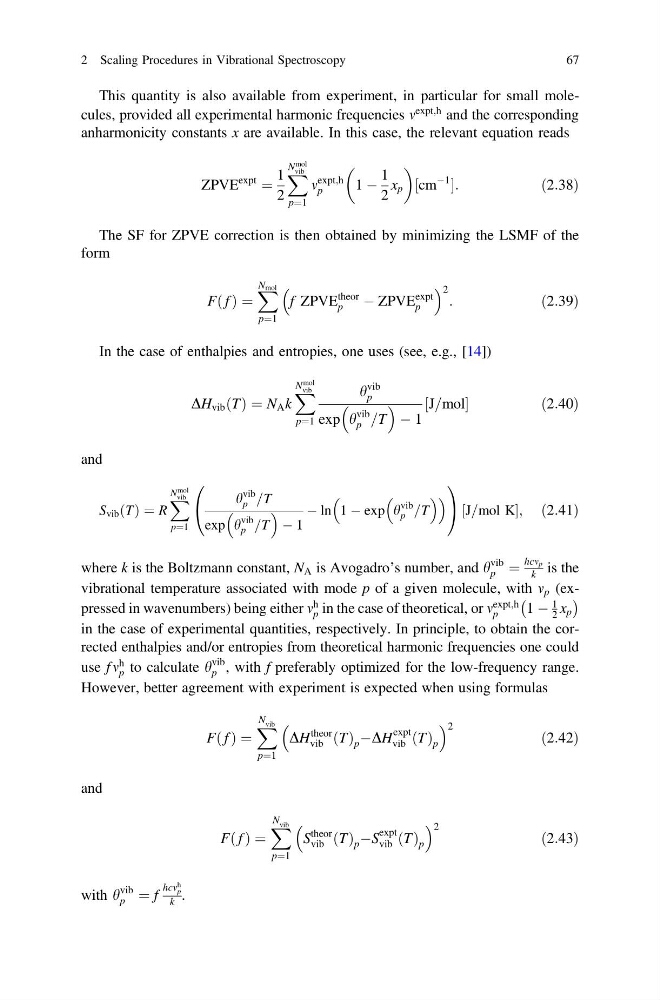
This quantity is also available from experiment, in particular for small molecules, provided all experimental harmonic frequencies m
expt;h and the corresponding
anharmonicity constants x are available. In this case, the relevant equation reads
ZPVE
expt
¼
1
2
X
N
mol
vib
p¼1
m
expt;h
p
1 À
1
2
x p
½cm
À1
:
ð2:38Þ
The SF for ZPVE correction is then obtained by minimizing the LSMF of the
form
F f
ð Þ ¼
X N mol
p¼1
f ZPVE
theor
p
À ZPVE
expt
p
2 :
ð2:39Þ
In the case of enthalpies and entropies, one uses (see, e.g., [14])
DH vib T
ð Þ ¼ N A k
X
N
mol
vib
p¼1
h
vib
p
exp h
vib
p =T
À 1
½J=mol
ð 2:40Þ
and
S vib T
ð Þ ¼ R
X
N
mol
vib
p¼1
h
vib
p =T
exp h
vib
p =T
À 1
À ln 1 À exp h
vib
p =T
0
@
1
A ½J=mol K; ð2:41Þ
where k is the Boltzmann constant, N A is Avogadro’s number, and h
vib
p ¼
hcm p
k is the
vibrational temperature associated with mode p of a given molecule, with m p (expressed in wavenumbers) being either m
h
p in the case of theoretical, or m
expt;h
p
1 À
1
2 x p
À
Á
in the case of experimental quantities, respectively. In principle, to obtain the corrected enthalpies and/or entropies from theoretical harmonic frequencies one could
use f m
h
p to calculate h
vib
p , with f preferably optimized for the low-frequency range.
However, better agreement with experiment is expected when using formulas
F f
ð Þ ¼
X
N vib
p¼1
DH
theor
vib T
ð Þ p ÀDH
expt
vib T
ð Þ p
2
ð2:42Þ
and
F f
ð Þ ¼
X
N vib
p¼1
S
theor
vib T
ð Þ p ÀS
expt
vib T
ð Þ p
2
ð2:43Þ
with h
vib
p ¼ f
hcm
h
p
k .
2 Scaling Procedures in Vibrational Spectroscopy
67
expt;h and the corresponding
anharmonicity constants x are available. In this case, the relevant equation reads
ZPVE
expt
¼
1
2
X
N
mol
vib
p¼1
m
expt;h
p
1 À
1
2
x p
½cm
À1
:
ð2:38Þ
The SF for ZPVE correction is then obtained by minimizing the LSMF of the
form
F f
ð Þ ¼
X N mol
p¼1
f ZPVE
theor
p
À ZPVE
expt
p
2 :
ð2:39Þ
In the case of enthalpies and entropies, one uses (see, e.g., [14])
DH vib T
ð Þ ¼ N A k
X
N
mol
vib
p¼1
h
vib
p
exp h
vib
p =T
À 1
½J=mol
ð 2:40Þ
and
S vib T
ð Þ ¼ R
X
N
mol
vib
p¼1
h
vib
p =T
exp h
vib
p =T
À 1
À ln 1 À exp h
vib
p =T
0
@
1
A ½J=mol K; ð2:41Þ
where k is the Boltzmann constant, N A is Avogadro’s number, and h
vib
p ¼
hcm p
k is the
vibrational temperature associated with mode p of a given molecule, with m p (expressed in wavenumbers) being either m
h
p in the case of theoretical, or m
expt;h
p
1 À
1
2 x p
À
Á
in the case of experimental quantities, respectively. In principle, to obtain the corrected enthalpies and/or entropies from theoretical harmonic frequencies one could
use f m
h
p to calculate h
vib
p , with f preferably optimized for the low-frequency range.
However, better agreement with experiment is expected when using formulas
F f
ð Þ ¼
X
N vib
p¼1
DH
theor
vib T
ð Þ p ÀDH
expt
vib T
ð Þ p
2
ð2:42Þ
and
F f
ð Þ ¼
X
N vib
p¼1
S
theor
vib T
ð Þ p ÀS
expt
vib T
ð Þ p
2
ð2:43Þ
with h
vib
p ¼ f
hcm
h
p
k .
2 Scaling Procedures in Vibrational Spectroscopy
67