

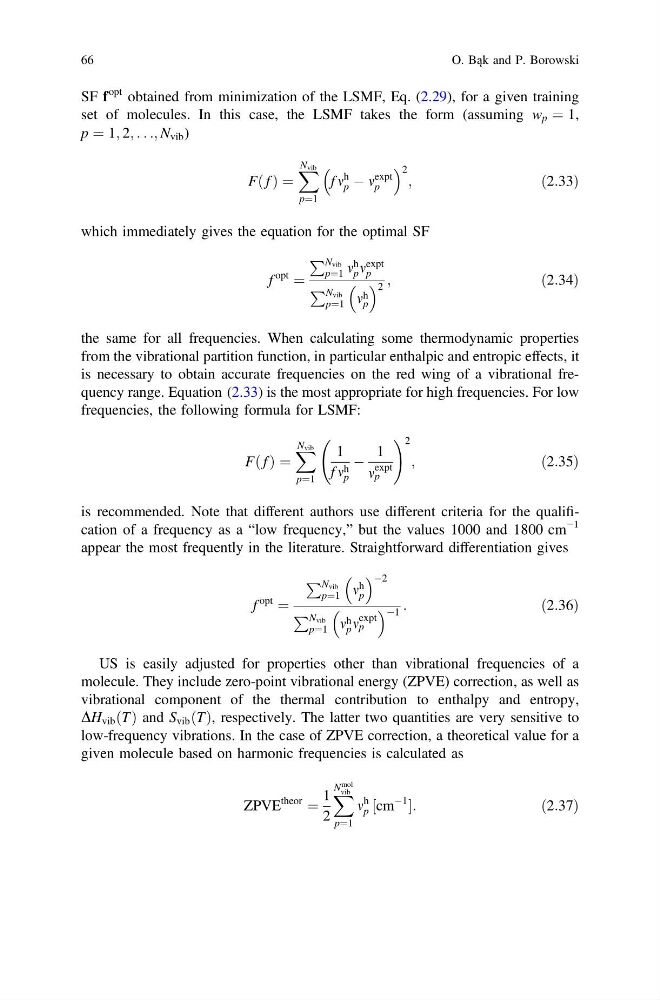
SF f
opt obtained from minimization of the LSMF, Eq. (2.29), for a given training
set of molecules. In this case, the LSMF takes the form (assuming w p ¼ 1,
p ¼ 1; 2; . . .; N vib )
F f
ð Þ ¼
X N vib
p¼1
f m
h
p À m
expt
p
2 ;
ð2:33Þ
which immediately gives the equation for the optimal SF
f
opt
¼
P N vib
p¼1 m
h
p m
expt
p
P N vib
p¼1 m h
p
2 ;
ð2:34Þ
the same for all frequencies. When calculating some thermodynamic properties
from the vibrational partition function, in particular enthalpic and entropic effects, it
is necessary to obtain accurate frequencies on the red wing of a vibrational frequency range. Equation (2.33) is the most appropriate for high frequencies. For low
frequencies, the following formula for LSMF:
F f
ð Þ ¼
X N vib
p¼1
1
f m h
p
À
1
m
expt
p
! 2
;
ð2:35Þ
is recommended. Note that different authors use different criteria for the qualification of a frequency as a “low frequency,” but the values 1000 and 1800 cm
−1
appear the most frequently in the literature. Straightforward differentiation gives
f
opt
¼
P N vib
p¼1 m
h
p
À2
P N vib
p¼1 m h
p m
expt
p
À1 :
ð2:36Þ
US is easily adjusted for properties other than vibrational frequencies of a
molecule. They include zero-point vibrational energy (ZPVE) correction, as well as
vibrational component of the thermal contribution to enthalpy and entropy,
DH vib T
ð Þ and S vib T
ð Þ, respectively. The latter two quantities are very sensitive to
low-frequency vibrations. In the case of ZPVE correction, a theoretical value for a
given molecule based on harmonic frequencies is calculated as
ZPVE
theor
¼
1
2
X
N
mol
vib
p¼1
m
h
p ½cm
À1
:
ð2:37Þ
66
O. Bąk and P. Borowski
opt obtained from minimization of the LSMF, Eq. (2.29), for a given training
set of molecules. In this case, the LSMF takes the form (assuming w p ¼ 1,
p ¼ 1; 2; . . .; N vib )
F f
ð Þ ¼
X N vib
p¼1
f m
h
p À m
expt
p
2 ;
ð2:33Þ
which immediately gives the equation for the optimal SF
f
opt
¼
P N vib
p¼1 m
h
p m
expt
p
P N vib
p¼1 m h
p
2 ;
ð2:34Þ
the same for all frequencies. When calculating some thermodynamic properties
from the vibrational partition function, in particular enthalpic and entropic effects, it
is necessary to obtain accurate frequencies on the red wing of a vibrational frequency range. Equation (2.33) is the most appropriate for high frequencies. For low
frequencies, the following formula for LSMF:
F f
ð Þ ¼
X N vib
p¼1
1
f m h
p
À
1
m
expt
p
! 2
;
ð2:35Þ
is recommended. Note that different authors use different criteria for the qualification of a frequency as a “low frequency,” but the values 1000 and 1800 cm
−1
appear the most frequently in the literature. Straightforward differentiation gives
f
opt
¼
P N vib
p¼1 m
h
p
À2
P N vib
p¼1 m h
p m
expt
p
À1 :
ð2:36Þ
US is easily adjusted for properties other than vibrational frequencies of a
molecule. They include zero-point vibrational energy (ZPVE) correction, as well as
vibrational component of the thermal contribution to enthalpy and entropy,
DH vib T
ð Þ and S vib T
ð Þ, respectively. The latter two quantities are very sensitive to
low-frequency vibrations. In the case of ZPVE correction, a theoretical value for a
given molecule based on harmonic frequencies is calculated as
ZPVE
theor
¼
1
2
X
N
mol
vib
p¼1
m
h
p ½cm
À1
:
ð2:37Þ
66
O. Bąk and P. Borowski