

kinetic energy expression. The term coupling molecular rotation and vibrations
cannot be eliminated though, but in low-resolution spectroscopy, it can be neglected
due to its insignificant contribution to the overall kinetic energy expression.
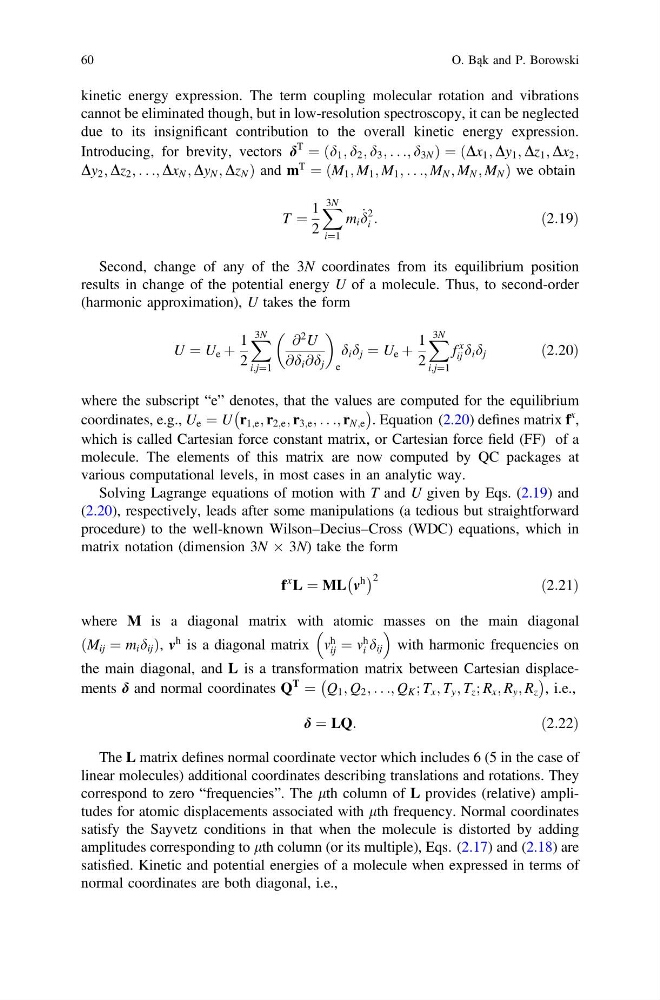
Introducing, for brevity, vectors d
T
¼ d 1 ; d 2 ; d 3 ; . . .; d 3N
ð
Þ ¼Dx 1 ; Dy 1 ; Dz 1 ; Dx 2 ;
ð
Dy 2 ; Dz 2 ; . . .; Dx N ; Dy N ; Dz N Þ and m
T
¼ M 1 ; M 1 ; M 1 ; . . .; M N ; M N ; M N
ð
Þ we obtain
T ¼
1
2
X 3N
i¼1
m i _
d
2
i :
ð2:19Þ
Second, change of any of the 3N coordinates from its equilibrium position
results in change of the potential energy U of a molecule. Thus, to second-order
(harmonic approximation), U takes the form
U ¼ U e þ
1
2
X 3N
i;j¼1
@
2 U
@d i @d j
e
d i d j ¼ U e þ
1
2
X 3N
i;j¼1
f
x
ij d i d j
ð2:20Þ
where the subscript “e” denotes, that the values are computed for the equilibrium
coordinates, e.g., U e ¼ U r 1;e ; r 2;e ; r 3;e ; . . .; r N;e
À
Á
. Equation (2.20) defines matrix f
x ,
which is called Cartesian force constant matrix, or Cartesian force field (FF) of a
molecule. The elements of this matrix are now computed by QC packages at
various computational levels, in most cases in an analytic way.
Solving Lagrange equations of motion with T and U given by Eqs. (2.19) and
(2.20), respectively, leads after some manipulations (a tedious but straightforward
procedure) to the well-known Wilson–Decius–Cross (WDC) equations, which in
matrix notation (dimension 3N Â 3N) take the form
f
x L ¼ ML m
h
À Á 2
ð2:21Þ
where M is a diagonal matrix with atomic masses on the main diagonal
ðM ij ¼ m i d ij Þ, m
h is a diagonal matrix m
h
ij ¼ m
h
i d ij
with harmonic frequencies on
the main diagonal, and L is a transformation matrix between Cartesian displacements d and normal coordinates Q
T
¼ Q 1 ; Q 2 ; . . .; Q K ; T x ; T y ; T z ; R x ; R y ; R z
À
Á
, i.e.,
d ¼ LQ:
ð2:22Þ
The L matrix defines normal coordinate vector which includes 6 (5 in the case of
linear molecules) additional coordinates describing translations and rotations. They
correspond to zero “frequencies”. The lth column of L provides (relative) amplitudes for atomic displacements associated with lth frequency. Normal coordinates
satisfy the Sayvetz conditions in that when the molecule is distorted by adding
amplitudes corresponding to lth column (or its multiple), Eqs. (2.17) and (2.18) are
satisfied. Kinetic and potential energies of a molecule when expressed in terms of
normal coordinates are both diagonal, i.e.,
60
O. Bąk and P. Borowski
cannot be eliminated though, but in low-resolution spectroscopy, it can be neglected
due to its insignificant contribution to the overall kinetic energy expression.
Introducing, for brevity, vectors d
T
¼ d 1 ; d 2 ; d 3 ; . . .; d 3N
ð
Þ ¼Dx 1 ; Dy 1 ; Dz 1 ; Dx 2 ;
ð
Dy 2 ; Dz 2 ; . . .; Dx N ; Dy N ; Dz N Þ and m
T
¼ M 1 ; M 1 ; M 1 ; . . .; M N ; M N ; M N
ð
Þ we obtain
T ¼
1
2
X 3N
i¼1
m i _
d
2
i :
ð2:19Þ
Second, change of any of the 3N coordinates from its equilibrium position
results in change of the potential energy U of a molecule. Thus, to second-order
(harmonic approximation), U takes the form
U ¼ U e þ
1
2
X 3N
i;j¼1
@
2 U
@d i @d j
e
d i d j ¼ U e þ
1
2
X 3N
i;j¼1
f
x
ij d i d j
ð2:20Þ
where the subscript “e” denotes, that the values are computed for the equilibrium
coordinates, e.g., U e ¼ U r 1;e ; r 2;e ; r 3;e ; . . .; r N;e
À
Á
. Equation (2.20) defines matrix f
x ,
which is called Cartesian force constant matrix, or Cartesian force field (FF) of a
molecule. The elements of this matrix are now computed by QC packages at
various computational levels, in most cases in an analytic way.
Solving Lagrange equations of motion with T and U given by Eqs. (2.19) and
(2.20), respectively, leads after some manipulations (a tedious but straightforward
procedure) to the well-known Wilson–Decius–Cross (WDC) equations, which in
matrix notation (dimension 3N Â 3N) take the form
f
x L ¼ ML m
h
À Á 2
ð2:21Þ
where M is a diagonal matrix with atomic masses on the main diagonal
ðM ij ¼ m i d ij Þ, m
h is a diagonal matrix m
h
ij ¼ m
h
i d ij
with harmonic frequencies on
the main diagonal, and L is a transformation matrix between Cartesian displacements d and normal coordinates Q
T
¼ Q 1 ; Q 2 ; . . .; Q K ; T x ; T y ; T z ; R x ; R y ; R z
À
Á
, i.e.,
d ¼ LQ:
ð2:22Þ
The L matrix defines normal coordinate vector which includes 6 (5 in the case of
linear molecules) additional coordinates describing translations and rotations. They
correspond to zero “frequencies”. The lth column of L provides (relative) amplitudes for atomic displacements associated with lth frequency. Normal coordinates
satisfy the Sayvetz conditions in that when the molecule is distorted by adding
amplitudes corresponding to lth column (or its multiple), Eqs. (2.17) and (2.18) are
satisfied. Kinetic and potential energies of a molecule when expressed in terms of
normal coordinates are both diagonal, i.e.,
60
O. Bąk and P. Borowski