

U s
ð Þ ¼ U s e
ð Þþ
1
2
X K
l;m¼1
U
2
ð Þ
lm s e
ð Þ s l À s l;e
À
Á
s m À s m;e
À
Á
þ
1
6
X K
l;m;j¼1
U
3
ð Þ
lmj s e
ð Þ s l À s l;e
À
Á
s m À s m;e
À
Á
s j À s j;e
À
Á þ Á Á Á
ð2:4Þ
where
U
2
ð Þ
lm s e
ð Þ ¼ U
00
lm s e
ð Þ ¼
@
2 U
@s l @s m
s¼s e
; etc:
ð2:5Þ
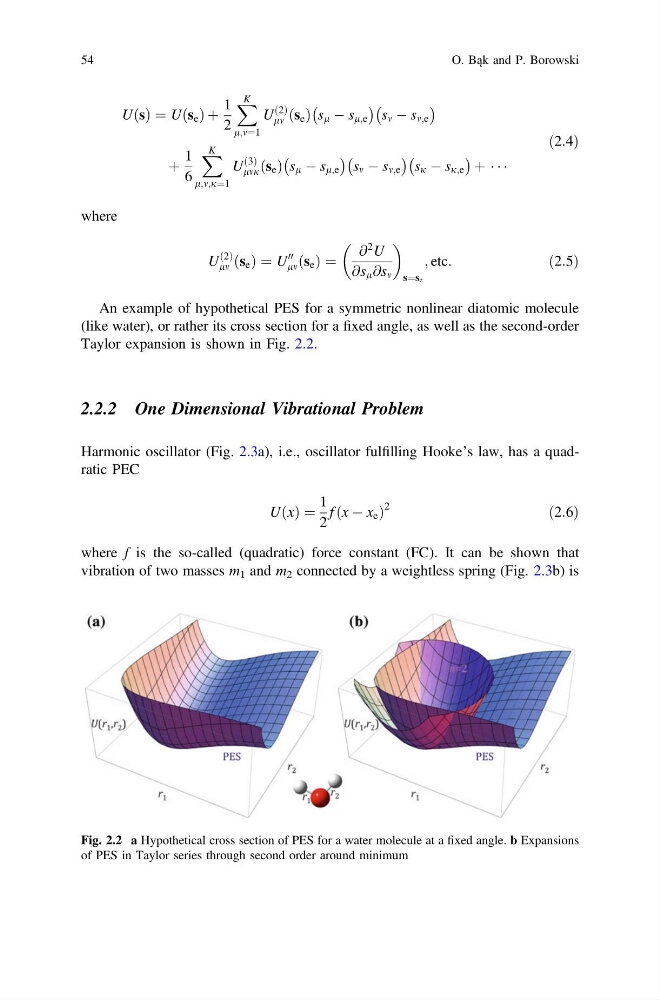
An example of hypothetical PES for a symmetric nonlinear diatomic molecule
(like water), or rather its cross section for a fixed angle, as well as the second-order
Taylor expansion is shown in Fig. 2.2.
2.2.2 One Dimensional Vibrational Problem
Harmonic oscillator (Fig. 2.3a), i.e., oscillator fulfilling Hooke’s law, has a quadratic PEC
U x
ð Þ ¼
1
2
f x À x e
ð
Þ
2
ð2:6Þ
where f is the so-called (quadratic) force constant (FC). It can be shown that
vibration of two masses m 1 and m 2 connected by a weightless spring (Fig. 2.3b) is
Fig. 2.2 a Hypothetical cross section of PES for a water molecule at a fixed angle. b Expansions
of PES in Taylor series through second order around minimum
54
O. Bąk and P. Borowski
ð Þ ¼ U s e
ð Þþ
1
2
X K
l;m¼1
U
2
ð Þ
lm s e
ð Þ s l À s l;e
À
Á
s m À s m;e
À
Á
þ
1
6
X K
l;m;j¼1
U
3
ð Þ
lmj s e
ð Þ s l À s l;e
À
Á
s m À s m;e
À
Á
s j À s j;e
À
Á þ Á Á Á
ð2:4Þ
where
U
2
ð Þ
lm s e
ð Þ ¼ U
00
lm s e
ð Þ ¼
@
2 U
@s l @s m
s¼s e
; etc:
ð2:5Þ
An example of hypothetical PES for a symmetric nonlinear diatomic molecule
(like water), or rather its cross section for a fixed angle, as well as the second-order
Taylor expansion is shown in Fig. 2.2.
2.2.2 One Dimensional Vibrational Problem
Harmonic oscillator (Fig. 2.3a), i.e., oscillator fulfilling Hooke’s law, has a quadratic PEC
U x
ð Þ ¼
1
2
f x À x e
ð
Þ
2
ð2:6Þ
where f is the so-called (quadratic) force constant (FC). It can be shown that
vibration of two masses m 1 and m 2 connected by a weightless spring (Fig. 2.3b) is
Fig. 2.2 a Hypothetical cross section of PES for a water molecule at a fixed angle. b Expansions
of PES in Taylor series through second order around minimum
54
O. Bąk and P. Borowski