

most important point on PEC is r e corresponding to minimum, called equilibrium
bond length. Alternatively, one can expand PEC in a Taylor series around r e , i.e.,
U r
ð Þ ¼ U r e
ð ÞþU
1
ð Þ r e
ð Þ r À r e
ð
Þþ
1
2
U
2
ð Þ r e
ð Þ r À r e
ð
Þ
2 þ
1
6
U
3
ð Þ r e
ð Þ r À r e
ð
Þ
3
þ
1
24
U
4
ð Þ r e
ð Þ r À r e
ð
Þ
4 þ Á Á Á
ð2:1Þ
where
U
1
ð Þ r e
ð Þ ¼ U
0 r e
ð Þ ¼
@U
@r
r¼r e
;
ð2:2Þ
U
2
ð Þ r e
ð Þ ¼ U
00 r e
ð Þ ¼
@
2 U
@r 2
r¼r e
; etc:
ð2:3Þ
The linear term vanishes for obvious reason. The derivatives, in particular third
and higher derivatives, can be calculated numerically; in the case of second
derivatives, most QC packages have analytic derivatives implemented. The
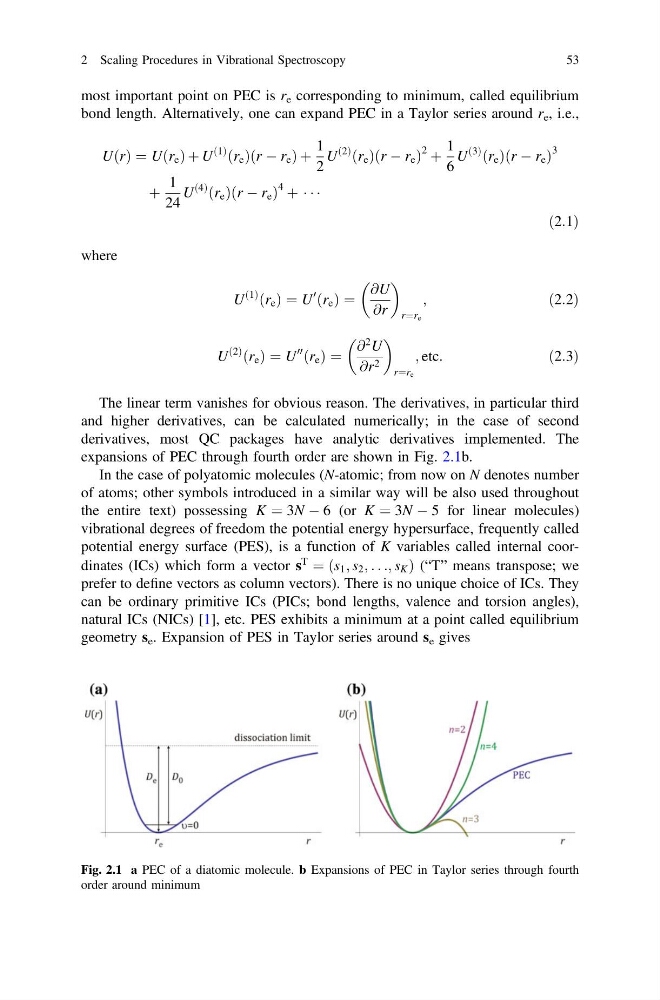
expansions of PEC through fourth order are shown in Fig. 2.1b.
In the case of polyatomic molecules (N-atomic; from now on N denotes number
of atoms; other symbols introduced in a similar way will be also used throughout
the entire text) possessing K ¼ 3N À 6 (or K ¼ 3N À 5 for linear molecules)
vibrational degrees of freedom the potential energy hypersurface, frequently called
potential energy surface (PES), is a function of K variables called internal coordinates (ICs) which form a vector s
T
¼ s 1 ; s 2 ; . . .; s K
ð
Þ(“T” means transpose; we
prefer to define vectors as column vectors). There is no unique choice of ICs. They
can be ordinary primitive ICs (PICs; bond lengths, valence and torsion angles),
natural ICs (NICs) [1], etc. PES exhibits a minimum at a point called equilibrium
geometry s e . Expansion of PES in Taylor series around s e gives
Fig. 2.1 a PEC of a diatomic molecule. b Expansions of PEC in Taylor series through fourth
order around minimum
2 Scaling Procedures in Vibrational Spectroscopy
53
bond length. Alternatively, one can expand PEC in a Taylor series around r e , i.e.,
U r
ð Þ ¼ U r e
ð ÞþU
1
ð Þ r e
ð Þ r À r e
ð
Þþ
1
2
U
2
ð Þ r e
ð Þ r À r e
ð
Þ
2 þ
1
6
U
3
ð Þ r e
ð Þ r À r e
ð
Þ
3
þ
1
24
U
4
ð Þ r e
ð Þ r À r e
ð
Þ
4 þ Á Á Á
ð2:1Þ
where
U
1
ð Þ r e
ð Þ ¼ U
0 r e
ð Þ ¼
@U
@r
r¼r e
;
ð2:2Þ
U
2
ð Þ r e
ð Þ ¼ U
00 r e
ð Þ ¼
@
2 U
@r 2
r¼r e
; etc:
ð2:3Þ
The linear term vanishes for obvious reason. The derivatives, in particular third
and higher derivatives, can be calculated numerically; in the case of second
derivatives, most QC packages have analytic derivatives implemented. The
expansions of PEC through fourth order are shown in Fig. 2.1b.
In the case of polyatomic molecules (N-atomic; from now on N denotes number
of atoms; other symbols introduced in a similar way will be also used throughout
the entire text) possessing K ¼ 3N À 6 (or K ¼ 3N À 5 for linear molecules)
vibrational degrees of freedom the potential energy hypersurface, frequently called
potential energy surface (PES), is a function of K variables called internal coordinates (ICs) which form a vector s
T
¼ s 1 ; s 2 ; . . .; s K
ð
Þ(“T” means transpose; we
prefer to define vectors as column vectors). There is no unique choice of ICs. They
can be ordinary primitive ICs (PICs; bond lengths, valence and torsion angles),
natural ICs (NICs) [1], etc. PES exhibits a minimum at a point called equilibrium
geometry s e . Expansion of PES in Taylor series around s e gives
Fig. 2.1 a PEC of a diatomic molecule. b Expansions of PEC in Taylor series through fourth
order around minimum
2 Scaling Procedures in Vibrational Spectroscopy
53