

1.3.1.2 Structure Disorder: Point Defects, Dopants, Vacancies
Another problem often encountered in the theoretical modeling of periodic systems
is the local disorder of the structure (substitutional or compositional disorder, in
contrast to positional, topological or structural disorder, typical for amorphous
solids, related to the loss of regular spatial periodicity), usually caused by structural
defects or admixtures of foreign atoms. In practice, two approaches are most often
used: the first ones being the mean field approximation method; here the most
popular are two approximations: the simpler one is the so-called Virtual Crystal
Approximation, VCA [127–129] basically consisting of creation at each potentially
disordered Wyckoff site a virtual atom interpolating the properties between the
actual atoms, host, and dopant, by means of weighted average of their site occupation (and therefore neglecting local effects like surrounding distortion and
averaging the properties of the site, thus making it practically impossible to
reproduce finer details of the disordered structure very accurately) or more
sophisticated approach, namely Coherent Potential Approximation, CPA, proposed
initially by Soven [130] and developed further by Velicky et al. [131, 132] and
consisting of replacement of varying potential of disordered system with periodic
effective potential of ideal crystal composed of average atom.
Second approach is based on constructing larger, ordered supercells followed by
a series of calculations carried out for various (preferably all possible) configurations and post-hoc configurational averaging. This approach is computationally
very expensive with practical application limited to bigger concentrations and thus
smaller supercells. The main advantage is, however, that this approach allows
studying local properties (structure deformation, electron density, or bonding
changes, etc., due to point defect—substitutional atom or vacancy), which is simply
not possible in mean field approximations [133, 134].
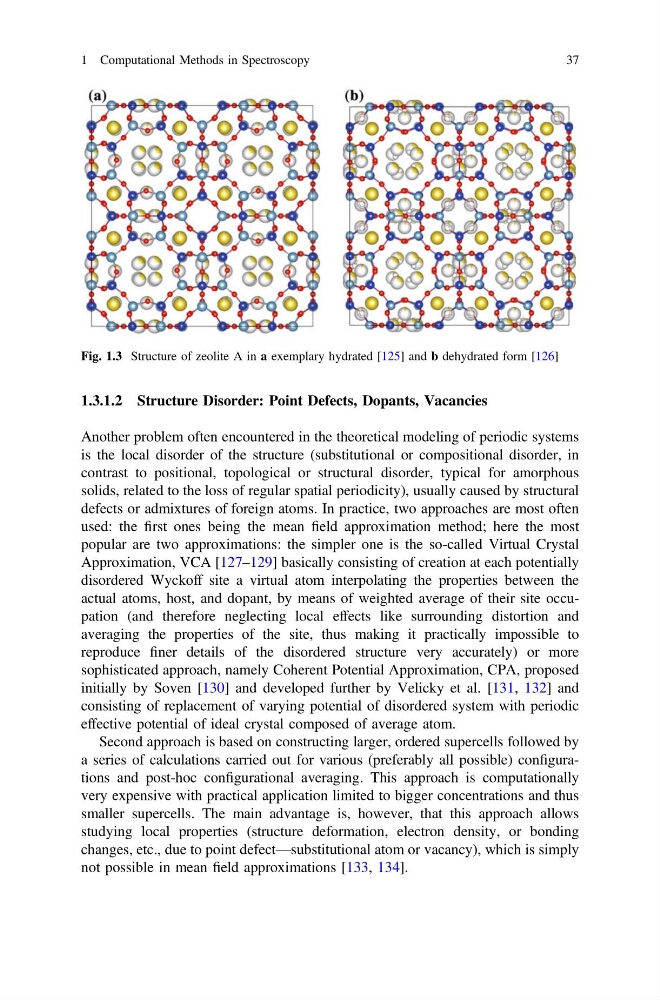
Fig. 1.3 Structure of zeolite A in a exemplary hydrated [125] and b dehydrated form [126]
1 Computational Methods in Spectroscopy
37
Another problem often encountered in the theoretical modeling of periodic systems
is the local disorder of the structure (substitutional or compositional disorder, in
contrast to positional, topological or structural disorder, typical for amorphous
solids, related to the loss of regular spatial periodicity), usually caused by structural
defects or admixtures of foreign atoms. In practice, two approaches are most often
used: the first ones being the mean field approximation method; here the most
popular are two approximations: the simpler one is the so-called Virtual Crystal
Approximation, VCA [127–129] basically consisting of creation at each potentially
disordered Wyckoff site a virtual atom interpolating the properties between the
actual atoms, host, and dopant, by means of weighted average of their site occupation (and therefore neglecting local effects like surrounding distortion and
averaging the properties of the site, thus making it practically impossible to
reproduce finer details of the disordered structure very accurately) or more
sophisticated approach, namely Coherent Potential Approximation, CPA, proposed
initially by Soven [130] and developed further by Velicky et al. [131, 132] and
consisting of replacement of varying potential of disordered system with periodic
effective potential of ideal crystal composed of average atom.
Second approach is based on constructing larger, ordered supercells followed by
a series of calculations carried out for various (preferably all possible) configurations and post-hoc configurational averaging. This approach is computationally
very expensive with practical application limited to bigger concentrations and thus
smaller supercells. The main advantage is, however, that this approach allows
studying local properties (structure deformation, electron density, or bonding
changes, etc., due to point defect—substitutional atom or vacancy), which is simply
not possible in mean field approximations [133, 134].
Fig. 1.3 Structure of zeolite A in a exemplary hydrated [125] and b dehydrated form [126]
1 Computational Methods in Spectroscopy
37