

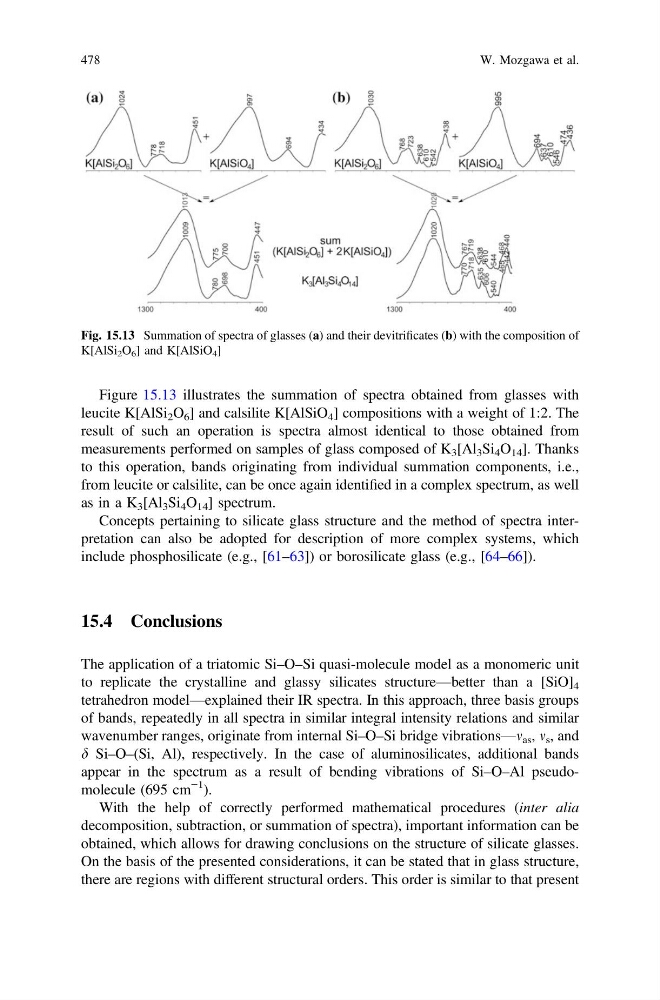
Figure 15.13 illustrates the summation of spectra obtained from glasses with
leucite K[AlSi 2 O 6 ] and calsilite K[AlSiO 4 ] compositions with a weight of 1:2. The
result of such an operation is spectra almost identical to those obtained from
measurements performed on samples of glass composed of K 3 [Al 3 Si 4 O 14 ]. Thanks
to this operation, bands originating from individual summation components, i.e.,
from leucite or calsilite, can be once again identified in a complex spectrum, as well
as in a K 3 [Al 3 Si 4 O 14 ] spectrum.
Concepts pertaining to silicate glass structure and the method of spectra interpretation can also be adopted for description of more complex systems, which
include phosphosilicate (e.g., [61–63]) or borosilicate glass (e.g., [64–66]).
15.4 Conclusions
The application of a triatomic Si–O–Si quasi-molecule model as a monomeric unit
to replicate the crystalline and glassy silicates structure—better than a [SiO] 4
tetrahedron model—explained their IR spectra. In this approach, three basis groups
of bands, repeatedly in all spectra in similar integral intensity relations and similar
wavenumber ranges, originate from internal Si–O–Si bridge vibrations—m as , m s , and
d Si–O–(Si, Al), respectively. In the case of aluminosilicates, additional bands
appear in the spectrum as a result of bending vibrations of Si–O–Al pseudomolecule (695 cm
−1 ).
With the help of correctly performed mathematical procedures (inter alia
decomposition, subtraction, or summation of spectra), important information can be
obtained, which allows for drawing conclusions on the structure of silicate glasses.
On the basis of the presented considerations, it can be stated that in glass structure,
there are regions with different structural orders. This order is similar to that present
Fig. 15.13 Summation of spectra of glasses (a) and their devitrificates (b) with the composition of
K[AlSi 2 O 6 ] and K[AlSiO 4 ]
478
W. Mozgawa et al.
leucite K[AlSi 2 O 6 ] and calsilite K[AlSiO 4 ] compositions with a weight of 1:2. The
result of such an operation is spectra almost identical to those obtained from
measurements performed on samples of glass composed of K 3 [Al 3 Si 4 O 14 ]. Thanks
to this operation, bands originating from individual summation components, i.e.,
from leucite or calsilite, can be once again identified in a complex spectrum, as well
as in a K 3 [Al 3 Si 4 O 14 ] spectrum.
Concepts pertaining to silicate glass structure and the method of spectra interpretation can also be adopted for description of more complex systems, which
include phosphosilicate (e.g., [61–63]) or borosilicate glass (e.g., [64–66]).
15.4 Conclusions
The application of a triatomic Si–O–Si quasi-molecule model as a monomeric unit
to replicate the crystalline and glassy silicates structure—better than a [SiO] 4
tetrahedron model—explained their IR spectra. In this approach, three basis groups
of bands, repeatedly in all spectra in similar integral intensity relations and similar
wavenumber ranges, originate from internal Si–O–Si bridge vibrations—m as , m s , and
d Si–O–(Si, Al), respectively. In the case of aluminosilicates, additional bands
appear in the spectrum as a result of bending vibrations of Si–O–Al pseudomolecule (695 cm
−1 ).
With the help of correctly performed mathematical procedures (inter alia
decomposition, subtraction, or summation of spectra), important information can be
obtained, which allows for drawing conclusions on the structure of silicate glasses.
On the basis of the presented considerations, it can be stated that in glass structure,
there are regions with different structural orders. This order is similar to that present
Fig. 15.13 Summation of spectra of glasses (a) and their devitrificates (b) with the composition of
K[AlSi 2 O 6 ] and K[AlSiO 4 ]
478
W. Mozgawa et al.