

From this perspective, a Si–O–Si (Fig. 15.6) bridge in all analyzed structures is
the result of the silicon–oxygen spatial connection with an adjacent polyhedron and
the consequence of its presence is mutual elements in IR spectra. In the geometric
sense, such a unit is close to the well-known in spectroscopy literature angular H 2 O
molecule [49] with heavier (compared to hydrogen) outermost silicon atoms and
with a smaller angle between bonds. As in the case of H 2 O molecules, three
oscillations (3N−6) are present in a Si–O–Si unit. These types of molecules can be
described using a C 2v point group, in which the symmetry elements are a double
axis and two symmetry planes perpendicular to one another. A reducible representation of the oscillation is expressed as:
C osc ¼ 2A 1 þ B 1
ð15:4Þ
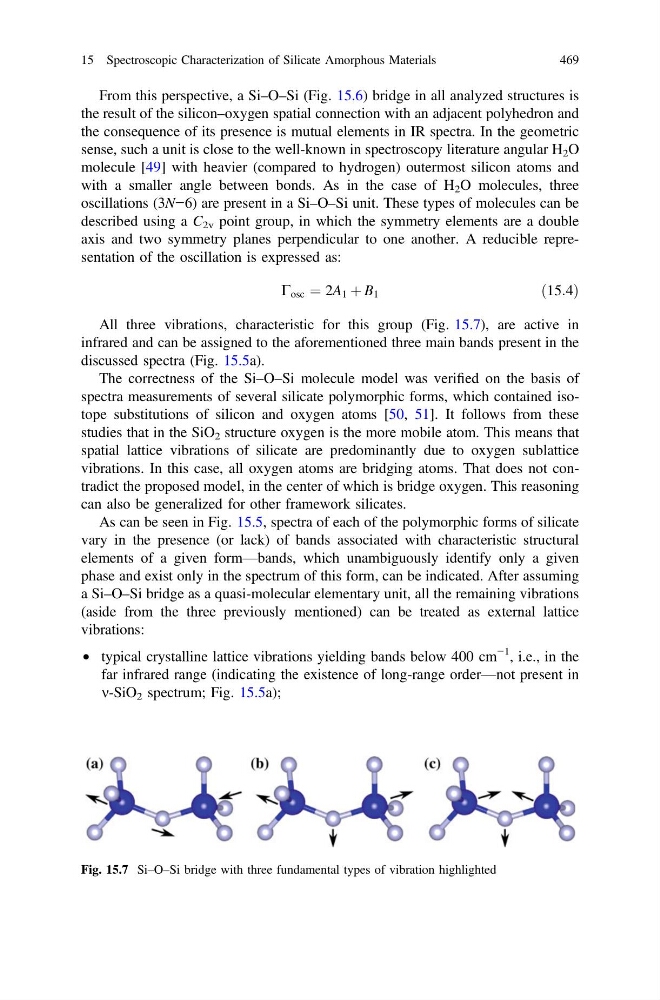
All three vibrations, characteristic for this group (Fig. 15.7), are active in
infrared and can be assigned to the aforementioned three main bands present in the
discussed spectra (Fig. 15.5a).
The correctness of the Si–O–Si molecule model was verified on the basis of
spectra measurements of several silicate polymorphic forms, which contained isotope substitutions of silicon and oxygen atoms [50, 51]. It follows from these
studies that in the SiO 2 structure oxygen is the more mobile atom. This means that
spatial lattice vibrations of silicate are predominantly due to oxygen sublattice
vibrations. In this case, all oxygen atoms are bridging atoms. That does not contradict the proposed model, in the center of which is bridge oxygen. This reasoning
can also be generalized for other framework silicates.
As can be seen in Fig. 15.5, spectra of each of the polymorphic forms of silicate
vary in the presence (or lack) of bands associated with characteristic structural
elements of a given form—bands, which unambiguously identify only a given
phase and exist only in the spectrum of this form, can be indicated. After assuming
a Si–O–Si bridge as a quasi-molecular elementary unit, all the remaining vibrations
(aside from the three previously mentioned) can be treated as external lattice
vibrations:
• typical crystalline lattice vibrations yielding bands below 400 cm
−1
, i.e., in the
far infrared range (indicating the existence of long-range order—not present in
m-SiO 2 spectrum; Fig. 15.5a);
Fig. 15.7 Si–O–Si bridge with three fundamental types of vibration highlighted
15 Spectroscopic Characterization of Silicate Amorphous Materials
469
the result of the silicon–oxygen spatial connection with an adjacent polyhedron and
the consequence of its presence is mutual elements in IR spectra. In the geometric
sense, such a unit is close to the well-known in spectroscopy literature angular H 2 O
molecule [49] with heavier (compared to hydrogen) outermost silicon atoms and
with a smaller angle between bonds. As in the case of H 2 O molecules, three
oscillations (3N−6) are present in a Si–O–Si unit. These types of molecules can be
described using a C 2v point group, in which the symmetry elements are a double
axis and two symmetry planes perpendicular to one another. A reducible representation of the oscillation is expressed as:
C osc ¼ 2A 1 þ B 1
ð15:4Þ
All three vibrations, characteristic for this group (Fig. 15.7), are active in
infrared and can be assigned to the aforementioned three main bands present in the
discussed spectra (Fig. 15.5a).
The correctness of the Si–O–Si molecule model was verified on the basis of
spectra measurements of several silicate polymorphic forms, which contained isotope substitutions of silicon and oxygen atoms [50, 51]. It follows from these
studies that in the SiO 2 structure oxygen is the more mobile atom. This means that
spatial lattice vibrations of silicate are predominantly due to oxygen sublattice
vibrations. In this case, all oxygen atoms are bridging atoms. That does not contradict the proposed model, in the center of which is bridge oxygen. This reasoning
can also be generalized for other framework silicates.
As can be seen in Fig. 15.5, spectra of each of the polymorphic forms of silicate
vary in the presence (or lack) of bands associated with characteristic structural
elements of a given form—bands, which unambiguously identify only a given
phase and exist only in the spectrum of this form, can be indicated. After assuming
a Si–O–Si bridge as a quasi-molecular elementary unit, all the remaining vibrations
(aside from the three previously mentioned) can be treated as external lattice
vibrations:
• typical crystalline lattice vibrations yielding bands below 400 cm
−1
, i.e., in the
far infrared range (indicating the existence of long-range order—not present in
m-SiO 2 spectrum; Fig. 15.5a);
Fig. 15.7 Si–O–Si bridge with three fundamental types of vibration highlighted
15 Spectroscopic Characterization of Silicate Amorphous Materials
469