

of the assumed order in domains. The most common assumption is that the ordered
domains more [23] or less [24] resemble the order in high-temperature cristobalite.
There are also theories that postulate the existence of ordered domains with tridymite structure [25–27]. The model proposed by Goodman [28] can be
acknowledged as a compromise for the controversy concerning the type of domain
order. This model postulates the existence of domains exhibiting the structure of
several SiO 2 polymorphs—the so-called strained mixed cluster model. At the
boundaries of such domains, compressive and tensile stresses are present due to the
structural mismatch of individual silicate polymorphs.
A large problem when describing a silicate glass network is also determining the
structure of disordered intermediate regions located between the domains. The
disorder present in these regions constitutes the difference between glass and a
polycrystalline structure. The disorder is so large that it eliminates long-range
translation symmetry. There are doubts concerning the way to carry out mutual
topological fitting of the domains through disordered regions. It is known that in
this range the network is more relaxed (voids) and chaotic. Up to now, it has not
been determined whether there is only one type of deformed atom arrangement
sequence, or if there are more (Fig. 15.3).
It seems that the most consistent model of silicate glass structure, developed on
the basis of detailed XRD and spectroscopic studies, was presented by Görlich
[1, 30–32]—domain model of glass structure. According to this concept, m-SiO 2
consists of a relaxed and randomly mixed texture of tetragonal domains in
high-temperature cristobalite, between which empty spaces are located, creating a
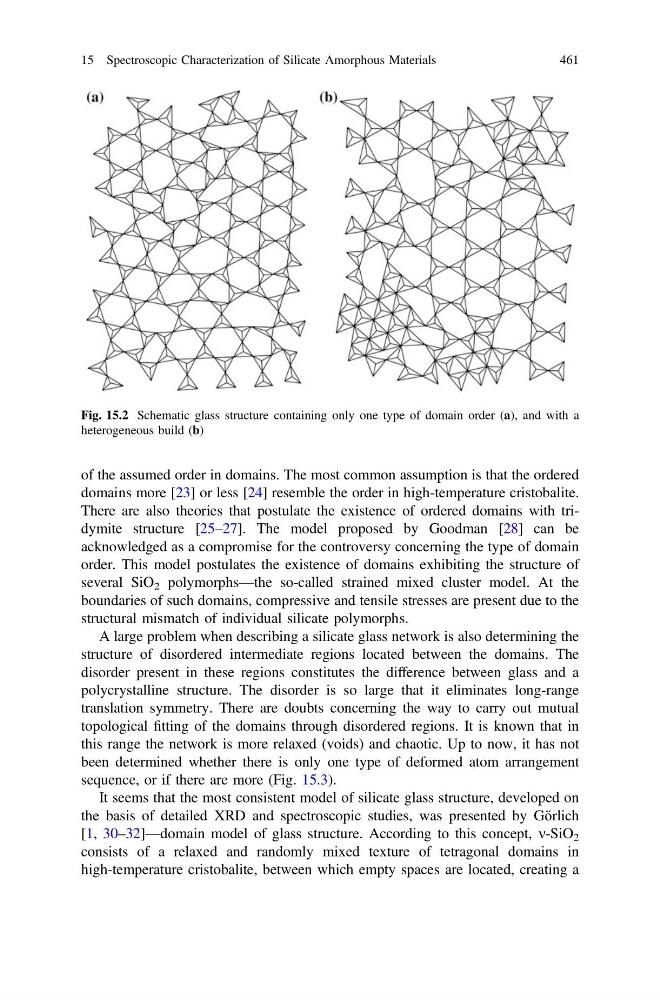
Fig. 15.2 Schematic glass structure containing only one type of domain order (a), and with a
heterogeneous build (b)
15 Spectroscopic Characterization of Silicate Amorphous Materials
461
domains more [23] or less [24] resemble the order in high-temperature cristobalite.
There are also theories that postulate the existence of ordered domains with tridymite structure [25–27]. The model proposed by Goodman [28] can be
acknowledged as a compromise for the controversy concerning the type of domain
order. This model postulates the existence of domains exhibiting the structure of
several SiO 2 polymorphs—the so-called strained mixed cluster model. At the
boundaries of such domains, compressive and tensile stresses are present due to the
structural mismatch of individual silicate polymorphs.
A large problem when describing a silicate glass network is also determining the
structure of disordered intermediate regions located between the domains. The
disorder present in these regions constitutes the difference between glass and a
polycrystalline structure. The disorder is so large that it eliminates long-range
translation symmetry. There are doubts concerning the way to carry out mutual
topological fitting of the domains through disordered regions. It is known that in
this range the network is more relaxed (voids) and chaotic. Up to now, it has not
been determined whether there is only one type of deformed atom arrangement
sequence, or if there are more (Fig. 15.3).
It seems that the most consistent model of silicate glass structure, developed on
the basis of detailed XRD and spectroscopic studies, was presented by Görlich
[1, 30–32]—domain model of glass structure. According to this concept, m-SiO 2
consists of a relaxed and randomly mixed texture of tetragonal domains in
high-temperature cristobalite, between which empty spaces are located, creating a
Fig. 15.2 Schematic glass structure containing only one type of domain order (a), and with a
heterogeneous build (b)
15 Spectroscopic Characterization of Silicate Amorphous Materials
461