

14.5 Optical Fibers from GeO 2 –Ga 2 O 3 –BaO System
Barium gallo-germanate glass system has been recently studied and proved to be an
excellent candidate as a host material as possessing good RE ions solubility,
comparatively low-phonon energy and favorable mechanical characteristics [44,
45]. Investigations on the optical fibers from the GeO 2 –Ga 2 O 3 –BaO glass system
related with low-phonon energy (805 cm
−1 ) resulting in vibrations Ge–O(Ge)
enables obtaining the luminescence in the visible range as a result of the
donor-acceptor energy transfer and the upconversion process [4, 46–48]. As in the
previous antimony-germanate glass, the analysis of concentrations of lanthanide
dopants conducted in co-doping systems (Yb
3+ /Tm
3+ , Yb
3+ /Tb
3+ , Yb
3+ /Eu
3+ )
enables optimization of the luminescence properties in the visible range. For further
research on optical fibers, sets of Yb
3+ /Tb
3+ ions and Yb
3+ /Eu
3+ ions were selected.
In this case, the emission in the visible range was obtained as a result of the
cooperative energy transfer with the efficiency η = 12.92%—Tb
3+ , η = 27.64%—
Eu
3+ .
Proposed sets of co-dopants enable to develop new constructions of active
double-clad optical fibers, in which there is the two-photon conversion of the pump
radiation (k exc = 976 nm) via the cooperative energy transfer and emission in the
visible range. Based on these studies, two types of double-clad optical fibers with
“offset” core co-doped with 0.7Yb 2 O 3 /0.7Tb 2 O 3 and 0.5Yb 2 O 3 /0.75Eu 2 O 3 have
been fabricated. Next, a comparative analysis of luminescence spectra of core glass
and optical fiber was made and mechanisms that have the impact on these differences were discussed [47–49].
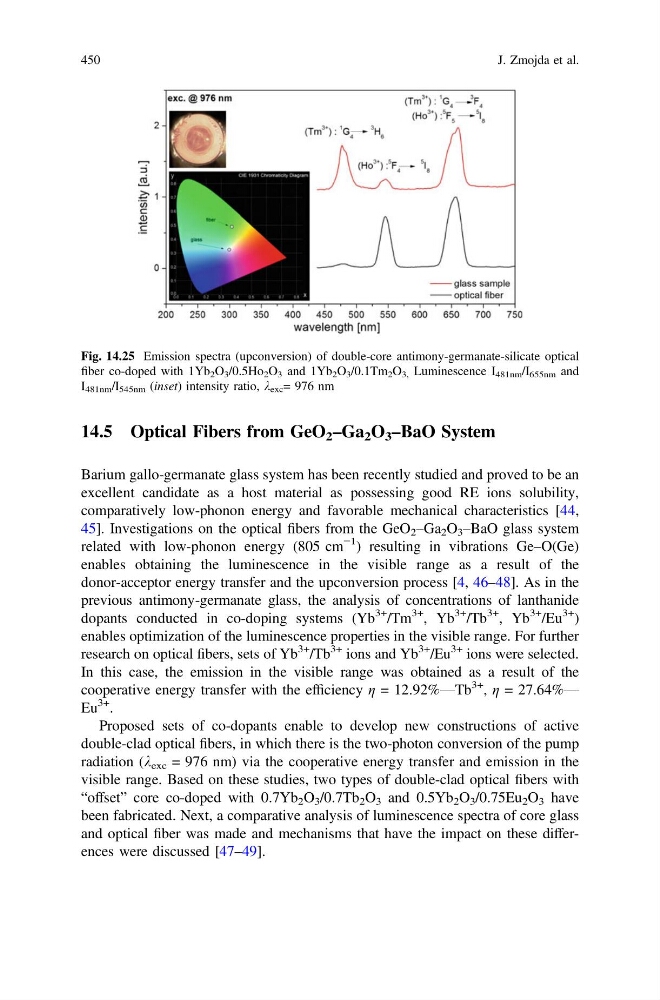
Fig. 14.25 Emission spectra (upconversion) of double-core antimony-germanate-silicate optical
fiber co-doped with 1Yb 2 O 3 /0.5Ho 2 O 3 and 1Yb 2 O 3 /0.1Tm 2 O 3, Luminescence I 481nm /I 655nm and
I 481nm /I 545nm (inset) intensity ratio, k exc = 976 nm
450
J. Zmojda et al.
Barium gallo-germanate glass system has been recently studied and proved to be an
excellent candidate as a host material as possessing good RE ions solubility,
comparatively low-phonon energy and favorable mechanical characteristics [44,
45]. Investigations on the optical fibers from the GeO 2 –Ga 2 O 3 –BaO glass system
related with low-phonon energy (805 cm
−1 ) resulting in vibrations Ge–O(Ge)
enables obtaining the luminescence in the visible range as a result of the
donor-acceptor energy transfer and the upconversion process [4, 46–48]. As in the
previous antimony-germanate glass, the analysis of concentrations of lanthanide
dopants conducted in co-doping systems (Yb
3+ /Tm
3+ , Yb
3+ /Tb
3+ , Yb
3+ /Eu
3+ )
enables optimization of the luminescence properties in the visible range. For further
research on optical fibers, sets of Yb
3+ /Tb
3+ ions and Yb
3+ /Eu
3+ ions were selected.
In this case, the emission in the visible range was obtained as a result of the
cooperative energy transfer with the efficiency η = 12.92%—Tb
3+ , η = 27.64%—
Eu
3+ .
Proposed sets of co-dopants enable to develop new constructions of active
double-clad optical fibers, in which there is the two-photon conversion of the pump
radiation (k exc = 976 nm) via the cooperative energy transfer and emission in the
visible range. Based on these studies, two types of double-clad optical fibers with
“offset” core co-doped with 0.7Yb 2 O 3 /0.7Tb 2 O 3 and 0.5Yb 2 O 3 /0.75Eu 2 O 3 have
been fabricated. Next, a comparative analysis of luminescence spectra of core glass
and optical fiber was made and mechanisms that have the impact on these differences were discussed [47–49].
Fig. 14.25 Emission spectra (upconversion) of double-core antimony-germanate-silicate optical
fiber co-doped with 1Yb 2 O 3 /0.5Ho 2 O 3 and 1Yb 2 O 3 /0.1Tm 2 O 3, Luminescence I 481nm /I 655nm and
I 481nm /I 545nm (inset) intensity ratio, k exc = 976 nm
450
J. Zmojda et al.