

intensity due to energy transfer between Er
3+ ions and agglomerates of Ag
0
nanoparticles (Fig. 14.9c). The obtained results clearly show that both, the concentration of Ag
+ ions, as well as annealing time, are key in shaping the luminescence signal in antimony-germanate glasses co-doped with Er
3+ /Ag
0 .
Continuing research on plasmon resonance and, due to the location of the
“plasmon” band in SGS (silica–germanium–antimony) glasses (k SPR = 450 nm),
europium ions were used, which, due to the location of their energy levels, are
characterized by effective emission at 612 nm and a good overlap between the
5 L 6
and
5 D 3 metastable levels and the “plasmonic” band [33]. At the same time, the
previously described SGS glasses were modified with B 2 O 3 and P 2 O 5 compounds
as follows: 25Sb 2 O 3 –25Ge 2 O 3 –5Al 2 O 3 –5Na 2 O–40B 2 O 3 /P 2 O 5 . The analysis of the
asymmetry ratio (R) of the Eu
3+ ion environment depending on the introduced
modifiers showed that the B 2 O 3 has the greatest influence on shape of luminescence
spectra (Fig. 14.12).
Hence, further research on the surface plasmon resonance has been directed
toward those glasses co-doped with Eu
3+ and Ag
+ ions and their additional thermal
treatment. Once more, the luminescence measurements showed a strong dependence both on doping with silver ions and further annealing (Fig. 14.13). In the
study, the fabricated glass characterized by the highest level of luminescence signal
was the sample without Ag ions. However, in both co-doped with 0.6 mol%
AgNO 3 /0.5 Eu 2 O 3 and after the annealing process, a decrease in emission in all
emission bands occurred, suggesting a reversal role of Ag
0 nanoparticles (absorption of luminescence) and an increase in energy transfer from Eu
3+
! Ag
0 .
In order to explain the mechanisms responsible for shaping luminescence by
interactions of silver nanoparticles with rare-earth ions, the SGB antimonygermanate-borate glasses and glass fibers were investigated to obtain a luminescence enhancement [34]. The following SGB glass composition: 25Sb 2 O 3 –25Ge 2 O 3 –
5Al 2 O 3 –5Na 2 O–40B 2 O 3 was selected and co-doped with Eu 2 O 3 /AgNO 3 . In the first
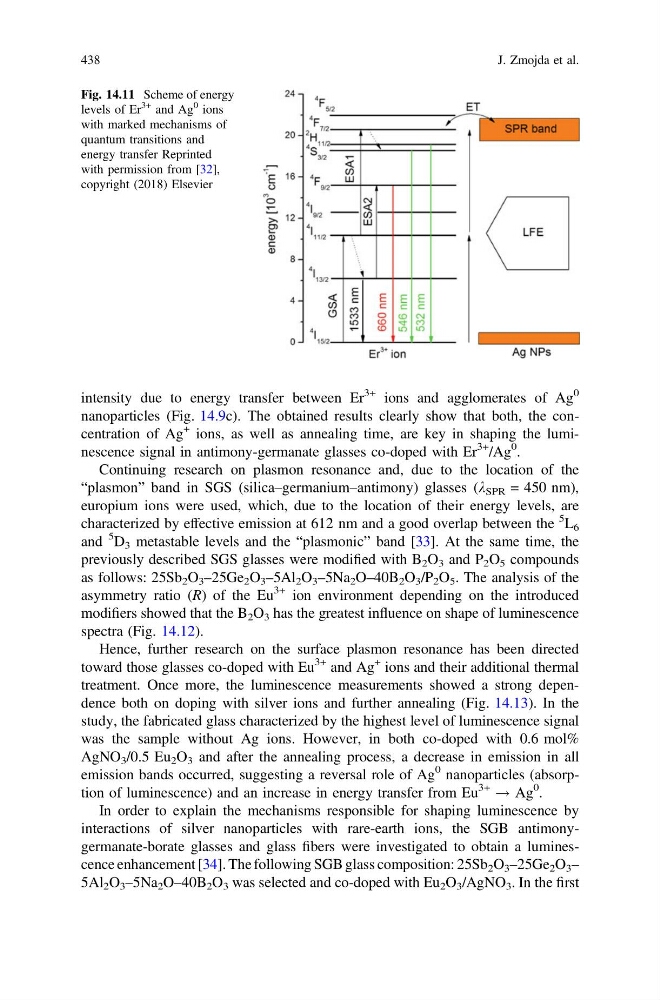
Fig. 14.11 Scheme of energy
levels of Er
3+ and Ag
0 ions
with marked mechanisms of
quantum transitions and
energy transfer Reprinted
with permission from [32],
copyright (2018) Elsevier
438
J. Zmojda et al.
3+ ions and agglomerates of Ag
0
nanoparticles (Fig. 14.9c). The obtained results clearly show that both, the concentration of Ag
+ ions, as well as annealing time, are key in shaping the luminescence signal in antimony-germanate glasses co-doped with Er
3+ /Ag
0 .
Continuing research on plasmon resonance and, due to the location of the
“plasmon” band in SGS (silica–germanium–antimony) glasses (k SPR = 450 nm),
europium ions were used, which, due to the location of their energy levels, are
characterized by effective emission at 612 nm and a good overlap between the
5 L 6
and
5 D 3 metastable levels and the “plasmonic” band [33]. At the same time, the
previously described SGS glasses were modified with B 2 O 3 and P 2 O 5 compounds
as follows: 25Sb 2 O 3 –25Ge 2 O 3 –5Al 2 O 3 –5Na 2 O–40B 2 O 3 /P 2 O 5 . The analysis of the
asymmetry ratio (R) of the Eu
3+ ion environment depending on the introduced
modifiers showed that the B 2 O 3 has the greatest influence on shape of luminescence
spectra (Fig. 14.12).
Hence, further research on the surface plasmon resonance has been directed
toward those glasses co-doped with Eu
3+ and Ag
+ ions and their additional thermal
treatment. Once more, the luminescence measurements showed a strong dependence both on doping with silver ions and further annealing (Fig. 14.13). In the
study, the fabricated glass characterized by the highest level of luminescence signal
was the sample without Ag ions. However, in both co-doped with 0.6 mol%
AgNO 3 /0.5 Eu 2 O 3 and after the annealing process, a decrease in emission in all
emission bands occurred, suggesting a reversal role of Ag
0 nanoparticles (absorption of luminescence) and an increase in energy transfer from Eu
3+
! Ag
0 .
In order to explain the mechanisms responsible for shaping luminescence by
interactions of silver nanoparticles with rare-earth ions, the SGB antimonygermanate-borate glasses and glass fibers were investigated to obtain a luminescence enhancement [34]. The following SGB glass composition: 25Sb 2 O 3 –25Ge 2 O 3 –
5Al 2 O 3 –5Na 2 O–40B 2 O 3 was selected and co-doped with Eu 2 O 3 /AgNO 3 . In the first
Fig. 14.11 Scheme of energy
levels of Er
3+ and Ag
0 ions
with marked mechanisms of
quantum transitions and
energy transfer Reprinted
with permission from [32],
copyright (2018) Elsevier
438
J. Zmojda et al.