

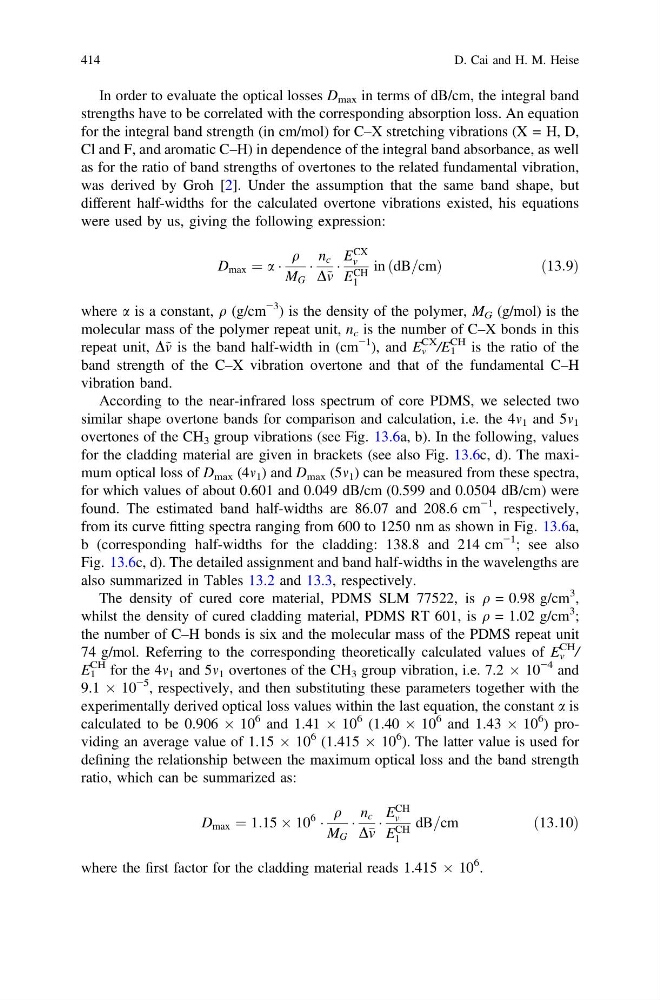
In order to evaluate the optical losses D max in terms of dB/cm, the integral band
strengths have to be correlated with the corresponding absorption loss. An equation
for the integral band strength (in cm/mol) for C–X stretching vibrations (X = H, D,
Cl and F, and aromatic C–H) in dependence of the integral band absorbance, as well
as for the ratio of band strengths of overtones to the related fundamental vibration,
was derived by Groh [2]. Under the assumption that the same band shape, but
different half-widths for the calculated overtone vibrations existed, his equations
were used by us, giving the following expression:
D max ¼ a Á
q
M G
Á
n c
D~ v
Á
E
CX
v
E
CH
1
in dB=cm
ð
Þ
ð13:9Þ
where a is a constant, q (g/cm
−3 ) is the density of the polymer, M G (g/mol) is the
molecular mass of the polymer repeat unit, n c is the number of C–X bonds in this
repeat unit, D~ v is the band half-width in (cm
−1 ), and E v
CX /E 1
CH is the ratio of the
band strength of the C–X vibration overtone and that of the fundamental C–H
vibration band.
According to the near-infrared loss spectrum of core PDMS, we selected two
similar shape overtone bands for comparison and calculation, i.e. the 4m 1 and 5m 1
overtones of the CH 3 group vibrations (see Fig. 13.6a, b). In the following, values
for the cladding material are given in brackets (see also Fig. 13.6c, d). The maximum optical loss of D max (4m 1 ) and D max (5m 1 ) can be measured from these spectra,
for which values of about 0.601 and 0.049 dB/cm (0.599 and 0.0504 dB/cm) were
found. The estimated band half-widths are 86.07 and 208.6 cm
−1 , respectively,
from its curve fitting spectra ranging from 600 to 1250 nm as shown in Fig. 13.6a,
b (corresponding half-widths for the cladding: 138.8 and 214 cm
−1 ; see also
Fig. 13.6c, d). The detailed assignment and band half-widths in the wavelengths are
also summarized in Tables 13.2 and 13.3, respectively.
The density of cured core material, PDMS SLM 77522, is q = 0.98 g/cm
3 ,
whilst the density of cured cladding material, PDMS RT 601, is q = 1.02 g/cm
3 ;
the number of C–H bonds is six and the molecular mass of the PDMS repeat unit
74 g/mol. Referring to the corresponding theoretically calculated values of E v
CH
/
E 1
CH for the 4m 1 and 5m 1 overtones of the CH 3 group vibration, i.e. 7.2 Â 10
−4 and
9.1 Â 10
−5 , respectively, and then substituting these parameters together with the
experimentally derived optical loss values within the last equation, the constant a is
calculated to be 0.906 Â 10
6 and 1.41 Â 10
6 (1.40 Â 10
6 and 1.43 Â 10
6 ) providing an average value of 1.15 Â 10
6 (1.415 Â 10
6 ). The latter value is used for
defining the relationship between the maximum optical loss and the band strength
ratio, which can be summarized as:
D max ¼ 1:15 Â 10
6
Á
q
M G
Á
n c
D v
Á
E
CH
v
E CH
1
dB=cm
ð13:10Þ
where the first factor for the cladding material reads 1.415 Â 10
6 .
414
D. Cai and H. M. Heise
strengths have to be correlated with the corresponding absorption loss. An equation
for the integral band strength (in cm/mol) for C–X stretching vibrations (X = H, D,
Cl and F, and aromatic C–H) in dependence of the integral band absorbance, as well
as for the ratio of band strengths of overtones to the related fundamental vibration,
was derived by Groh [2]. Under the assumption that the same band shape, but
different half-widths for the calculated overtone vibrations existed, his equations
were used by us, giving the following expression:
D max ¼ a Á
q
M G
Á
n c
D~ v
Á
E
CX
v
E
CH
1
in dB=cm
ð
Þ
ð13:9Þ
where a is a constant, q (g/cm
−3 ) is the density of the polymer, M G (g/mol) is the
molecular mass of the polymer repeat unit, n c is the number of C–X bonds in this
repeat unit, D~ v is the band half-width in (cm
−1 ), and E v
CX /E 1
CH is the ratio of the
band strength of the C–X vibration overtone and that of the fundamental C–H
vibration band.
According to the near-infrared loss spectrum of core PDMS, we selected two
similar shape overtone bands for comparison and calculation, i.e. the 4m 1 and 5m 1
overtones of the CH 3 group vibrations (see Fig. 13.6a, b). In the following, values
for the cladding material are given in brackets (see also Fig. 13.6c, d). The maximum optical loss of D max (4m 1 ) and D max (5m 1 ) can be measured from these spectra,
for which values of about 0.601 and 0.049 dB/cm (0.599 and 0.0504 dB/cm) were
found. The estimated band half-widths are 86.07 and 208.6 cm
−1 , respectively,
from its curve fitting spectra ranging from 600 to 1250 nm as shown in Fig. 13.6a,
b (corresponding half-widths for the cladding: 138.8 and 214 cm
−1 ; see also
Fig. 13.6c, d). The detailed assignment and band half-widths in the wavelengths are
also summarized in Tables 13.2 and 13.3, respectively.
The density of cured core material, PDMS SLM 77522, is q = 0.98 g/cm
3 ,
whilst the density of cured cladding material, PDMS RT 601, is q = 1.02 g/cm
3 ;
the number of C–H bonds is six and the molecular mass of the PDMS repeat unit
74 g/mol. Referring to the corresponding theoretically calculated values of E v
CH
/
E 1
CH for the 4m 1 and 5m 1 overtones of the CH 3 group vibration, i.e. 7.2 Â 10
−4 and
9.1 Â 10
−5 , respectively, and then substituting these parameters together with the
experimentally derived optical loss values within the last equation, the constant a is
calculated to be 0.906 Â 10
6 and 1.41 Â 10
6 (1.40 Â 10
6 and 1.43 Â 10
6 ) providing an average value of 1.15 Â 10
6 (1.415 Â 10
6 ). The latter value is used for
defining the relationship between the maximum optical loss and the band strength
ratio, which can be summarized as:
D max ¼ 1:15 Â 10
6
Á
q
M G
Á
n c
D v
Á
E
CH
v
E CH
1
dB=cm
ð13:10Þ
where the first factor for the cladding material reads 1.415 Â 10
6 .
414
D. Cai and H. M. Heise