

13.2.3 Optical Measurements
Refractive index measurements were carried out using an “Abbe Refractometer”
from Zeiss (Jena, Germany) to determine the PDMS refractive indices by the limit
angle of total reflection at different wavelengths. For this, a sodium emission lamp
with filter at 589 nm and a halogen tungsten lamp with different filters at 515, 632,
852, 1300 and 1550 nm, respectively, under a constant temperature of 20 °C were
used.
Near-infrared and visible spectroscopic measurements were carried out using a
FT-NIR spectrometer Vector 22 N from Bruker Optics (Ettlingen, Germany)
equipped with a Ge diode as detector. Further measurements including the
long-wave NIR region and the visible range were performed with a scanning double
monochromator-based spectrometer Cary 5 from Varian (Darmstadt, Germany).
PDMS samples were prepared with optically flat surfaces, and their thickness varied
between 3 and 30 mm for reaching appropriate band absorbance values measured in
transmission. For FT-NIR measurements, 1500 scans were co-added (spectral
resolution 64 cm
−1 , Norton–Beer apodization), whereas spectra were recorded
using the Cary spectrometer at a scan speed of 100 nm/min and a slit width of
5 nm. The measurements were carried out in a temperature-controlled environment
of 23 ± 2 °C.
The optical insertion loss of PDMS waveguides was measured at 850 nm, which
is generally used for commercial optical datacom transmission in multimode
waveguides. For this, the instrument OMS150 of the company “Wavetek Wandel
Goltermann” (Eningen u.A., Germany) was used. For our experiments, a dual laser
arrangement with wavelengths of 650 nm and 850 nm and one detector were
applied. The spectral range was independent of the operating temperature with
tolerances of ± 10 nm. The laser radiation was launched into the waveguides
through a butt-in-coupling GI fibre of 50-µm diameter and a 200-µm diameter SI
fibre for butt-out-coupling.
Further optical measurements on materials and waveguides were carried out after
the application of different stress conditions. For reliable fabrication and operation of a
product, it is of crucial importance to test it against relevant environmental parameters.
Based on potential applications of PDMS multimode waveguides, e.g. in splitters and
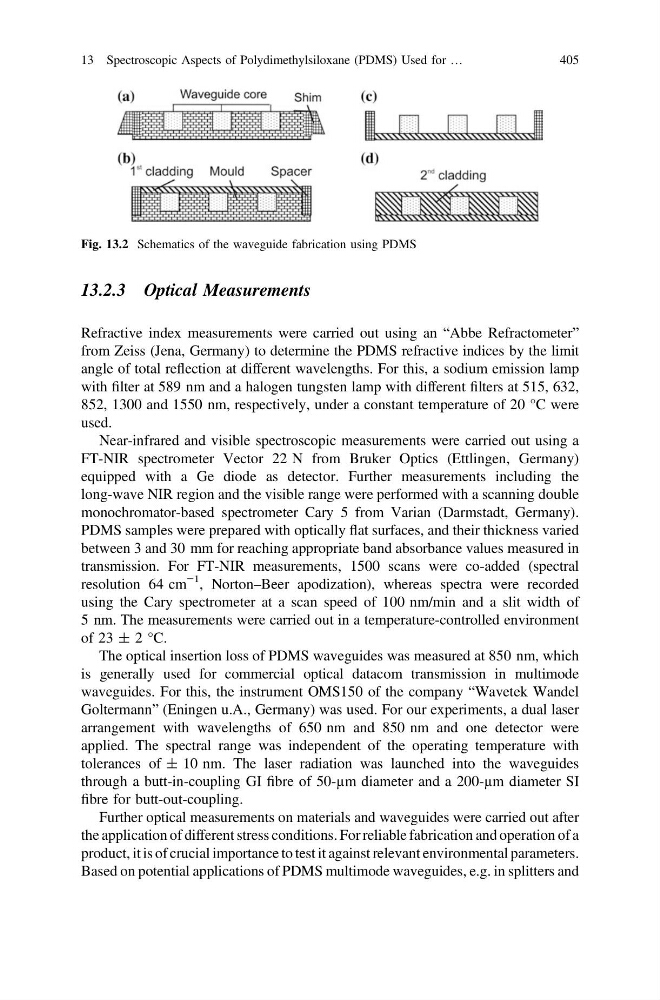
Fig. 13.2 Schematics of the waveguide fabrication using PDMS
13 Spectroscopic Aspects of Polydimethylsiloxane (PDMS) Used for …
405
Refractive index measurements were carried out using an “Abbe Refractometer”
from Zeiss (Jena, Germany) to determine the PDMS refractive indices by the limit
angle of total reflection at different wavelengths. For this, a sodium emission lamp
with filter at 589 nm and a halogen tungsten lamp with different filters at 515, 632,
852, 1300 and 1550 nm, respectively, under a constant temperature of 20 °C were
used.
Near-infrared and visible spectroscopic measurements were carried out using a
FT-NIR spectrometer Vector 22 N from Bruker Optics (Ettlingen, Germany)
equipped with a Ge diode as detector. Further measurements including the
long-wave NIR region and the visible range were performed with a scanning double
monochromator-based spectrometer Cary 5 from Varian (Darmstadt, Germany).
PDMS samples were prepared with optically flat surfaces, and their thickness varied
between 3 and 30 mm for reaching appropriate band absorbance values measured in
transmission. For FT-NIR measurements, 1500 scans were co-added (spectral
resolution 64 cm
−1 , Norton–Beer apodization), whereas spectra were recorded
using the Cary spectrometer at a scan speed of 100 nm/min and a slit width of
5 nm. The measurements were carried out in a temperature-controlled environment
of 23 ± 2 °C.
The optical insertion loss of PDMS waveguides was measured at 850 nm, which
is generally used for commercial optical datacom transmission in multimode
waveguides. For this, the instrument OMS150 of the company “Wavetek Wandel
Goltermann” (Eningen u.A., Germany) was used. For our experiments, a dual laser
arrangement with wavelengths of 650 nm and 850 nm and one detector were
applied. The spectral range was independent of the operating temperature with
tolerances of ± 10 nm. The laser radiation was launched into the waveguides
through a butt-in-coupling GI fibre of 50-µm diameter and a 200-µm diameter SI
fibre for butt-out-coupling.
Further optical measurements on materials and waveguides were carried out after
the application of different stress conditions. For reliable fabrication and operation of a
product, it is of crucial importance to test it against relevant environmental parameters.
Based on potential applications of PDMS multimode waveguides, e.g. in splitters and
Fig. 13.2 Schematics of the waveguide fabrication using PDMS
13 Spectroscopic Aspects of Polydimethylsiloxane (PDMS) Used for …
405