

epoxy group-containing compound first: 4-vinylcyclohexene-1,2-epoxide [89] or
1,2-epoxyhex-5-ene [90]; then to the reaction mixture di(propylene glycol) allyl
ether methacrylate [89] or pent-4-enoic acid or 2-methylpent-4-enoic acid [90] was
added. In this way, the molecules containing S5 and S7 or S6 and S8, S9 groups
(Table 12.3) were obtained. Reactions were conducted in toluene, with dichloro
(dicyclopentadienyl)platinum(II) complex at 55 °C [89] or Speier’s catalyst at 80–
70 °C [90]. For comparison, Soh et al. [89] treated Q 8 M 8
H exclusively with di
(propylene glycol) allyl ether methacrylate and Kastner et al. [90]—with each
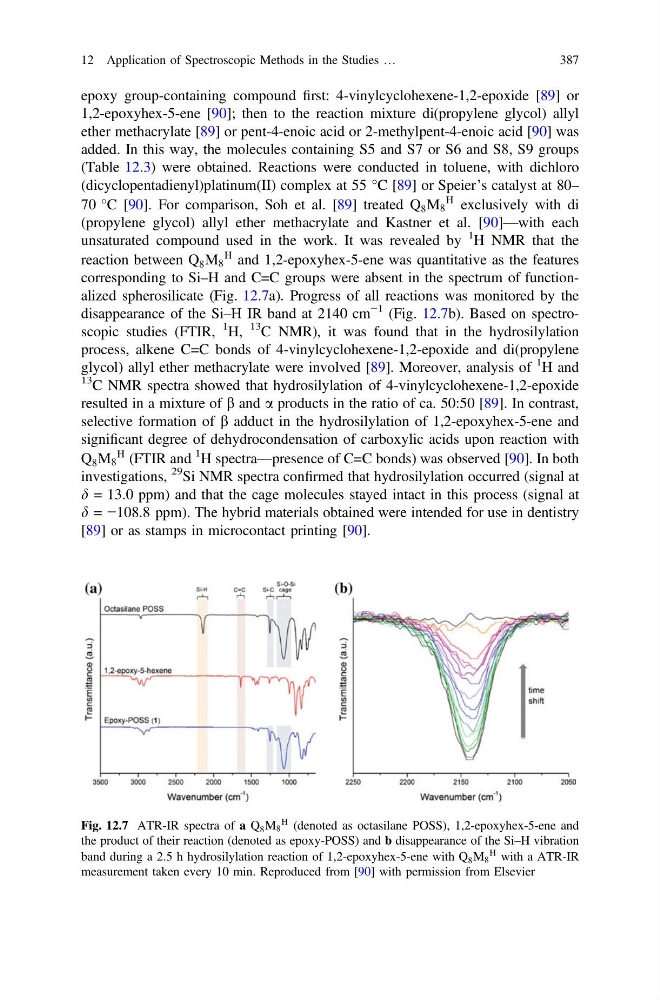
unsaturated compound used in the work. It was revealed by
1 H NMR that the
reaction between Q 8 M 8
H and 1,2-epoxyhex-5-ene was quantitative as the features
corresponding to Si–H and C=C groups were absent in the spectrum of functionalized spherosilicate (Fig. 12.7a). Progress of all reactions was monitored by the
disappearance of the Si–H IR band at 2140 cm
−1 (Fig. 12.7b). Based on spectroscopic studies (FTIR,
1 H,
13 C NMR), it was found that in the hydrosilylation
process, alkene C=C bonds of 4-vinylcyclohexene-1,2-epoxide and di(propylene
glycol) allyl ether methacrylate were involved [89]. Moreover, analysis of
1 H and
13 C NMR spectra showed that hydrosilylation of 4-vinylcyclohexene-1,2-epoxide
resulted in a mixture of b and a products in the ratio of ca. 50:50 [89]. In contrast,
selective formation of b adduct in the hydrosilylation of 1,2-epoxyhex-5-ene and
significant degree of dehydrocondensation of carboxylic acids upon reaction with
Q 8 M 8
H (FTIR and
1 H spectra—presence of C=C bonds) was observed [90]. In both
investigations,
29 Si NMR spectra confirmed that hydrosilylation occurred (signal at
d = 13.0 ppm) and that the cage molecules stayed intact in this process (signal at
d = −108.8 ppm). The hybrid materials obtained were intended for use in dentistry
[89] or as stamps in microcontact printing [90].
Fig. 12.7 ATR-IR spectra of a Q 8 M 8
H (denoted as octasilane POSS), 1,2-epoxyhex-5-ene and
the product of their reaction (denoted as epoxy-POSS) and b disappearance of the Si–H vibration
band during a 2.5 h hydrosilylation reaction of 1,2-epoxyhex-5-ene with Q 8 M 8
H with a ATR-IR
measurement taken every 10 min. Reproduced from [90] with permission from Elsevier
12 Application of Spectroscopic Methods in the Studies …
387
1,2-epoxyhex-5-ene [90]; then to the reaction mixture di(propylene glycol) allyl
ether methacrylate [89] or pent-4-enoic acid or 2-methylpent-4-enoic acid [90] was
added. In this way, the molecules containing S5 and S7 or S6 and S8, S9 groups
(Table 12.3) were obtained. Reactions were conducted in toluene, with dichloro
(dicyclopentadienyl)platinum(II) complex at 55 °C [89] or Speier’s catalyst at 80–
70 °C [90]. For comparison, Soh et al. [89] treated Q 8 M 8
H exclusively with di
(propylene glycol) allyl ether methacrylate and Kastner et al. [90]—with each
unsaturated compound used in the work. It was revealed by
1 H NMR that the
reaction between Q 8 M 8
H and 1,2-epoxyhex-5-ene was quantitative as the features
corresponding to Si–H and C=C groups were absent in the spectrum of functionalized spherosilicate (Fig. 12.7a). Progress of all reactions was monitored by the
disappearance of the Si–H IR band at 2140 cm
−1 (Fig. 12.7b). Based on spectroscopic studies (FTIR,
1 H,
13 C NMR), it was found that in the hydrosilylation
process, alkene C=C bonds of 4-vinylcyclohexene-1,2-epoxide and di(propylene
glycol) allyl ether methacrylate were involved [89]. Moreover, analysis of
1 H and
13 C NMR spectra showed that hydrosilylation of 4-vinylcyclohexene-1,2-epoxide
resulted in a mixture of b and a products in the ratio of ca. 50:50 [89]. In contrast,
selective formation of b adduct in the hydrosilylation of 1,2-epoxyhex-5-ene and
significant degree of dehydrocondensation of carboxylic acids upon reaction with
Q 8 M 8
H (FTIR and
1 H spectra—presence of C=C bonds) was observed [90]. In both
investigations,
29 Si NMR spectra confirmed that hydrosilylation occurred (signal at
d = 13.0 ppm) and that the cage molecules stayed intact in this process (signal at
d = −108.8 ppm). The hybrid materials obtained were intended for use in dentistry
[89] or as stamps in microcontact printing [90].
Fig. 12.7 ATR-IR spectra of a Q 8 M 8
H (denoted as octasilane POSS), 1,2-epoxyhex-5-ene and
the product of their reaction (denoted as epoxy-POSS) and b disappearance of the Si–H vibration
band during a 2.5 h hydrosilylation reaction of 1,2-epoxyhex-5-ene with Q 8 M 8
H with a ATR-IR
measurement taken every 10 min. Reproduced from [90] with permission from Elsevier
12 Application of Spectroscopic Methods in the Studies …
387